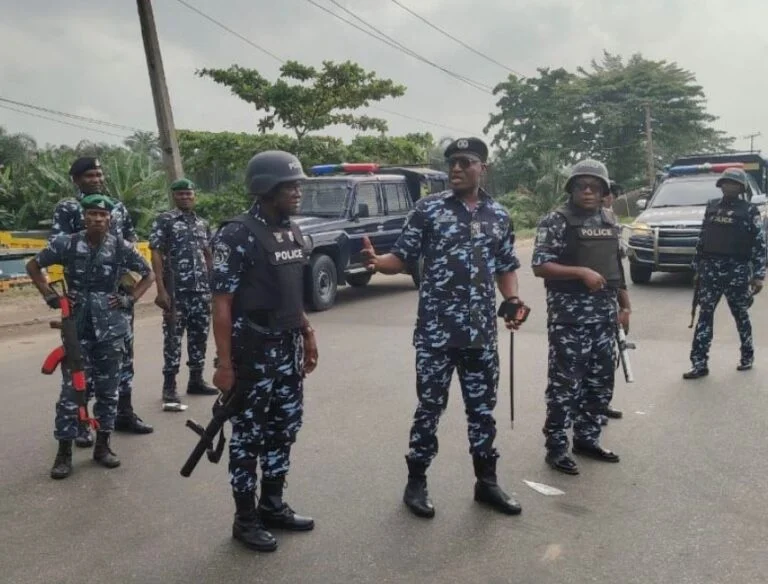
In a sprawling metropolis where 20 million lives intersect with chaos and ambition, one man is tasked with imposing order. This is the story of the philosophy, the pressure, and the profound human calculus behind policing Africa's most dynamic city.
On a humid Tuesday morning in February 2026, the Lagos State Police Command Headquarters in Ikeja hums with a controlled frenzy. The compound, a fortress of concrete and purpose in Nigeria’s commercial nerve center, is the operational brain for securing a population larger than that of New York City. It is here that Commissioner of Police Moshood Olohundare Jimoh, a career officer with over three decades of service, articulates what he calls "The Art of Policing Lagos." It is not merely a job of enforcement, he explains to a visiting journalist from The Nation, but a delicate, continuous performance of balance—between authority and empathy, between swift justice and community trust, in a city that never sleeps and rarely forgives.
The Canvas: A City of Impossible Scale
To understand the art, one must first appreciate the canvas. Lagos is an urban phenomenon. According to the Lagos Bureau of Statistics, the state’s population is estimated at over 20 million, with a density exceeding 6,500 persons per square kilometer in areas like Lagos Island. It generates over 30% of Nigeria’s GDP and handles 80% of the nation’s maritime trade. This economic gravity pulls in over 5,000 new residents daily, as reported by the state’s Ministry of Economic Planning and Budget, each seeking opportunity but also straining the city’s fragile infrastructure and social fabric.
Policing this behemoth falls to the Lagos State Police Command, a force of approximately 35,000 officers, as detailed in internal briefings. This means, in crude terms, one officer for every 571 residents, a ratio that underscores the immense pressure on the force. "You are not just policing geography," CP Jimoh states, his demeanor calm but intense. "You are policing aspirations, desperation, immense wealth, profound poverty, and the frantic energy that comes from their collision. Every traffic stop, every market dispute, every report of a kidnapping on the outskirts, is a brushstroke on this vast, complex portrait."
The Philosophy: Community as Co-Artist
Central to CP Jimoh’s doctrine, as elaborated in discussions with Economic Confidential, is a radical reconception of the police-community relationship. The old model of a distant, fearsome force is, in his view, untenable for modern Lagos. "The art fails if the community sees us as separate from them, as an occupying force. We must be partners, co-artists in creating security," he asserts.
This philosophy is operationalized through revived Community Policing Committees (CPCs) across the state’s 110 wards. According to command data, these committees, comprising local leaders, youth representatives, and police liaisons, have facilitated the resolution of over 1,200 low-level disputes in the past year alone, preventing them from escalating into violent conflicts. The "Safer Lagos" initiative, a tech-enabled platform for anonymous tips, receives an average of 500 actionable reports weekly, a testament to growing, if cautious, public engagement.
However, the shadow of history looms large. The memory of the October 2020 #EndSARS protests, which originated from grievances against police brutality at the now-infamous SARS unit, remains a raw nerve. CP Jimoh acknowledges this directly. "That was a tragic masterpiece of failure—failure of communication, failure of accountability, failure of humanity. Our art today is painted with the lessons of that period. Every officer is reminded that their authority is a grant from the people they serve."
The Palette: Technology and Terrain
The technical dimension of policing Lagos is a story of innovation battling obsolescence. The Command has integrated technology as a force multiplier. According to internal reports cited in Blueprint Newspapers, the Lagos Command now monitors over 1,000 high-resolution CCTV cameras at major intersections and crime hotspots, linked to a central Real-Time Crime Center. Automated Number Plate Recognition (ANPR) systems have led to the recovery of over 300 stolen vehicles in 2025.
Yet, the terrain fights back. Megacity policing is as much about logistics as law enforcement. The infamous Lagos traffic, which costs the economy an estimated $4 billion annually according to a 2025 World Bank study, is a critical tactical challenge. Emergency response times can vary from minutes to hours. To combat this, the Command has deployed over 200 motorcycle patrol units (the "Lagos Bike Squad") and 15 marine units to navigate the city’s infamous "go-slows" and extensive waterways, which are often used for criminal transit.
"Technology gives us eyes, but boots on the ground—or wheels in the traffic—give us presence," explains a senior tactical officer. "A drone can spot a kidnapping on the Lekki-Ikoyi link bridge, but only an officer in a patrol boat or on a bike can interdict it."
The Human Element: Stress, Sacrifice, and Society
Beneath the strategic talk lies a profound human story. Policing Lagos is a vocation of extreme stress. Officers often work 12-14 hour shifts, face public suspicion, and are prime targets for violent criminals. The Command’s welfare office reports a 40% increase in officers seeking counseling for job-related stress and PTSD between 2023 and 2025.
CP Jimoh emphasizes officer welfare as a cornerstone of ethical policing. "A bitter, exhausted, and underpaid officer cannot practice the art. He becomes a blunt instrument," he notes. Initiatives like upgraded barracks, better health insurance, and educational grants for officers’ children are, in his view, not perks but essential investments in institutional sanity and public safety.
The social dimension is equally complex. Lagos is a mosaic of cultures: the indigenous Yoruba communities, the vast population of Igbo business owners, the burgeoning community of Nigerien and Malian immigrants, and the elite expatriate bubble of Ikoyi and Victoria Island. Each group has a different historical relationship with the police. "Policing in Alimosho, with its dense residential sprawl, is different from policing in Apapa port, with its complex logistics and syndicates, which is different again from policing the nightlife of Victoria Island," a divisional police officer (DPO) from the Ajah area explains. "The art is knowing which brush to use where."
Political Pressures and the Pursuit of Autonomy
The political landscape forms the frame within which CP Jimoh must work. The Lagos State Government, under Governor Babajide Sanwo-Olu, has invested heavily in security, donating hundreds of patrol vehicles, gunboats, and communication equipment. This support is crucial but comes with immense expectations for visible results, especially in safeguarding the economic engines of the state.
Furthermore, the police in Nigeria are a federal institution. The Commissioner of Police in a state reports ultimately to the Inspector-General of Police in Abuja, creating a potential tension between federal directives and local realities. Navigating this requires diplomatic skill. "My loyalty is to the constitution and the people of Lagos," CP Jimoh states carefully. "My operational strategy is built on the specific threats of Lagos, but within the national policy framework. It is a constant, delicate negotiation."
This was evident during the 2023 elections, where the Command managed to maintain relative calm in a historically tense political environment, a feat praised by local and international observers. It demonstrated the application of "the art" on a macro-political scale: visible deterrence, proactive engagement with political parties, and rapid response to flare-ups.
Future Implications: The Evolving Masterpiece
As Lagos continues its relentless growth, projected to hit 30 million inhabitants by 2035, the art of policing it will have to evolve. CP Jimoh and his team are already planning for a future defined by several key trends:
1. The Cybersecurity Frontier: As Lagos’s financial tech (fintech) sector booms, so will digital crime. The Command is establishing a dedicated Cybercrime Unit with personnel trained in digital forensics, anticipating a shift from armed robbery to sophisticated cyber-fraud targeting the nation’s financial capital. 2. Climate Change and Conflict: Rising sea levels and extreme weather events threaten to displace thousands in Lagos’s coastal slums like Makoko and Ijora. History shows that environmental displacement is a potent catalyst for crime and social unrest. Future policing will require collaboration with urban planners and disaster management agencies in unprecedented ways. 3. The Demographic Time Bomb: Over 60% of Lagos’s population is under 25. Providing security for this youth bulge means going beyond crime-fighting to creating partnerships that offer alternatives to criminality. CP Jimoh’s vision includes expanding the "Police Youth Volunteers" program, which engages young people in community safety projects, building bridges for the next generation. 4. Artificial Intelligence and Predictive Policing: Experiments are underway with AI-driven data analytics to predict crime hotspots based on variables like weather, traffic patterns, and social media sentiment. The ethical implications are vast, but the potential to allocate scarce resources more efficiently is compelling for a force stretched so thin.Conclusion: The Unfinished Portrait
Leaving the Command Headquarters in Ikeja, the scale of the challenge is palpable. CP Moshood Jimoh’s "art of policing" is a work in progress, an unfinished portrait of a megacity in flux. It is an art that demands the strength of a soldier, the wisdom of a judge, the empathy of a social worker, and the innovation of a technologist.
His approach—rooted in community, enabled by technology, and mindful of humanity—offers a blueprint not just for Lagos, but for megacities across the Global South grappling with similar crises of growth, inequality, and security. The ultimate masterpiece, however, will not be judged by crime statistics alone, but by whether the citizens of Lagos feel they are safe co-authors of their city’s future, not merely subjects under watch. In the high-stakes gallery of urban survival, CP Jimoh is betting that the most powerful tool in his arsenal is not the weapon on his hip, but the trust he can build on the street. The canvas is vast, the paints are mixed, and the portrait of 21st-century Lagos is being drawn, one careful, complicated stroke at a time.
0 Comments
Sign in to commentNo comments yet. Be the first to share your thoughts!