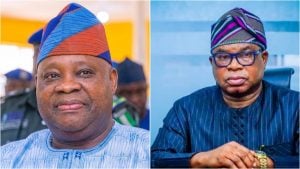
The August sun hung low over Osogbo, casting long shadows across the notice board of the Osun Governorship Election Petitions Tribunal where two crisply typed petitions lay side by side like opposing banners in a quiet battle. Just weeks earlier, Governor Ademola Adeleke had stood before a jubilant crowd, his voice ringing with the promise of continuity after securing 511,067 votes — a slender but decisive margin of 66,252 over his All Progressives Congress challenger, Asiwaju Munirudeen Bola Oyebamiji, who had garnered 444,815 ballots. The Independent National Electoral Commission’s declaration, announced on the sixteenth of August, had been met with both celebration and disbelief, as Oyebamiji’s camp conceded defeat in a public statement that praised the democratic process while hinting at unresolved grievances. Yet, as the tribunal’s secretary, Belemo Diete‑Spiff, affixed the notices to the board on that Monday morning, the political landscape shifted from celebratory rallies to the sterile corridors of legal contention. According to Daily Trust, the APC’s legal team, led by a cadre of Senior Advocates of Nigeria, had publicly disowned the petition bearing Oyebamiji’s name, insisting that no formal challenge had been authorised by the party’s hierarchy. TVC News echoed this denial, quoting the Osun APC Governorship Campaign Council which labelled the reports “false and mischievous” and maintained that neither the party nor its candidate had filed any suit.
In stark contrast, the International Centre for Investigative Reporting revealed that both the APC and the Peoples Democratic Party had indeed lodged separate petitions — EPT/Os/Gov/01/2026 and EPT/Os/Gov/02/2026 — each naming Adeleke, the Accord Party and INEC as respondents, while the PDP’s petition also listed Senator Nurudeen Ademola Adeleke as a respondent. Politics Nigeria noted that the tribunal had commenced proceedings by displaying the notices at noon, confirming that the legal challenge was now officially before the court. Amid this swirl of contradictory claims, Oyebamiji himself had, on August twenty‑ninth, extended a congratulatory message to Adeleke, urging supporters to remain committed to lawful avenues and calling for investigations into alleged violence that had claimed more than thirty APC members during the election period. The scene thus unfolded as a tableau of political theater, where public declarations of unity coexisted with private maneuvers in the chambers of justice, setting the stage for a deeper examination of Osun’s electoral fault lines.
The Courtroom Stage: Where Petitions Collide Like Storm Clouds
Inside the tribunal’s modest chambers, the air thrummed with the weight of precedent as lawyers from both major parties prepared to argue whether the August fifteenth vote truly reflected the will of the Osun electorate or was marred by irregularities that warranted judicial correction. The APC petition, marked EPT/Os/Gov/01/2026, alleged that the Independent National Electoral Commission had compromised the integrity of the process through alleged collusion with the Accord Party and that numerous polling units suffered from ballot box stuffing, intimidation and the deliberate disenfranchisement of APC strongholds in eleven local government areas. Counsel for the petitioners, citing affidavits from party agents, claimed that over three hundred instances of electoral malpractice had been documented, a figure that, if substantiated, could potentially overturn the narrow margin that awarded Adeleke his second term. Conversely, the PDP’s petition, EPT/Os/Gov/02/2026, took a different tack, focusing less on outright fraud and more on systemic shortcomings — arguing that the electoral commission failed to ensure timely distribution of sensitive materials, that voter education was inadequate in rural districts, and that the results announced by INEC did not align with the collated figures from several polling stations where the PDP alleged vote suppression. As reported by Premium Times Nigeria, the tribunal’s secretary, Pefe Belemore, had earlier disclosed that the necessary notices would be pasted before noon, a procedural step that underscored the gravity of the matter and triggered a flurry of legal preparations behind the scenes.
Legal analysts, speaking on condition of anonymity, observed that the dual filings represented an unusual convergence of interests: while the APC sought to reclaim a lost mandate, the PDP appeared intent on exploiting any perceived weakness in Adeleke’s victory to weaken his political capital ahead of the 2026 general elections. The tribunal’s docket now bore the weight of these competing narratives, each side marshaling affidavits, witness testimonies and statistical analyses in a bid to convince the judges that the election outcome either stood firm or crumbled under scrutiny. Observers noted that the presence of Senior Advocates such as Dr Biodun Layoonu, Dr Yomi Aliyu and Kunle Adegoke — all of whom had previously advised the APC against litigation — added a layer of intrigue, suggesting that internal party dynamics might be as decisive as the legal arguments themselves. As the hearings progressed, the tribunal’s deliberations promised to become a litmus test not only for Osun’s political future but also for the broader credibility of Nigeria’s electoral adjudication system.
The Voters’ Pulse: Economic Strain and Social Fabric Under Scrutiny
Beyond the legal briefs and courtroom rhetoric, the everyday realities of Osun’s citizens offered a vivid backdrop against which the election dispute could be measured, revealing how economic hardship and social tensions had intertwined with the political contest. According to Vanguard News, the state’s unemployment rate hovered around twenty‑three percent in the months leading up to the election, with youth unemployment spiking to nearly thirty‑five percent in the agrarian belts of Ife and Ilesa, where many residents relied on informal trade and small‑scale farming for survival. Adeleke’s campaign had emphasized a promise of industrial revitalization, pledging to attract agro‑processing factories and to rehabilitate dilapidated road networks that had long hampered the movement of goods between Osogbo and the commercial hubs of Lagos and Ibadan. Oyebamiji, meanwhile, had highlighted allegations of targeted violence against APC supporters, claiming that more than thirty‑five party members had been killed in clashes that he attributed to political intolerance, a narrative that resonated in communities where memories of past electoral violence still lingered. The Politics Nigeria report noted that Oyebamiji’s post‑election statement called for a thorough police investigation into these alleged killings, urging the state’s Chief Security Officer to protect lives and property in the volatile post‑election period.
Social commentators observed that the election had become a proxy for deeper frustrations: rising food prices, erratic power supply and the perceived neglect of rural health clinics had fueled a sense of abandonment among many voters, regardless of party affiliation. In the bustling markets of Osogbo, traders whispered that the election’s outcome would determine whether the state government would finally address the chronic shortages of fertilizer and seedlings that had plagued the planting season, while motorcycle taxi drivers debated whether improved road infrastructure would cut their daily commute times and increase their earnings. The ICIR Nigeria piece highlighted that both petitions referenced the Accord Party as a respondent, a detail that underscored the fragmented nature of Osun’s political landscape, where smaller parties often acted as kingmakers or spoilers in tightly contested races. As the tribunal’s proceedings unfolded, the voices of ordinary citizens — mothers worrying about school fees, artisans fretting over dwindling patronage, and elders recalling the promise of past administrations — formed an undercurrent that no legal argument could fully silence, reminding all observers that the true stakes of the election extended far beyond the courtroom’s marble floors.
The Party’s Fracture: APC’s Internal Dissonance and PDP’s Opportunistic Gambit
Within the ranks of the All Progressives Congress, the disavowal of the petition by its legal team exposed a rift that had been simmering beneath the surface of party unity, revealing a strategic calculus that prioritized long‑term political capital over immediate judicial redress. Senior Advocate Kunle Adegoke, speaking to Daily Trust, recounted how the APC’s legal cadre — comprising himself, Dr Biodun Layoonu, Dr Yomi Aliyu and Dr Muritala Abdulrasheed, along with esteemed professors such as Prof Mojeed Alabi — had convened shortly after the election’s announcement and collectively advised the party’s leadership to refrain from litigation, arguing that the evidence did not meet the threshold required to overturn the result. Adegoke emphasized that the decision was rooted in a principle of honor: having allowed Oyebamiji to publicly congratulate Adeleke without duress, it would be incongruous for the candidate to then sanction a covert legal challenge behind the scenes. This internal counsel was echoed by the Osun APC Governorship Campaign Council, which, in a statement disseminated by TVC News, dismissed the reports of a filed petition as “false and mischievous,” insisting that neither the party nor its candidate had initiated any suit. Yet, the very existence of the petition bearing Oyebamiji’s name — displayed on the tribunal’s notice board and reported by Politics Nigeria and Premium Times Nigeria — suggested that a faction within the party, perhaps aligned with disgruntled campaign financiers or local godfathers, had pursued an independent line of action, bypassing the official legal team.
On the opposite side of the aisle, the Peoples Democratic Party appeared to have seized the moment to bolster its own narrative, filing a petition that, while not seeking to overturn Adeleke’s victory outright, aimed to highlight perceived irregularities that could be leveraged in future political contests. Analysts noted that the PDP’s move was less about immediate electoral reversal and more about sowing doubt in the legitimacy of the incumbent’s mandate, thereby weakening his ability to consolidate power and potentially creating openings for the PDP to regain ground in the upcoming 2026 general elections. The dichotomy between the APC’s public stance of restraint and the private filing of a petition illustrated a classic tension within Nigerian political parties: the struggle between institutional discipline and the patronage‑driven impulses of local power brokers. As the tribunal’s deliberations continued, the outcome would not only determine the fate of Adeleke’s second term but also serve as a barometer for the internal health of both major parties, signaling whether they could reconcile internal dissent with the demands of democratic accountability.
Future Implications: A Blueprint for Electoral Justice or a Band‑Aid on Deep Wounds
As the tribunal’s judges retreated to weigh the affidavits, expert testimonies and statistical models presented by both sides, the broader implications of their impending verdict began to crystallize, offering a glimpse into how Osun — and perhaps Nigeria — might navigate the fraught terrain of electoral dispute resolution in the years ahead. Legal scholars interviewed by Punchng.com warned that a ruling in favor of either petition could set a precedent that either emboldens parties to pursue litigation as a routine tool of political contestation or, conversely, discourages future challenges if the courts demand an exceptionally high burden of proof. Should the tribunal uphold Adeleke’s victory, the decision would reinforce the sanctity of the Independent National Electoral Commission’s declarations, potentially strengthening public trust in electoral institutions — provided that the judgment is accompanied by clear, transparent reasoning that addresses the specific allegations of ballot box stuffing, voter intimidation and logistical failures raised by the petitioners. Conversely, if the tribunal finds merit in the claims and orders a rerun or invalidates certain results, it could trigger a cascade of political recalibrations, compelling parties to invest more heavily in grassroots monitoring, voter education and internal dispute‑resolution mechanisms to avoid costly legal entanglements. Economists noted that prolonged political uncertainty often dissuades investment; thus, a swift, credible resolution could reassure domestic and foreign investors wary of instability, while a protracted legal battle might exacerbate the state’s already fragile fiscal situation, deterring planned infrastructure projects and dampening efforts to attract agro‑processing industries that Adeleke’s administration had touted as central to its development agenda.
Socially, the episode underscored the need for robust mechanisms to address allegations of violence and intimidation; civil society groups urged the state government to establish independent commissions to investigate the alleged killings of APC supporters, a recommendation echoed by Oyebamiji’s own post‑election statement calling for police accountability. Technologically, the controversy highlighted the potential benefits of deploying biometric voter verification and real‑time results transmission — tools that could reduce the scope for manual tampering and increase the speed with which results are collated and disseminated. Looking ahead, the Osun experience may serve as a case study for electoral reform advocates who argue that Nigeria’s judiciary must be equipped with clearer guidelines, adequate resources and temporal efficiency to handle election petitions without becoming a pawn in partisan power plays. Whether the tribunal’s ultimate judgment becomes a blueprint for strengthening democratic accountability or merely a temporary band‑aid on deeper systemic wounds will depend not only on the legal reasoning it employs but also on the willingness of political actors, institutions and citizens alike to translate its lessons into sustained reforms that honor the true spirit of the ballot.
📰 Sources Cited
- Daily Trust: Confusion as APC legal team disowns election petition against Adeleke victory
- TVC News: Osun APC Denies Filing Petition Against August 15 Governorship Election
- ICIR Nigeria: APC, PDP challenge Adeleke’s re-election in Osun
- Politics Nigeria: JUST IN: APC, PDP Drag Adeleke To Court Over Osun Election Results
- Google News Nigeria: Osun 2026: APC, PDP challenge Gov. Adeleke’s victory at election tribunal - Premium Times Nigeria
0 Comments
Sign in to commentNo comments yet. Be the first to share your thoughts!