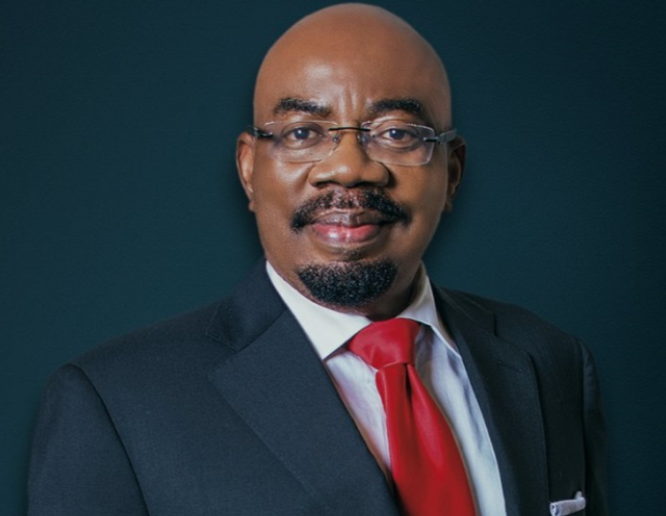
There are moments in the life of a corporation when the calendar ceases to be a mere administrative tool and becomes a narrative device, measuring not days but dynasties, and such a moment arrived on a Tuesday in Lagos when Zenith Bank convened its 35th Annual General Meeting to announce that its founder, Jim Ovia, had finally surrendered the chairman's gavel to the inexorable arithmetic of regulatory time. The news, delivered with the formal politesse that characterizes Nigerian corporate communications, carried a historical weight that no press release could fully contain: Ovia, who had steered the institution from its birth in 1990 through its adolescence as Group Managing Director and CEO, and then shepherded its maturity from the chairman's seat since July 16, 2014, was stepping down after completing the mandatory 12-year tenure prescribed by the Central Bank of Nigeria's corporate governance guidelines. For an institution that has grown from a modest startup into one of Africa's largest financial holding companies, the retirement of its founder is not merely a change of personnel but a test of whether the edifice can stand without the architect present, whether systems can outlast the man who built them. Engr. Mustafa Bello, a civil engineer by training, a former Federal Minister of Commerce, and the bank's longest-serving director since joining the board on December 29, 2017, now inherits the burden of continuity, approved for the role during a board meeting held on April 27 and formally unveiled to the market in a corporate notice dated May 5, 2026.
The transition has been heralded by the bank as a triumph of governance, a seamless transfer designed to preserve stability and maintain the rigorous oversight standards that have defined Zenith's market positioning, yet beneath the official optimism lies a deeper question that haunts every founder-led institution in the developing world: when the visionary departs, does the vision survive? As shareholders filed out of the AGM hall and traders on the Lagos Stock Exchange adjusted their positions, the silence that followed Ovia's final chairman's address was not merely the end of a speech but the punctuation mark on an era, the moment when Nigeria's most storied banking dynasty officially entered its post-founder age.
The Architecture of Twelve: Governance, Time, and the Founder's Exit
To understand the significance of Ovia's departure, one must first comprehend the peculiar nature of Nigerian banking history, where the distinction between ownership and control has often been blurred by the force of personality, and where founders have traditionally treated boardrooms as extensions of their private fiefdoms. Jim Ovia was not merely a chairman in the passive, British sense of the term; as the institution's founder, he was the gravitational center around which every major strategic decision had orbited for more than three decades, first as CEO from 1990 to 2010, and then as chairman for the twelve years that the CBN's corporate governance codes would permit. Leadership Newspaper reported that the Board explicitly credited him with providing strategic direction and oversight throughout his chairmanship, while Vanguard News noted that the bank's official statement praised a tenure defined by governance, guidance, and board oversight. The Board's formal commendation, as relayed in press statements, emphasized Ovia's commitment to governance standards and stakeholder value creation, attributing to his leadership the enhanced positioning and reputation that Zenith now enjoys in the crowded landscape of African financial services. Yet the very fact that his exit was triggered not by electoral defeat or shareholder revolt but by the cold precision of a regulatory clock—the mandatory 12-year service period for non-executive directors—speaks to a profound shift in Nigeria's financial culture.
Where once founders ruled for life, the Central Bank of Nigeria has gradually imposed term limits designed to professionalize boardrooms, reduce entrenchment, and prevent the kind of dominance that can mask institutional fragility beneath the charisma of a single individual. Banking analysts observe that Zenith's compliance with this deadline, announced with choreographed precision at the 35th AGM, sends a signal to the market that the institution respects regulatory boundaries even when they inconvenience its most powerful stakeholder. As the bank noted in its own disclosures, Ovia's retirement complies with tenure limits governing board members in financial institutions, a sentence that reads as dry legalese but represents nothing less than the maturation of Nigerian capitalism.
The Ministry to the Boardroom: Bello's Unlikely Curriculum Vitae
If Ovia's exit was the end of a banking epic, the ascension of Mustafa Bello represents the beginning of a political thriller transplanted into the world of high finance, a career trajectory that zigzags from engineering barracks to cabinet chambers before landing in the leather-upholstered serenity of a bank chairman's office. Channels Television, which published an extensive profile alongside the appointment announcement, traced Bello's origins to the Ahmadu Bello University in Zaria, where he graduated in 1978 with a Bachelor of Engineering in Civil Engineering, earning Second Class Upper Division honors and capturing the Shell Prize for the best project and thesis in the Faculty of Engineering that same year. From there, he served in the Directorate of Quartering and Engineering Service of the Nigerian Army between 1978 and 1979, before crossing into civilian infrastructure as a Senior Civil Engineer at the Niger State Housing Corporation from 1980 to 1983, a grounding in brick-and-mortar nation-building that would later inform his approach to economic policy. His political ascent was swift and sustained: he served as Federal Minister of Commerce from 1999 to 2002 under President Olusegun Obasanjo, then as Executive Secretary and Chief Executive Officer of the Nigerian Investment Promotion Commission from November 2003 to February 2014, a tenure that saw him oversee the CAC online project in 2002 and help develop a WTO-consistent trade policy for the Federal Republic.
When he joined Zenith's board on December 29, 2017, he brought not merely a politician's address book but a technocrat's understanding of regulatory architecture, and his status as the longest-serving director on the board gave him the institutional memory that outsiders typically lack. Corporate governance experts suggest that appointing a chairman with both public-sector experience and deep board familiarity is a calculated hedge against volatility, ensuring that the bank can navigate the intersection of government policy and market forces without losing its strategic footing. As Bello assumes the chairman's seat that Ovia occupied for twelve years, he carries with him the curious distinction of being one of the few Nigerian bank chairmen who can claim to have built roads, drafted trade laws, and chaired an investment commission before ever signing off on a balance sheet.
The Shadow of the CBN: Regulation, Succession, and the Politics of Banking
The Ovia succession cannot be separated from the broader political economy of Nigerian banking, where the Central Bank of Nigeria functions less as a mere regulator and more as a gatekeeper of careers, a institution whose governance guidelines can end tenures as decisively as any shareholder vote. The mandatory term limits that triggered Ovia's departure were forged in the crucible of post-consolidation reform, born from a recognition that Nigerian banks had become dangerously tethered to the egos of their founders, and that systemic stability required the institutionalization of succession planning. Yet the CBN's shadow extends beyond term limits into the very selection of who gets to lead, as illustrated by the career of Godwin Emefiele, who succeeded Ovia as Zenith Bank CEO before being appointed CBN Governor by President Goodluck Jonathan while still acting as the bank's chief executive, a move that blurred the lines between regulatory oversight and corporate patronage. Emefiele would go on to retain that governorship throughout the eight years of late President Muhammadu Buhari's administration, a longevity that underscores how Nigerian banking and political power have become intertwined in ways that defy easy categorization. Daily Trust, in its report on Ovia's retirement, noted this historical lineage, reminding readers that Zenith has not merely produced billionaires but has served as a launching pad for the nation's most powerful financial regulators.
For Bello, this means his chairmanship will unfold in an environment where the CBN's policy shifts can instantaneously rewrite the rules of profitability, where exchange rate adjustments can obliterate capital adequacy ratios overnight, and where political connections are often as valuable as credit risk models. Banking sector analysts warn that the true test of Bello's leadership will not be his ability to manage board meetings but his dexterity in navigating the Lagos-Abuja corridor, where the distinction between regulatory compliance and political survival grows thinner with each election cycle. The bank's official statement emphasized that Bello's appointment would preserve continuity and stability while maintaining governance standards, but in a system where the regulator and the regulated share alumni from the same corporate halls, continuity is itself a political act.
Future Implications: The Post-Founder Era and the Fortress of Continuity
The dust will settle on the 35th AGM, the shareholders will return to their portfolios, and the Lagos business press will move on to the next quarterly earnings report, but the strategic questions raised by Ovia's departure will linger in the corridors of Zenith's glass-and-steel headquarters long after the ceremonial handshakes have faded. For Nigeria's banking sector, the transition offers a template for how founder-led institutions can navigate the treacherous passage from personal rule to institutional governance without sacrificing the market confidence that founders typically command. Financial technologists argue that the next frontier for Zenith will not be branch expansion or loan growth but digital transformation, cybersecurity resilience, and the integration of artificial intelligence into credit decision-making—challenges that require a chairman capable of understanding both ledger sheets and algorithmic risk models. Vanguard News reported that the bank explicitly framed Bello's appointment as a mechanism for ensuring smooth transfer of leadership responsibilities, a phrase that reveals the anxiety underlying even the most confident succession announcements, for investors have long memories and short patience when it comes to governance vacuums. The broader cultural significance of the handover should not be underestimated: in a nation where family businesses routinely collapse in the second generation and political parties dissolve when their godfathers depart, Zenith's ability to survive its founder's exit could become a parable for institutional resilience across Nigerian capitalism.
Yet the risks remain formidable; Bello's career is rooted in the public-sector politics of the Obasanjo era, and the banking landscape he now chairs is being reshaped by fintech disruptors, crypto-asset speculation, and a generation of customers who have never set foot in a physical branch. Until Nigerian banks can prove that their governance structures are robust enough to outlast their founders, that their boards are truly independent rather than ceremonial rubber stamps, and that their chairmen are selected for competence rather than connections, the Ovia succession will remain an exception rather than a rule. As the market watches Bello take his seat at the head of the table, the only certainty is that the clock which governed Ovia's departure will eventually govern his own, and the true measure of Zenith's maturity will be whether the institution is still standing tall when that second hand finally stops.
0 Comments
Sign in to commentNo comments yet. Be the first to share your thoughts!