Became a Ghost Ship in Full Sail
A Senate President Sings the Requiem While the Lifeboats Row Toward 2027
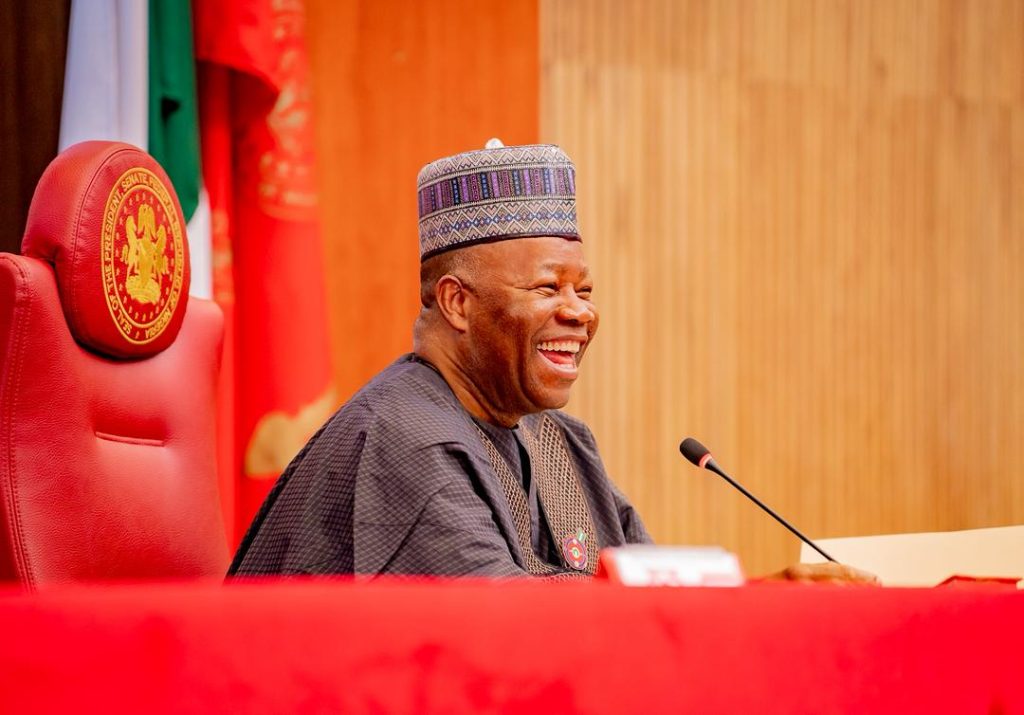
On a Tuesday afternoon that will be etched into the institutional memory of Nigeria's National Assembly, the hallowed red chamber of the Senate transformed from a legislative arena into something resembling a theatrical stage where a political obituary was being read aloud, line by excruciating line, to an audience of lawmakers who laughed, heckled, and watched with the morbid fascination of spectators at a coliseum. Senate President Godswill Akpabio, presiding over plenary with the gavel in one hand and a stack of defection letters in the other, did not merely announce the departure of two more senators from the African Democratic Congress; he performed a rite of passage, declaring with the cadence of a man who had seen this script before that the party was, for all practical purposes, no longer among the living.
According to Vanguard News, Akpabio looked out across the chamber and declared that the ADC was dead, a sentiment he would repeat with varying degrees of surgical precision throughout the session, at one point suggesting that defectors ought to compile their resignations into a single document so the Senate would not have to endure what he wryly termed a "daily ritual." The chamber erupted in laughter, a sound that echoed off the marble walls with a cruelty that only politics can make communal, as one by one, the letters were read, each confirming what insiders had long whispered but what was now being shouted from the highest legislative pulpit in the land. Business Hallmark reported that Akpabio framed the trend as evidence of declining strength within the ADC, a clinical understatement that stood in stark contrast to the blunt force of his later declaration that the party had simply ceased to function as a viable political organism. The Punch Nigeria headline captured the moment with declarative finality: "ADC is dead," it read, reducing a party's entire existential crisis to four syllables that would ripple through the nation's political bloodstream for days to come.
What made the scene particularly arresting was not merely the substance of the defections but the atmosphere of performative burial that accompanied them, as Akpabio, who has never been accused of political subtlety, used the platform of the Senate to transform a procedural reading of resignation letters into a public autopsy of a party that had once dared to dream of national relevance. By the time the session adjourned, the message had been received with crystalline clarity across the corridors of Abuja's power centres: the ADC was not simply wounded; it was being administered last rites by the very institution it had sought to influence, and the physicians had already moved on to the next patient.
The Letters From the South-East: Two Senators, Two Destinations, One Damning Verdict
At the centre of this exodus stood two men from Nigeria's South-East geopolitical zone, Senators Victor Umeh and Enyinnaya Abaribe, whose decisions to abandon the ADC for rival parties laid bare the depth of the organisational rot that had festered within the party's hierarchy until it could no longer sustain the weight of its own contradictions. As reported by Daily Trust, Umeh, who has represented Anambra Central Senatorial District with the tenacity of a politician who understands the mechanics of grassroots mobilisation, chose to cast his lot with the Nigeria Democratic Congress (NDC), a party that has been steadily consolidating the fragments of disillusioned opposition figures into a coalition of the discontented. His counterpart, Abaribe, the veteran lawmaker from Abia South whose voice has carried through multiple political cycles with the gravitas of a man who has seen parties rise and fall like seasonal tides, made his way to the Labour Party (LP), a movement that has positioned itself as the refuge for politicians who have grown weary of the traditional establishment's machinery and its relentless appetite for internal conflict.
Leadership Newspaper chronicled how both men cited what they described as persistent leadership crises and internal disputes, with Umeh going so far as to detail in his letter the extensive consultations he had undertaken with his family, constituents, and political allies before reaching what he called an irreversible conclusion, a process that underscored the gravity of a decision no elected official takes lightly in a political culture where party loyalty is often the currency of survival. Abaribe, for his part, did not mince words or cloak his departure in diplomatic ambiguity; according to Politics Nigeria, he informed the Senate in language that brooked no interpretation that his resignation was effective immediately, grounding his decision in what he described as a deepening leadership crisis occasioned by multiple legal suits that had rendered the ADC not merely dysfunctional but fundamentally ungovernable.
The symmetry of their departures—two South-East senators, two different destination parties, one common diagnosis of institutional failure—spoke volumes about the geographic and ideological fracturing that now defines the opposition landscape, as the ADC, which had once harboured ambitions of becoming a credible third force capable of disrupting Nigeria's bipolar political duopoly, found itself hemorrhaging its most prominent legislators to parties with clearer structures and more compelling narratives. Umeh, in his letter, reaffirmed his commitment to national development, noting that he would continue to serve through his new political platform, the NDC, a gesture that sought to reassure his constituents that his departure was not an abandonment of their interests but rather a strategic relocation to a vessel capable of carrying their aspirations. Abaribe's letter, by contrast, carried the sting of finality, as he informed his colleagues that his decision was anchored on what he called the "now well-known leadership crisis within the ADC," a phrase that suggested the party's troubles were not hidden afflictions but public wounds that had festered long enough to become common knowledge among even the most casual observers of Nigeria's political theatre.
Together, these two letters, read aloud in the Senate by Akpabio himself, formed a devastating indictment of a party that could no longer retain the loyalty of its elected representatives, and their coordinated departure raised uncomfortable questions about whether the ADC had any meaningful presence left in the legislative chambers it had once hoped to dominate.
The Theatre of Exit: Mockery, Mathematics, and the Comedy of Defection
If the defections themselves were a blow to the ADC's already fragile anatomy, it was Akpabio's response that turned the procedural announcement into a piece of political performance art, complete with audience participation, rhetorical flourishes, and the kind of savage humour that passes for statesmanship in the pressure cooker of Nigerian legislative politics. According to Daily Trust, Akpabio did not limit himself to reading the letters with the solemnity that such departures might ordinarily warrant; instead, he used the moment to taunt the coalition of opposition forces that has been coalescing around the objective of unseating President Bola Tinubu in the upcoming electoral cycle, suggesting that their organisational vehicle was not merely faltering but actively decomposing before the nation's eyes.
When he came to Abaribe's letter, Akpabio could not resist the temptation to make the personal political, turning to the Abia senator with a question that drew another wave of laughter from the chamber: "Senator, I should be asking you, 'How many times have you defected in a month?'"—a query that, beneath its jocular surface, carried the sharp edge of a man who knows that in Nigerian politics, party allegiance is often treated as a revolving door rather than a marriage. The Punch Nigeria report captured the moment when Akpabio broadened his inquiry to Senator Adamu Aliero, an elder statesman whom he addressed with the mock deference of a student seeking wisdom from a master, asking how many times a lawmaker could legitimately defect in a month. Aliero's response—"Once!"—came with the certainty of a man who believes in rules, but Akpabio was ready with the counterpunch, interjecting with impeccable comic timing that some had done so three times, a revelation that prompted the chamber to erupt once more into laughter that seemed to say more about the state of Nigerian party discipline than any white paper ever could.
The Vanguard News account of the session noted that Akpabio went so far as to suggest that all intending defectors should compile their names into a single list, organised by destination party, so that the Senate could process their exits with the efficiency of a bureaucracy rather than the theatricality of a daily soap opera, a proposal that revealed as much about the sheer volume of defections as it did about Akpabio's growing impatience with what had become a recurring distraction from the Senate's legislative agenda. "Maybe all those defecting from ADC should just compile everything in one paper and bring it, so that we don't keep announcing, announcing," he said, according to Politics Nigeria, his voice carrying the exasperation of a man who had read one too many resignation letters and was now treating the collapse of a political party with the administrative pragmatism of a clerk processing paperwork.
It was, by any measure, a masterclass in political theatre, as Akpabio transformed what should have been a moment of sombre reflection for the ADC into a comedy routine that left no doubt about which party controlled the narrative in the red chamber, and whose coalition was currently bleeding members with the inevitability of gravity.
The House Catches Fire: Seventeen Representatives and the Geography of Collapse
The Senate drama, however theatrical, was merely the most visible eruption of a volcanic crisis that has been rumbling beneath the surface of the ADC for months, if not years, and the defections in the upper chamber were accompanied by a parallel exodus in the House of Representatives that underscored the national scope of the party's unravelling. Vanguard News reported that no fewer than seventeen lawmakers in the lower house formally announced their exit from the ADC to the NDC during plenary on the same Tuesday, citing what they described as unresolved crises raging from the national level all the way down to the ward structures, a cascading failure of governance that had left the party's grassroots infrastructure in ruins. These defectors, who hailed from a geographic spread that included Kano, Anambra, Lagos, Edo, and Rivers states, read separate letters on the floor of the House, each one adding another nail to the ADC's coffin and another recruit to the NDC's growing army of converts, a party that appears to have positioned itself as the primary beneficiary of the ADC's implosion.
The Business Hallmark analysis of the trend noted that the wave of departures points not merely to internal squabbles but to a fundamental breakdown in the ADC's ability to project itself as a credible alternative to the ruling All Progressives Congress and the main opposition Peoples Democratic Party, a failure that has become increasingly costly as Nigeria approaches the 2027 general elections. Leadership Newspaper, in its coverage, emphasised the legal dimension of the crisis, noting that the ADC has been paralysed by multiple litigations and leadership disputes that have rendered it incapable of presenting a unified front, a condition that makes it virtually impossible for the party to meet the organisational requirements that the Independent National Electoral Commission demands for full political recognition and ballot access. Political analysts who have watched the ADC's trajectory note that the party's crisis is not unique in Nigeria's history, where parties are often formed around personalities rather than ideologies, and where legal battles over leadership become proxy wars for control of the party's ticket and its associated patronage networks, a structural weakness that ensures no party is ever truly safe from the kind of internal combustion that the ADC is currently experiencing.
What distinguishes this moment, however, is the speed and visibility of the collapse, as senior senators and House members alike have chosen to abandon ship not in the quiet of backroom negotiations but in the full glare of legislative plenary, transforming private grievances into public spectacle and ensuring that the ADC's wounds are displayed before a national audience that is already deeply cynical about the durability of political institutions. The Punch Nigeria headline, with its blunt declaration that the ADC is dead, may have been journalistic shorthand, but it captured a sentiment that is rapidly hardening into conventional wisdom among the political class: that the ADC has passed the point of no return, and that its remaining members would be well advised to follow the example of Umeh, Abaribe, and the seventeen representatives who have already calculated that their political futures lie elsewhere.
Future Implications: The Opposition's Reckoning or the Ruling Party's Requiem?
As the dust settles over Tuesday's plenary and the laughter in the Senate chamber fades into the ambient noise of Abuja's perpetual political churn, the questions that remain are less about what happened to the ADC and more about what its collapse portends for the broader architecture of Nigerian opposition politics in the run-up to the 2027 elections. According to Daily Trust, Akpabio's taunting reference to the coalition seeking to unseat President Tinubu suggests that the ruling establishment views the ADC's disintegration not merely as the demise of a minor party but as a strategic victory that weakens the opposition's ability to present a united front against the incumbency advantage that Tinubu and the APC currently command. Politics Nigeria reported that the Nigeria Democratic Congress, which has now absorbed legislators from both the Senate and the House of Representatives, is positioning itself as the new gravitational centre for disaffected opposition figures, but whether it can avoid the same centrifugal forces that tore the ADC apart—personality cults, legal infighting, and the absence of a coherent ideological anchor—remains the defining question that will determine if it becomes a genuine contender or merely the next waypoint in an endless cycle of political migration.
Leadership Newspaper highlighted the significance of Abaribe's defection to the Labour Party, noting that a political brand of his stature in the South-East may signal to other lawmakers that the LP remains a viable destination for those seeking to distance themselves from the traditional establishment without surrendering to the NDC's expanding orbit. Business Hallmark's analysis of the broader trend suggests that Nigeria's party system is entering a period of unusual fluidity, where the barriers between opposition platforms are becoming increasingly permeable and where the very concept of party loyalty is being redefined by legislators who treat political platforms as tactical vehicles rather than ideological homes, a trend that could produce a 2027 electoral landscape of unprecedented fragmentation or, conversely, a consolidated opposition that finally learns the lessons of the ADC's catastrophic failure.
For the ADC itself, the path forward is narrow and treacherous; with its most prominent legislators gone, its legal battles unresolved, and its reputation shattered by the very public humiliation of having its obituary read aloud in the Senate, the party must either undergo a radical restructuring that addresses the leadership crises its own former members have documented, or resign itself to the historical footnote that Akpabio has already written in the annals of the National Assembly. The Punch Nigeria framing of the event as a definitive declaration of death, rather than a reversible illness, suggests that the political marketplace has already priced the ADC out of contention, and that any remaining members who hope to retain their relevance would be wise to calculate whether their loyalties are worth more than their electoral survival in a system where voters increasingly reward organisational competence over nostalgic attachment to party labels.
In the end, Tuesday's plenary was not merely about two senators and seventeen representatives changing their party affiliations; it was about the brutal mathematics of political survival in a system where parties live and die not by the strength of their manifestos but by the coherence of their leadership, and where even the Senate President can find himself, gavel in hand, presiding over a funeral that nobody bothered to schedule but everyone knew was coming.
📰 Sources Cited
- Vanguard News: I think ADC is dead – Akpabio
- Business Hallmark: ADC ‘dying,’ Akpabio says as Abaribe, other lawmakers dump party
- Punch Nigeria: ADC is dead, Akpabio reacts to wave of defections in National Assembly
- Daily Trust: Defections: ADC loses senators to NDC, Labour Party
- Leadership Newspaper: ADC Crisis Deepens As 2 South-East Senators Defect To NDC, LP
- Politics Nigeria: “I think ADC is dead” – Akpabio announces as two senators dump party
- Daily Trust: Akpabio: I think ADC is dead
- Daily Trust: JUST IN: I think ADC is dead, says Akpabio
0 Comments
Sign in to commentNo comments yet. Be the first to share your thoughts!