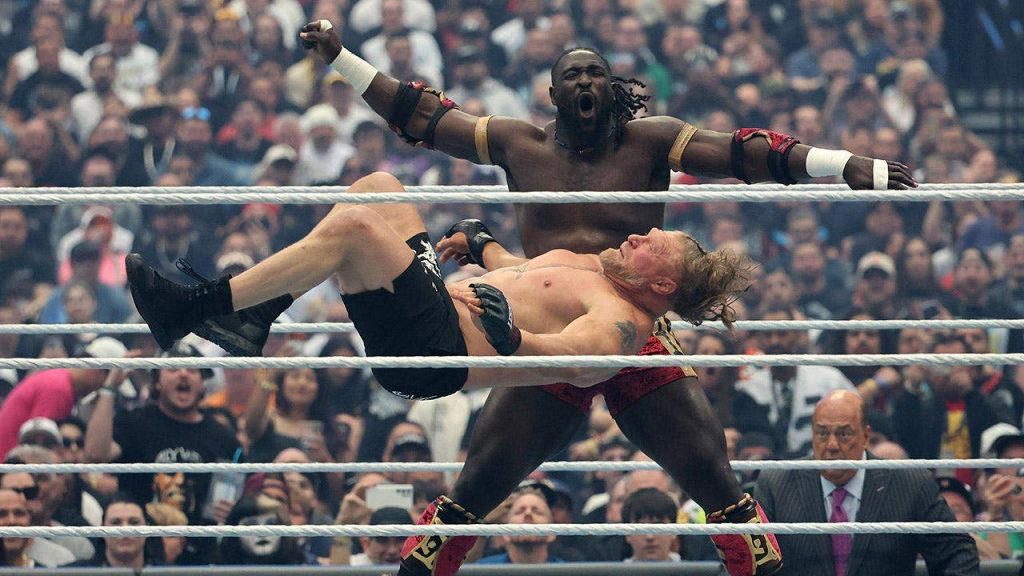
The desert air above Allegiant Stadium in Nevada carried the electric charge of history long before the opening bell of WrestleMania 42's second night, yet nothing in the meticulously choreographed spectacle of sports entertainment could have prepared the global audience for the seismic shift that would unfold beneath the bright lights of the squared circle. In a venue accustomed to hosting gladiatorial contests of will and strength, where the line between athletic prowess and theatrical grandeur blurs into a singular American cultural institution, a 27-year-old Nigerian newcomer named Isaac Odugbesan—known to the world as Oba Femi—stepped into the ring against a man who had defined an era of dominance so completely that his very name, Brock Lesnar, had become synonymous with intimidating excellence. As reported by Vanguard News, the generational contrast was almost incomprehensible: Femi, born in Lagos on April 22, 1998, was merely four years old when Lesnar made his WWE debut in 2002, a temporal gulf that spanned not just decades but entire epochs in the evolution of professional wrestling, from the territorial strongmen of the early aughts to the NIL-bred athletes of the modern era. The bout, which Leadership Newspaper described as one of the headline clashes of the evening, would last less than five minutes according to multiple ringside accounts, yet within that compressed window of time, the architecture of WWE's future seemed to redraw itself with startling clarity.
For the tens of millions watching across streaming platforms and broadcast networks—including live coverage tracked by ESPN and Yahoo Sports—the match represented something far more profound than a standard upset; it was the violent, beautiful poetry of succession, rendered in suplexes and powerbombs, a moment where the torch was not gently passed but rather seized with the uncompromising authority that defines true champions.
The Anatomy of Succession: When the Crown Demands Itself
What transpired within the ropes defied the expectations of even the most seasoned wrestling analysts, as the contest began with the familiar brutality that has made Lesnar's matches appointment viewing for over two decades, the 48-year-old "Beast Incarnate" briefly asserting control through a punishing series of offensive maneuvers that sent his younger opponent toward the harrowing neighborhood fans call "Suplex City." According to Sun News Online, the turning point arrived with a devastating finality after Lesnar executed his signature F5, a maneuver that has felled countless challengers and cemented ten world championships; yet in a moment that will be replayed in highlight reels for generations, Femi absorbed the impact and rose with a resilience that seemed almost superhuman, the stadium's atmosphere shifting from anticipatory dread to thunderous disbelief. The Nigerian then mounted a comeback of staggering ferocity, delivering a chokeslam of biblical proportions before sealing the pinfall victory with his trademark "Fall From Grace" sit-out powerbomb, a sequence of events that TVC News noted transpired with such rapid dominance that it resembled less a competitive contest than a coronation by force. In the heavy silence that followed the three-count, as documented in detailed match reports, Lesnar remained seated in the center of the ring while the crowd's chant of "Thank you, Brock" swelled into a mournful roar, the veteran slowly removing his gloves and boots in a gesture that wrestling tradition universally interprets as retirement, leaving the gear behind like a soldier abandoning his armor on a distant battlefield.
Paul Heyman, the longtime advocate who has orchestrated Lesnar's career with the precision of a master strategist, entered the ring to share an emotional embrace with his client, a visual coda that Punch Nigeria suggested may signal the end of an era spanning UFC heavyweight gold, Royal Rumble triumphs, and main-event spectacles that defined the peak of sports entertainment's crossover into mainstream athletic culture.
The Economic Alchemy: From Collegiate Shot Put to Global Brand Equity
Beneath the theatrical blood and sweat of the contest lies a fascinating narrative of economic transformation, one that traces Femi's journey from a standout shot-putter at the University of Alabama to a marketable phenomenon who signed with WWE in 2021 through its Next In Line (NIL) program, an initiative designed to monetize collegiate athletic talent before they ever turn professional. Blueprint Newspapers noted that Femi has enjoyed a meteoric rise since that initial contract, capturing multiple developmental championships including the NXT North American title and becoming the first NIL athlete to win a WWE championship, a milestone that represents a significant return on investment for a company increasingly dependent on developmental pipelines to refresh its main-roster product. For WWE, which has spent decades cultivating global markets, the emergence of a Nigerian-born main-event talent arrives at a critical juncture in the company's expansion strategy, offering access to one of Africa's most populous nations and its vast, youthful demographic of potential subscribers to the WWE Network and Peacock streaming services. Industry analysts point out that Femi's transition to the main roster just three months prior to WrestleMania 42, followed immediately by a victory over one of the company's most bankable legends, constitutes an unprecedented acceleration of brand value, effectively compressing years of careful character building into a single evening of explosive commercial potential.
As PM News Nigeria emphasized in its coverage, the explosive nature of the clash generated immediate trending status across digital platforms, translating raw athletic spectacle into the kind of viral marketing that no advertising budget can manufacture, while simultaneously positioning Nigeria not merely as a consumer of Western entertainment product but as a genuine exporter of athletic celebrity to the world's most watched wrestling promotion.
The Cultural Cartography: "The Ruler" and the Weight of Representation
Culturally, the ascent of Oba Femi—whose ring name "The Ruler" evokes both Nigerian royal traditions and an uncompromising authority in the ring—represents a watershed moment in the representation of African athletes within the predominantly Western narrative architecture of professional wrestling, a genre that has historically relied on reductive stereotypes when depicting continental talent. Standing at six feet four inches and weighing approximately 310 pounds, Femi possesses the physical phenotype that wrestling promoters have long fetishized, yet his background as a former track and field athlete who transitioned through WWE's developmental system lends his character an authenticity that transcends the cartoonish excesses often imposed upon foreign performers. Vanguard News detailed how Femi built his reputation in NXT by winning the 2023 Men's Breakout Tournament and the 2024 Men's Iron Survivor Challenge, accomplishments that required not merely physical dominance but the psychological acuity to navigate WWE's grueling schedule of televised and live events, a crucible that forged him into a performer capable of holding his own against a master of the craft like Lesnar. For Nigerian audiences, as cultural commentators have observed, his victory arrived as a moment of pure catharsis, a validation of the nation's sporting infrastructure and its capacity to produce world-class talent beyond the traditional domains of football and long-distance running, instead claiming space in the hyper-masculine, highly theatrical world of sports entertainment where physical charisma commands global currency.
The imagery of a Lagos-born athlete standing victorious over a ten-time world champion while the Nigerian diaspora watched via satellite and streaming links around the world served as a potent reminder of how athletic achievement continues to function as a form of cultural diplomacy, rewriting perceptions through the universal language of competition.
The Social Resonance: Screens, Hashtags, and the Anatomy of a Viral Moment
In the immediate aftermath of the pinfall, social media platforms across Nigeria and the broader African continent erupted with a ferocity that underscored the deeply social nature of modern sports consumption, transforming a single match into a collective national experience that transcended the boundaries of the wrestling fanbase. Sun News Online documented the widespread joy and thrill amongst Nigerians, a sentiment amplified by the fact that Femi's victory occurred on one of entertainment's largest stages, WrestleMania, an annual event that commands viewership figures comparable to major championship football matches and serves as a cultural touchstone for millions of casual fans who may not follow weekly programming. The contrast between the two competitors became a social narrative in itself: as multiple outlets noted, the 27-year-old Femi facing the 48-year-old Lesnar represented not merely a clash of individuals but a generational referendum, the athletic optimism of youth colliding with the accumulated gravitas of a veteran who had headlined numerous WrestleMania events against legends including Kurt Angle, The Undertaker, John Cena, Roman Reigns, and Cody Rhodes. Digital anthropologists and media analysts have pointed to the match as a case study in how streaming technology and social platforms have democratized the consumption of live events, allowing Nigerian fans to witness and celebrate the triumph in real-time alongside spectators in Las Vegas, creating a transnational community of celebration that would have been impossible in the era of tape-delayed broadcasts.
The post-show moment, when Femi sent a direct message to Roman Reigns—known to the WWE universe as the "Original Tribal Chief"—further ignited speculation about future blockbusters, demonstrating how the social ecosystem of modern wrestling depends upon these carefully planted narrative seeds to sustain engagement between major events.
The Political Theatre: Soft Power in the Squared Circle
While professional wrestling operates within the realm of scripted entertainment, its implications for national image and soft power projection remain stubbornly real, particularly for a nation like Nigeria that has wrestled with international perceptions ranging from economic potential to security challenges. The elevation of Oba Femi to main-event status at WrestleMania 42 arrives at a moment when African nations are increasingly asserting themselves in global cultural markets, from Afrobeats dominating international music charts to Nollywood commanding streaming platform investments, and Femi's triumph inserts Nigeria into yet another lane of cultural export. Diplomatic observers note that athletic ambassadors often accomplish what traditional statecraft cannot, humanizing national narratives through individual excellence, and Femi's dominant display—overpowering a competitor widely regarded as one of the most formidable figures in professional wrestling history—projects an image of Nigerian strength and capability that resonates far beyond the sports pages. As TVC News reported in its coverage of the headline bout, the symbolic weight of a Nigerian athlete defeating a ten-time champion on his debut carries undertones that political speechwriters could only envy, a wordless argument for Nigerian potential delivered through chokeslams and powerbombs to a global audience numbering in the tens of millions. The political dimension extends to WWE's own corporate calculus as well, with the promotion's evident investment in Femi reflecting a strategic recognition that the future of global entertainment markets lies in diversifying its talent pool to reflect the demographics of its international viewership, a form of commercial pragmatism that nonetheless produces genuinely progressive outcomes in representation and opportunity.
The Technological Colosseum: Broadcast Infrastructure and the Digital Arena
The technological scaffolding that enabled WrestleMania 42 to reach its global audience represents an underappreciated dimension of the spectacle, one that has transformed professional wrestling from a regional carnival attraction into a technologically sophisticated media product distributed across multiple platforms and time zones. Live coverage provided by ESPN and Yahoo Sports, as referenced in Nigerian Google News aggregations, offered real-time updates and analysis that catered to the contemporary viewer's demand for immediate information, while the underlying WWE production apparatus deployed cameras, instant replay systems, and augmented reality graphics that rendered Femi's victory with cinematic clarity. For Nigerian viewers, access to the event occurred primarily through streaming services and digital platforms, a technological leap that stands in stark contrast to previous decades when international wrestling content arrived through pirated videotapes or sporadic satellite broadcasts, and this democratization of access has fundamentally altered how diasporic communities engage with global entertainment products. Media technologists have observed that the virality of Femi's win—captured in shareable clips, GIFs of the "Fall From Grace" finisher, and reaction videos that circulated within minutes of the broadcast's conclusion—depends entirely upon the robust digital infrastructure that now undergirds live sports entertainment, an ecosystem where the secondary social media discourse often generates as much viewership as the primary broadcast itself.
The presence of Nigerian news outlets like Leadership Newspaper, Vanguard, and The Sun providing comprehensive ringside-style coverage further illustrates how digital journalism has collapsed the distance between Lagos and Las Vegas, allowing local media to serve global stories to domestic audiences with a speed and granularity that rivals their international counterparts.
Future Implications: The Crown Heavy Upon the Head
As the dust settles over Allegiant Stadium and the wrestling industry processes the implications of Brock Lesnar's symbolic farewell, the path forward for Oba Femi appears simultaneously luminous and treacherously steep, laden with the expectations that accompany any performer who announces himself on the grandest stage with such overwhelming force. WWE has not officially confirmed Lesnar's retirement, according to Sun News Online's follow-up reporting, yet the visual poetry of discarded gloves, an emotional embrace with Paul Heyman, and a stadium chanting its gratitude creates a narrative momentum that will be difficult to reverse, effectively clearing the main-event landscape for a new generation of heavyweights led by Femi's imposing presence. The post-show challenge issued to Roman Reigns, reported across multiple Nigerian outlets including Blueprint Newspapers, signals the company's apparent confidence in Femi's ability to carry marquee storylines, though analysts caution that sustaining main-event status requires more than a single triumphant debut; it demands the consistent refinement of in-ring craft, character work, and the intangible magnetism that separates memorable champions from forgotten contenders. For Nigeria, Femi's trajectory offers a template for how athletes from non-traditional wrestling backgrounds can navigate the global sports entertainment complex, leveraging collegiate athletic discipline and NIL opportunities into sustainable careers on the world stage, a development that may inspire increased investment in combat sports and athletic development programs across West Africa.
The technological and economic ecosystems that amplified his victory will continue to evolve, likely subjecting Femi to the unblinking scrutiny of a digital fanbase that demands both authenticity and excellence, yet if his performance against Lesnar revealed anything, it was that the young man from Lagos possesses the composure to absorb pressure and the power to reshape it into something magnificent. As the WWE calendar turns toward its next phase of premium live events, the industry finds itself at an inflection point where the past has been politely but firmly shown the exit, and the future stands six-foot-four, weighs three hundred and ten pounds, and answers to the name "The Ruler."
📰 Sources Cited
- Sun News Online: WrestleMania: Nigerian Oba Femi stuns Brock Lesnar with five-minute win
- Blueprint Newspapers: Nigeria’s Oba Femi floors Brock Lesnar on WWE debut
- Vanguard News: Nigerian Oba Femi defeats Brock Lesnar in five minutes on WWE debut
- Leadership Newspaper: Excitement As Nigerian Oba Femi Beats Lesnar On WrestleMania Debut
- TVC News: Nigerian Wrestler Oba Femi Beats 10-Time Champion Lesnar on WrestleMania Debut
- Sun News Online: WWE wrestler Brock Lesnar hints at retirement after loss to Nigerian Oba Femi
- Punch Nigeria: Nigerian wrestler Oba Femi beats Lesnar on WrestleMania debut
- PM News Nigeria: Nigerian wrestler Oba Femi overpowers Lesnar in explosive WrestleMania debut
- Google News Nigeria: WWE WrestleMania 42 Night 2 live results: Updates, grades, analysis for tonight's Roman Reigns, CM Punk finale - Yahoo Sports
- Google News Nigeria: WWE WrestleMania 42 Night 2: Live match results and analysis - ESPN
0 Comments
Sign in to commentNo comments yet. Be the first to share your thoughts!