The Abuja Covenant: When Two West African Giants Lowered Their
Guard
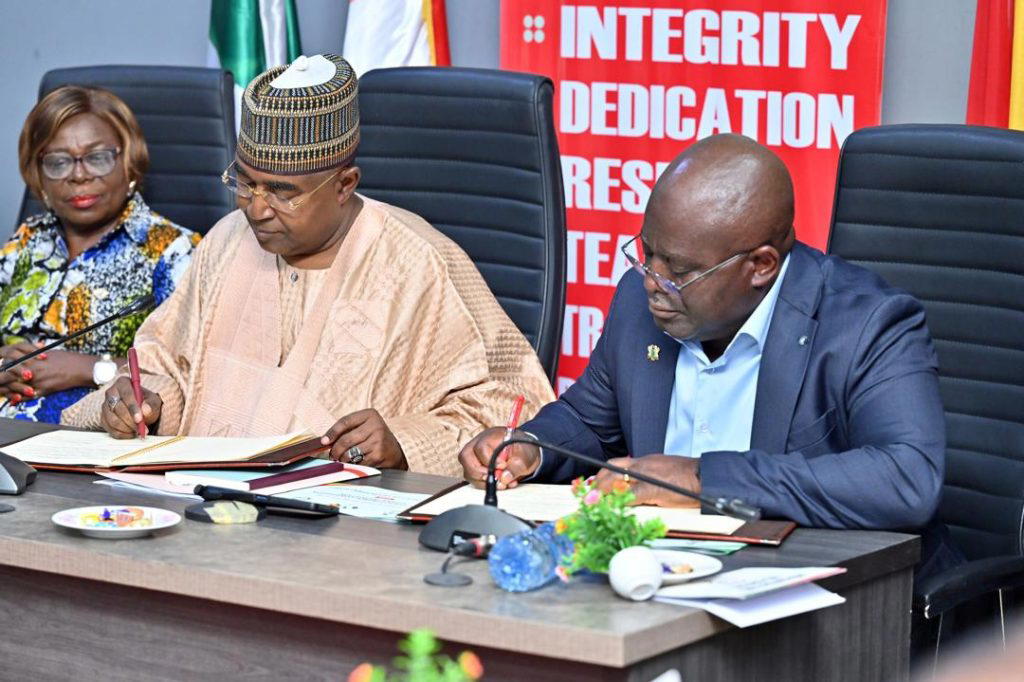
The dry-season heat of Abuja on that Tuesday afternoon bore none of the mercy that the Harmattan winds usually promise, and inside the headquarters of Nigeria's National Drug Law Enforcement Agency, the air conditioning struggled against the weight of a gathering that would reshape the cartography of West African law enforcement. Mohamed Buba Marwa, the Chairman and Chief Executive Officer of the NDLEA, stood at the center of a ceremonial room where the flags of Nigeria and Ghana hung with the formal symmetry of nations choosing cooperation over competition, a visual statement that betrayed nothing of the violent underworld their representatives had convened to dismantle. According to Vanguard News, whose correspondent Kingsley Omonobi documented the event, Marwa was playing host to a delegation from Ghana's Narcotics Control Commission (NACOC), led by its Director-General, Maxwell Obuba Mantey, a man whose presence in Abuja signaled that Accra had moved beyond diplomatic pleasantries into the realm of operational vulnerability, admitting that Nigeria's anti-drug architecture had something worth studying.
Among the officials gathered were senior representatives from both capitals, including Gladys Mansa Yawa Feddy Akyea, whose presence alongside the principal delegations underscored the cross-sectional nature of the threat and the response. TVC News reported that the two countries had moved to strengthen a joint offensive against drug trafficking in West Africa, framing the meeting not as a routine diplomatic courtesy but as the opening salvo in a coordinated campaign to constrict the arteries through which narcotics and psychotropic substances have flooded the sub-region for decades.
The contrast between the room's polite formality and the brutal commerce it sought to destroy could not have been starker: while officials exchanged protocol folders and posed for photographs, the cartels they targeted were somewhere in the labyrinthine ports and border crossings of West Africa, moving precursors and laundered money with the indifference of men who had grown accustomed to operating in the blind spots between sovereign nations. Peoples Gazette captured the essence of the moment in stark headline prose, noting that the new partnership would serve as a warning to drug cartels in the West African sub-region, a declaration that transformed the quiet bureaucracy of an Abuja afternoon into a thunderclap heard in the shadow economy of organized crime. For the diplomats and law enforcement officials present, the ceremony was the visible tip of an iceberg whose submerged mass consisted of intelligence dossiers, intercepted communications, and the accumulated grief of families destroyed by addiction and violence.
When the last handshake was completed and the delegations retreated to air-conditioned conference rooms, the question hanging in the Sahara-dusted air was whether this display of West African unity would translate into the kind of operational synchronization that cartels, with their borderless supply chains and mercenary adaptability, have historically exploited.
The Cartel's Ledger: Blood Money, Psychotropics, and the Economics of Pain
To understand why an afternoon in Abuja matters beyond the realm of press releases and protocol, one must first read the ledger that the cartels have kept across West Africa, a balance sheet written in the depreciated currencies of broken lives and the laundered dollars that flow through the region's banking systems with the ease of legitimate commerce. Vanguard News reported that the Memorandum of Understanding signed between NDLEA and NACOC specifically targets the illicit production of psychotropic substances, their precursors, and related money laundering activities, a tripartite focus that reveals the sophistication of the enemy: these are not mere marijuana smugglers operating from jungle clearings, but industrial-scale networks capable of manufacturing chemical dependencies and sanitizing the proceeds through front companies and shell accounts. Punch Nigeria, in its characteristically punchy headline idiom, declared that the partnership aims to tighten the noose on trafficking, a metaphor that carries economic weight because every centimeter of constriction represents disrupted revenue streams, seized assets, and the costly rerouting of supply chains that cartels must undertake when law enforcement achieves genuine interoperability.
The economic dimension of this pact extends beyond the narcotics themselves to the ancillary industries of corruption and violence that drug money fertilizes across West Africa; when a kilogram of cocaine moves through Lagos or Tema, it does not travel alone but accompanied by bribes for port officials, payments for armed escorts, and the slow metastasis of illicit capital into legitimate real estate and political influence. Drug trade economists who monitor the region estimate that West Africa serves as both a transit hub and an emerging consumer market, a dual role that has transformed countries like Nigeria and Ghana from waystations into battlegrounds where the domestic demand for psychotropics now rivals the transatlantic flow in terms of social devastation. The MoU's emphasis on money laundering is particularly significant because it strikes not at the cartels' muscle but at their metabolism, threatening to freeze the financial oxygen that allows criminal enterprises to purchase loyalty, intimidation, and the technical expertise required to evade traditional interdiction.
For Ghana, whose economy has struggled with currency volatility and inflationary pressures, the infusion of drug money poses an existential threat to monetary stability, while Nigeria's sprawling informal sector provides the perfect camouflage for laundering operations that would be conspicuous in more regulated economies. As the delegations pored over the document's provisions in Abuja, they were not merely signing a bilateral agreement but attempting to redraw the cost-benefit analysis that cartels perform every morning when they decide which borders to cross and which officials to bribe.
The Glass War: Digital Forensics and the Invisible Battlefield
If the MoU signed in Abuja represents the diplomatic surface of this new alliance, its submerged machinery consists of technologies and methodologies that would have been unimaginable to the narcotics officers of the 1980s, when West Africa's drug problem was still measured in kilograms of cannabis rather than metric tons of synthetics and the digital trails they leave across encrypted networks. Vanguard News reported that Marwa emphasized closer collaboration in intelligence-led operations, interdiction strategies, and digital forensics, a triad of capabilities that signals a shift from the reactive policing of seizures and arrests to the proactive dismantling of networks through data analysis, signal interception, and the algorithmic tracing of financial flows that now move as easily through mobile money platforms as they once did through suitcases of cash.
The Ghanaian delegation, led by Mantey, was explicitly in Nigeria on a study tour to understudy the NDLEA's operational model, an admission of technological asymmetry that carries its own diplomatic weight; Accra was not in Abuja to teach but to learn, to absorb the institutional knowledge that Nigeria has acquired through years of confronting cartels who have turned Lagos ports and northern border crossings into laboratories for smuggling innovation. TVC News noted that cartels operating across the sub-region will face increased pressure from coordinated enforcement actions, pressure that will depend almost entirely on the ability of Nigerian and Ghanaian technicians to share databases, synchronize surveillance protocols, and present unified digital evidence in courts that have historically been handicapped by jurisdictional fragmentation. The mention of digital forensics is especially resonant in an era when cartels recruit chemists, hackers, and logistics specialists from the same universities that produce the region's legitimate technocrats, creating an arms race where the side with superior data analytics wins not by force of arms but by the precision of prediction.
For the NDLEA, whose operational model has earned it a reputation as one of West Africa's more aggressive anti-drug agencies, the partnership offers a force multiplier: Ghanaian intelligence on maritime routes through the Gulf of Guinea can now be married to Nigerian expertise in urban surveillance and precursor tracking, creating a regional mesh that narrows the operational space available to traffickers. Yet the technological promise of the Abuja pact comes with vulnerabilities that neither country has fully addressed, including the patchwork of cybercrime legislation that varies between Accra and Abuja, the shortage of trained digital forensics experts, and the perpetual risk that cartels with deeper pockets will simply outbid governments for the region's best technical talent. As the WhatsApp images from the signing ceremony circulated through West African media channels on that Tuesday afternoon, they carried a message intended as much for the cartels' IT departments as for their enforcers: the glass war had begun, and the battlefield was no longer the physical street corner but the invisible architecture of servers, satellites, and encrypted chatter.
Jollof Brothers in Arms: Culture, Rivalry, and the West African Pulse
Beneath the operational and technological scaffolding of the NDLEA-NACOC partnership lies a cultural substrate that no Memorandum of Understanding can fully codify, the centuries-old fraternal rivalry between Nigeria and Ghana that has produced everything from culinary wars over jollof rice to competitive banter in Afrobeats lyrics, yet has also generated a solidarity forged in the shared experience of colonial extraction, post-independence struggle, and the perpetual challenge of governing diverse populations within artificial borders. Marwa himself underscored this dimension when he noted, as reported by Vanguard News, that the visit underscores the long-standing relationship between the two countries, a phrase that, in the context of West African diplomacy, carries the weight of blood and history rather than the anemic courtesy it might suggest in European capitals.
The social fabric that drug cartels seek to unravel is remarkably similar on both sides of the border: Nigerian and Ghanaian youth face parallel epidemics of synthetic drug abuse, from tramadol to codeine-based cough syrups, substances that have migrated from legitimate pharmaceutical supply chains into the informal markets where unemployment and hopelessness create a ready clientele for chemical escape. Peoples Gazette captured the deterrent rhetoric that framed the Abuja meeting, reporting that the new partnership would serve as a warning to cartels, but the warning resonates most powerfully not in the boardrooms of traffickers but in the households of Lagos and Accra, where parents have watched the promise of youthful potential dissolve into the agitated twitch of amphetamine addiction. The cultural symbolism of Nigerian and Ghanaian officials standing shoulder to shoulder against a common threat cannot be overstated in a region where ECOWAS has often struggled to translate Pan-African sentiment into concrete security cooperation; this was not a distant bureaucratic initiative in Addis Ababa or New York, but a handshake in Abuja between men who share ancestral lineages, musical traditions, and the visceral understanding that the enemy they face does not recognize passports.
For Maxwell Obuba Mantey and his delegation, the study tour represented more than technical acquisition; it was an act of cultural humility, the admission that in the fight against transnational crime, national pride must yield to regional survival. Analysts who study regional security in West Africa note that the Nigeria-Ghana axis has always functioned as the gravitational center of ECOWAS, and when these two nations move in concert, smaller states from Senegal to Cameroon tend to realign their own policies, creating the possibility that the Abuja pact could serve as a template for a broader West African anti-narcotics consortium. As the delegations exchanged gifts and reviewed intelligence briefings, the subtext of their cooperation was clear: the jollof wars could continue on Twitter and in music videos, but in the war rooms where West Africa's future was being decided, there was only one table and one enemy.
Beyond the Handshake: A Pact Forged in Fire or Fool's Gold?
The Abuja afternoon faded into a mauve dusk, and the delegations dispersed to their respective embassies and hotels, leaving behind the signed MoU and the photographs that would adorn tomorrow's newspapers, but the true measure of their achievement would not be taken in the ceremony's aftermath but in the months ahead, when the cartels tested the resolve of this new alliance with the same ruthless ingenuity they have applied to every previous law enforcement initiative. Punch Nigeria framed the stakes with characteristic economy, declaring that the NDLEA-Ghana partnership aims to tighten the noose on trafficking, a phrase that now hangs over West Africa as both promise and provocation, for cartels have historically responded to pressure not by surrendering but by innovating, shifting routes from monitored ports to unmanned beaches, from formal banking to cryptocurrency, and from conspicuous kingpins to decentralized cell structures that can absorb the loss of any single node.
TVC News reported that Buba Marwa issued a stern warning that cartels would face increased pressure from coordinated enforcement actions, but security experts who have watched similar pacts come and go across Latin America and Southeast Asia caution that pressure without persistence merely displaces rather than destroys, pushing traffickers into the jurisdictions of neighboring states that lack the capacity or political will to resist. The historical record of bilateral anti-drug agreements in West Africa is checkered at best; memoranda have been signed before, task forces convened, and joint operations launched, only to founder on the rocks of budgetary constraints, electoral cycles that deprioritize long-term security investments, and the corrosive influence of cartel money on the very institutions charged with enforcement. For the NDLEA and NACOC, the path from MoU to material impact will require sustained joint training initiatives, the harmonization of evidentiary standards that allow prosecutions to survive judicial scrutiny in both countries, and the political courage to pursue high-value targets whose connections to business and government elites make them dangerous to touch.
The digital forensics and intelligence-led operations that Marwa championed in Abuja offer genuine advantages, but only if backed by budgets that match the rhetoric, a condition that has historically eluded West African security agencies competing for funding against education, health, and infrastructure demands. If the Nigeria-Ghana pact succeeds, it will not be because of the signatures affixed to a document on a Tuesday in May, but because the technicians, investigators, and judges who must implement it receive the resources, protection, and institutional autonomy to treat cartels as the existential threat they are rather than as a manageable nuisance. For now, the cartels have been warned, the noose has been rhetorically tightened, and the jollof brothers have stood together in Abuja; whether that solidarity hardens into an impenetrable barrier or dissolves into another folder of unimplemented promises depends on whether West Africa's two largest economies can sustain the fire of that Tuesday afternoon through the long, grinding years of enforcement that victory demands.
📰 Sources Cited
- Peoples Gazette: Nigeria, Ghana strengthen cooperation against drug trafficking cartels
- TVC News: Nigeria, Ghana Strengthen Ties Against Drug Trafficking Cartel in W’Africa
- Punch Nigeria: NDLEA, Ghana’s anti-drug agency sign pact to tackle drug cartels
- Vanguard News: Nigeria, Ghana unite against drug cartels
0 Comments
Sign in to commentNo comments yet. Be the first to share your thoughts!