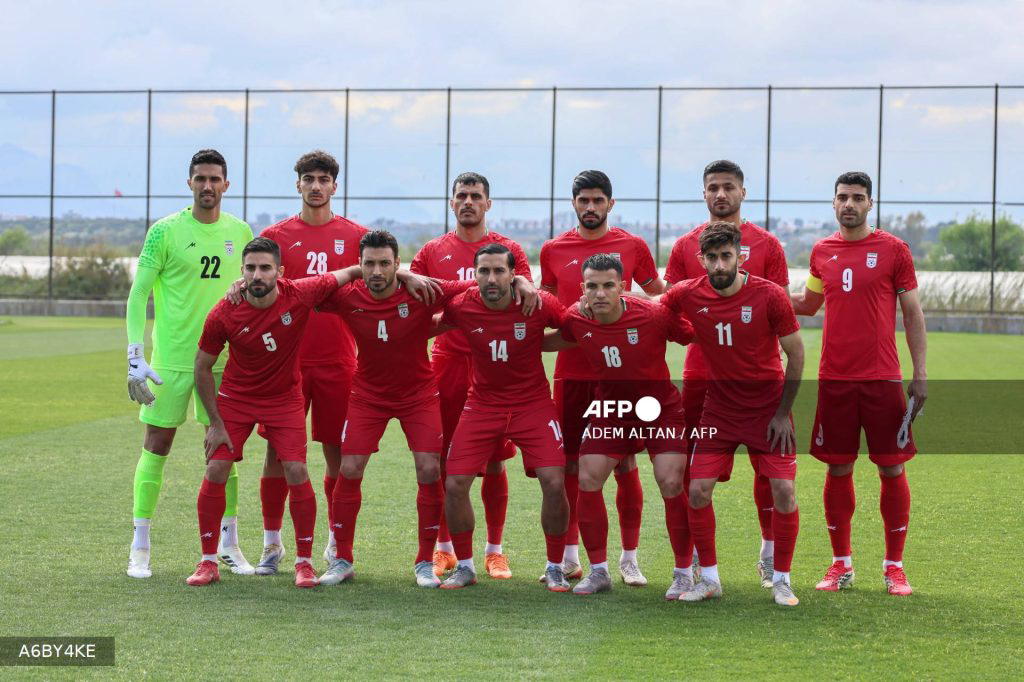
In the parched landscape of Tucson, Arizona, where the Santa Catalina Mountains rise like sentinels above a city that knows more about border politics than bicycle kicks, the Iranian national football team will establish its operational headquarters for the 2026 FIFA World Cup under circumstances that would have been unimaginable to the tournament's founders. While the players stretch on practice fields a short drive from the United States-Mexico border, their federation president Mehdi Taj will be negotiating not training schedules but diplomatic protocols, armed with a list of ten conditions that transform the world's greatest sporting festival into a tense bilateral summit. The demands—visas for Islamic Revolutionary Guard Corps veterans, guarantees of cultural respect, high-security corridors from airport to hotel to stadium—arrive not from a position of strength but from a nation under active bombardment, as Vanguard News reported, since the United States and Israel launched war on Iran in February. That the host nation is simultaneously bombing the visiting team's homeland and preparing to welcome its athletes with confetti and national anthems captures the central absurdity of the 2026 tournament, a competition that will run from June 11 to July 19 and that was supposed to celebrate North American unity but now risks becoming the most politically charged World Cup in history.
As the federation declared on its official website, Iran will participate "without any retreat from our beliefs, culture, and convictions," a statement that sounds less like a team announcement than a declaration of cultural war, one that forces FIFA, the United States, and the global sporting community to confront a question they have long avoided: can football truly transcend active warfare, or does it merely provide a prettier stage for the conflicts it claims to rise above?
The Manifesto of the Pitch: Mehdi Taj, the IRGC, and Ten Non-Negotiables
Mehdi Taj's ten conditions, delivered on Iranian state television on Friday and formalized the following day, read like a treaty drafted in a war room rather than a sporting itinerary, reflecting the unprecedented position of a national team whose homeland is under attack by the military forces of its host continent's most powerful ally. At the summit of Taj's list is the demand that all players and technical staff receive visas without scrutiny, a condition that specifically addresses the status of figures like striker Mehdi Taremi and defender Ehsan Hajsafi, who performed mandatory military service in the IRGC—an organization Canada designated as a terrorist group in 2024 and that the United States also proscribes, Punch Newspapers reported. This is not abstract diplomacy: last month, Canadian authorities refused entry to the Iranian federation chief before the FIFA Congress because of his IRGC links, a precedent that Tehran now cites as proof that politics is already interfering with its sporting sovereignty, according to Vanguard News. The conditions cascade from visas to cultural respect—the flag, the anthem—to security protocols at airports, hotels, and stadium routes, demands that convert routine athlete accommodation into a military logistics operation. As one diplomatic historian observed, "Taj has effectively issued a ten-point ultimatum to the world's most powerful nation, using the World Cup as leverage to demand recognition and security guarantees that his government cannot secure through traditional diplomacy." United States Secretary of State Marco Rubio has attempted to navigate this minefield by welcoming Iranian footballers while warning that Washington may still bar IRGC-linked delegation members, a position that pleases neither Tehran nor Washington's own hardliners, Al Jazeera reported.
Meanwhile, FIFA President Gianni Infantino, for his part, has insisted that Iran will play its scheduled matches in the United States as planned, maintaining the organization's traditional neutrality even as that neutrality appears increasingly untenable in an era of live-fire conflict.
Three Nations, One Enemy: The Geography of Hostility
The tri-nation hosting arrangement of the 2026 World Cup—spanning the United States, Mexico, and Canada—was designed as a celebration of continental solidarity, but for Iran it presents a diplomatic labyrinth where each border crossing carries the risk of detention, denial, or humiliation. The February eruption of war in the Middle East, following American and Israeli strikes on Iranian targets, transformed what should have been a routine qualification into a geopolitical minefield, as Vanguard News noted when reporting the federation's admission that Iran's presence had been "shrouded in uncertainty" since the first bombs fell. That uncertainty became concrete last month when Canada, enforcing its 2024 IRGC designation, blocked the Iranian federation chief from entering the country for the FIFA Congress—a move Tehran interpreted not as standard border enforcement but as a deliberate assault on its sporting legitimacy. The BBC captured Iran's rhetorical counter-offensive with its report of Taj's declaration that Iran's host "is Fifa, not Mr Trump or America," a framing that attempts to elevate the dispute from bilateral hostility to a question of international institutional authority. Yet this rhetorical maneuver cannot obscure the material reality that Iran's team is slated to be based in Tucson, Arizona—a state whose political leadership has been among the most hawkish on Iran—and to open its campaign on June 15 in Los Angeles against New Zealand, followed by Group G fixtures against Belgium and Egypt, matches that will require the squad to traverse a nation whose government is actively bombing their homeland.
As Al Jazeera reported, the federation's demand that the United States "must not insult the IRGC during the World Cup" reveals the psychological stakes: for Iranian athletes, every airport screening, every stadium announcement, every press conference will be monitored not for sporting content but for signs of political disrespect from a nation they regard as an active combatant.
The Flag in the Crosshairs: Culture, Anthem, and the Politics of Respect
Beneath the visa disputes and security negotiations lies a deeper confrontation about whether the 2026 World Cup can accommodate national identities that its host nations officially designate as enemies, a tension crystallized in the Iranian federation's insistence that participation will come "without any retreat from our beliefs, culture, and convictions." For a regime that has long used football as a stage for patriotic display, the treatment of the Iranian flag and national anthem in American stadiums becomes a proxy for national dignity, particularly when the United States government is simultaneously targeting Iranian military and cultural institutions. As Vanguard News reported, the federation's Saturday statement—published on its official website alongside Taj's Friday television address—framed the ten conditions as prerequisites for dignified participation, suggesting that any perceived slight against Iranian symbols would constitute an extension of the military aggression already underway in the Middle East. The demand for cultural respect reverberates differently across the three host nations: in Canada, where the IRGC designation is already being weaponized to exclude Iranian officials; in Mexico, which has sought neutrality; and in the United States, where the political climate has created an environment where Iranian patriotic displays may face open hostility. A scholar of sports and nationalism might argue that "the stadium is becoming the last sovereign territory of the nation-state abroad, where a flag under bombardment at home must be saluted without mockery, and where an anthem that survives air strikes must be played with the same reverence accorded to the hosts." For players like Taremi and Hajsafi, who must perform under this symbolic weight while knowing their military records are being debated in foreign ministries, the psychological burden transforms athletic preparation into an act of political endurance, one where scoring a goal becomes inseparable from defending a national honor that is simultaneously under military assault.
The Price of Admission: Economics, Security, and the Cost of a Conditional Cup
The financial architecture of Iran's conditional participation reveals how thoroughly politics has penetrated the commercial calculus of modern sport, with security costs, visa processing, and boycott threats now line items in a tournament budget originally designed around hospitality and advertising revenue. Tehran's requirement for "high security at airports, hotels and routes to the stadiums," as detailed by Vanguard News, will impose millions in additional costs on American organizers already managing the logistics of an expanded forty-eight-team tournament, expenses ultimately borne by taxpayers, sponsors, or ticket buyers. The federation's base in Tucson—a city selected for its climate, not its geopolitical significance—now requires protective infrastructure typically reserved for visiting heads of state, including secure transport corridors to Los Angeles for the June 15 opener and subsequent group matches. From an economic standpoint, Iran's presence creates a dilemma for FIFA and commercial partners: excluding the team would trigger accusations of politicizing sport and potentially invalidate broadcasting contracts across the Middle East, while accommodating Tehran's conditions risks alienating American sponsors who view any concession to an IRGC-linked regime as morally untenable. As one global sports economist noted, "We are no longer calculating hotel blocks and training pitch rentals; we are calculating the commercial cost of a terrorism designation against the geopolitical cost of a Muslim-world boycott." The visa issue carries direct market implications, with the potential exclusion of star players like Taremi threatening the marketability of Group G fixtures and the integrity of betting markets, while the prospect of protests—by Iranian exiles in American cities or domestic groups opposed to any Iranian presence—creates revenue risks no spreadsheet can quantify.
The federation's defiant declaration that "no external power can deprive Iran of its participation" adds a further commercial complication, transforming the tournament from a neutral marketplace into an ideological battleground where every ticket sold and every broadcast minute aired carries political freight.
Future Implications: The World Cup After the War
When the final whistle echoes across Los Angeles on July 19, 2026, the precedent established by Iran's conditional participation will likely redefine how international football navigates the intersection of active warfare and global tournament hosting for a generation. FIFA's insistence that Iran must fulfill its fixtures in the United States, articulated by Infantino and reported across multiple outlets, will be remembered either as a principled defense of sporting neutrality or as institutional naivety that permitted a live conflict to infiltrate the world's most-watched spectacle. For future tournaments, the 2026 episode will serve as cautionary precedent: host nations actively engaged in military conflict with participating teams cannot expect sport's rituals to insulate them from foreign policy consequences, a lesson that will resonate as the 2030 tournament expands to three continents and the 2034 edition convenes in Saudi Arabia. The ten conditions may themselves become a template, demonstrating that visa guarantees, security protocols, and cultural respect can be transformed from administrative footnotes into sovereign demands when issued by a nation with sufficient geopolitical leverage. Yet the most enduring legacy may be the shattering of sport's most cherished fiction: if Iranian footballers can take the field in Tucson while American missiles strike Tehran, and if the IRGC can be simultaneously designated a terrorist organization and the former employer of World Cup athletes, then the myth that football exists in a realm beyond politics will have been definitively demolished.
As the Iranian federation declared in its defiant Saturday statement, Iran will participate "in a cup to which it has qualified with merit"—words that future generations of athletes and diplomats will be forced to reckon with whenever war and the World Cup converge on the same calendar.
📰 Sources Cited
- PM News Nigeria: 2026 World Cup: Iran tables 10 conditions to host countries
- Punch Nigeria: Iran demands conditions for World Cup participation
- Vanguard News: Iran to play in 2026 FIFA World Cup, with conditions
- Al Jazeera Africa: Iran says it will play at 2026 World Cup if hosts address ‘concerns’
- Google News Nigeria: Iran demands conditions for World Cup participation - Punch Newspapers
0 Comments
Sign in to commentNo comments yet. Be the first to share your thoughts!