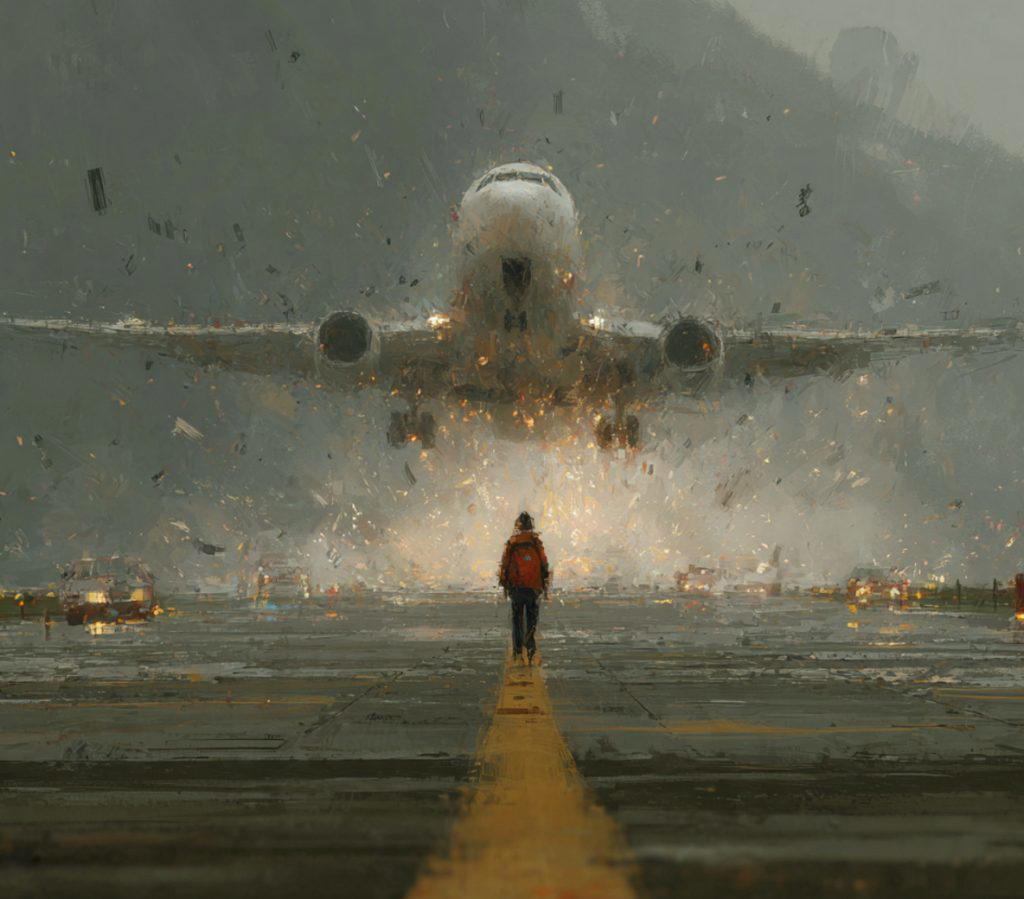
At 11:19 pm on a Friday night that should have ended like any other in the American Midwest, the calculus of modern aviation collided with the oldest vulnerability of the human condition: the fragility of a single life in the path of overwhelming force. Denver International Airport, that vast cathedral of glass and steel perched on the high plains of Colorado, had already processed hundreds of departures that day, its runways humming with the routine precision that makes commercial flight the safest mode of travel in human history. But routine is a deceptive mask, and beneath it, on runway 17L, something unimaginable was about to fracture the night. Frontier Flight 4345, an Airbus A321 bound for Los Angeles International Airport with 224 passengers and seven crew members aboard, had begun its takeoff roll when the impossible became real: a pedestrian was walking across the runway, invisible to the pilots until the moment of impact, a split-second horror that no simulator trains for and no manual can adequately address. The aircraft was traveling at a speed that made evasion impossible, its mass and momentum transforming the runway from a corridor of departure into a killing ground where the physics of collision allowed no mercy. As reported by Vanguard News, the flight aborted its takeoff in a violent scramble of thrust reversers and braking systems, but not before the aircraft struck the individual, whose body was, according to ABC News and an unidentified official, at least partially consumed by one of the roaring engines, a detail so gruesome that it seemed borrowed from a nightmare rather than an incident report from one of America's busiest airports.
The engine fire that followed, though brief, illuminated the tarmac with an orange glow that witnesses would later describe as surreal, a campfire brightness in the middle of an industrial landscape dedicated to human movement. The pilot's voice, captured in audio from ATC.com and reproduced across Nigerian newspapers from Punch to Blueprint, crackled across the frequencies with a stunned disbelief that transcended professional composure: "We're stopping on the runway, we just hit somebody, we have an engine fire... There was an individual walking across the runway." In those twenty-three words, the boundary between the controlled universe of commercial aviation and the chaos of human tragedy dissolved entirely, leaving two hundred and thirty-one survivors to carry the weight of a night that began with the ordinary promise of a flight to California and ended in the kind of horror that redefines the meaning of travel itself.
The Engine's Maw: Machinery, Fire, and the Anatomy of Catastrophe
The physics of what happened next unfolded with terrible speed, a cascade of mechanical and human responses that revealed both the extraordinary resilience and the horrifying limits of modern aircraft design. According to the airport's official statement, reported by Vanguard News, there was a brief engine fire that erupted in the aftermath of the strike, a tongue of flame licking at the night sky that was promptly extinguished by the Denver Fire Department, whose crews arrived with the practiced efficiency of professionals who had trained for this moment even as they prayed never to face it. But the fire was only the most visible symptom of a deeper trauma: inside the cabin, smoke began to infiltrate the pressurized environment, triggering the pilots' decision to abort the takeoff and initiating an emergency evacuation that Frontier Airlines later described in a statement as a precautionary measure, with passengers sliding down inflatable chutes into the cool Colorado air while emergency vehicles swarmed the tarmac like antibodies rushing to a wound. The smoke, though quickly contained, represented a secondary threat that could have turned catastrophic had the Airbus A321's fire suppression systems failed or had the pilots hesitated even a fraction of a second longer than they did.
Punch Nigeria reported that at least one passenger suffered minor injuries in the chaos, a statistical footnote that belied the psychological scars carried by all 231 souls who had boarded expecting a routine flight to Los Angeles and instead found themselves participants in a tragedy they would replay in their minds for years to come. Aviation analysts consulted by industry observers noted that the aircraft's engine ingestion of a human body would have caused catastrophic compressor damage, potentially sending debris through the turbine blades in a manner that could have led to uncontained engine failure had the pilots not reacted with the split-second decisiveness that their training demanded. The damage to the engine would have been instantaneous and irreversible, a mechanical trauma that no maintenance protocol could have anticipated or prevented. The aircraft, valued at approximately $110 million and capable of carrying passengers across the continental United States in comfort, had become, in an instant, an instrument of death on a runway where speed and safety are supposed to exist in perfect equilibrium. And as the passengers sat on the bus to the terminal, their luggage still locked in the hold and their vacation plans in ruins, the full weight of their narrow escape began to settle upon them like a second atmosphere, heavier than the air at altitude and far more difficult to breathe.
The Uninvited Shadow: Security, Surveillance, and the Runway's Vulnerable Perimeter
How a pedestrian came to be walking across an active runway at one of America's largest airports remains the central mystery that investigators from the National Transportation Safety Board must unravel, a question that touches not only on the specific failures of a single night but on the broader architecture of airport security in an age of hyper-vigilance. As Vanguard News reported, the NTSB has been notified and runway 17L will remain closed during the investigation, a shutdown that will ripple through Denver International Airport's schedule with the economic force of a minor earthquake, disrupting hundreds of flights and costing airlines millions in rerouting, delays, and missed connections at a hub that serves as a critical node in the North American aviation network. The daily throughput of Denver International Airport, which handles more than sixty million passengers annually, means that every hour of closure translates into cascading disruptions that reach from cargo shipments in Memphis to connecting passengers in Tokyo, a global interconnectedness that makes local accidents universally expensive. Security experts familiar with airport perimeter protocols point out that Denver International Airport spans fifty-two square miles, making it the largest commercial airport in North America by land area, a vastness that creates natural blind spots in surveillance coverage despite the millions of dollars invested in motion sensors, thermal cameras, and perimeter fencing designed to prevent exactly the kind of breach that occurred here.
The fact that someone not only penetrated these defenses but reached an active runway during a live takeoff operation suggests either a catastrophic failure of technology, a breakdown in human monitoring, or a scenario so anomalous that existing protocols simply had no answer for it, according to safety consultants who spoke on condition of anonymity because they were not authorized to discuss an active investigation. Frontier Airlines, for its part, issued a statement reproduced by multiple Nigerian outlets including Blueprint Newspapers, expressing that they were "deeply saddened by this event" and pledging to coordinate with airport authorities and safety regulators, language that, while sincere, cannot begin to address the chasm between corporate responsibility and the irreversible loss of a human life. The incident also raises uncomfortable questions about the privatization of airport security functions and the relentless pressure on airlines to maintain schedules that can sometimes compromise the margins of safety, margins that exist precisely for nights like this one when the system faces a test it was never designed to pass. And beneath all the regulatory language and investigative protocols lies a simpler, more haunting truth: somewhere in the hours before 11:19 pm, a person made a decision, or a series of decisions, that led them onto a runway in the path of an accelerating jet, a chain of choices that may never be fully understood but whose consequence is now permanently inscribed in the history of American aviation.
The Atlantic Mirror: How a Denver Tragedy Echoed in Nigerian Headlines
There is a peculiar intimacy to global tragedy in the digital age, a phenomenon wherein an event occurring at 11:19 pm on a Friday in Colorado can dominate front pages in Lagos, Abuja, and Port Harcourt by dawn, translated through the wire services and social media algorithms that compress distance and time into a single shared moment of horror. Nigerian newspapers, from the established mastheads of Punch and Vanguard to the digital pages of Blueprint, gave prominent coverage to the Denver incident, their headlines stripped of embellishment yet heavy with the weight of recognition: "Plane hits pedestrian during takeoff at Denver airport," read Punch Nigeria's stark dispatch, while Vanguard News ran the image of the Airbus A321 alongside the alt-text "Breaking: Plane hits pedestrian during takeoff," a framing that placed the Nigerian reader in the position of witness to an American catastrophe. The prominence of the story in Nigerian media reflects something deeper than mere newsworthiness; it speaks to a global citizenry that understands, instinctively, that the vulnerabilities exposed in Denver are not exclusive to the United States, that runways in Lagos and Abuja face their own challenges with perimeter security, unauthorized access, and the delicate balance between operational efficiency and human safety. Aviation economists note that incidents of this magnitude carry ripple effects across the global industry, influencing insurance premiums, security technology procurement, and regulatory harmonization between the Federal Aviation Administration and its counterparts at the Nigerian Civil Aviation Authority, where officials monitor American accident investigations with the understanding that findings in Denver often become mandates in Murtala Muhammed International Airport within months.
The economic calculus is relentless: a single fatal incident can raise global insurance premiums by three to five percent, costs that are ultimately passed to passengers through higher ticket prices, creating a hidden tax on air travel that funds the aftermath of tragedy. The social dimension of the tragedy also transcended borders, as Nigerian social media users reacted with the same visceral shock as their American counterparts, sharing the ATC audio and expressing disbelief that someone could simply walk onto a runway at a major international airport, a disbelief that masked a deeper anxiety about the fragility of the systems that modern life depends upon. In the comment sections of Vanguard News and the social feeds of Nigerian aviation enthusiasts, the conversation quickly shifted from sympathy to analysis, from mourning to scrutiny, as citizens in a nation with its own complex aviation history grappled with the universality of risk. And in that transatlantic dialogue, the cultural boundaries between witness and victim, between observer and participant, dissolved into a shared recognition that the runways of the world are connected by more than flight paths; they are linked by the common vulnerability of the human beings who walk, work, and fly upon them.
The Voice in the Static: Technology, Communication, and the Documentation of Disaster
In an era when every significant event leaves a digital trail, the Denver incident was preserved with haunting immediacy through the very technologies designed to prevent it, creating a paradoxical record in which surveillance and communication systems captured the tragedy even as they failed to avert it. The pilot's transmission to air traffic controllers, archived on ATC.com and circulated globally within hours, provided a raw, unscripted narrative that no press release could match, the crackling audio carrying not just information but the human tremor of a professional confronting the unimaginable, a moment when thousands of hours of training collide with a reality that no curriculum anticipates. According to the airport's statement on X, emergency crews responded to the scene and bussed passengers to the terminal, a logistical operation that unfolded with mechanical precision despite the emotional chaos of the situation, the airport's social media presence functioning simultaneously as a public information tool and a real-time chronicle of institutional response. The platform formerly known as Twitter has become, in moments of crisis, the de facto official channel for institutions worldwide, a technological shift that has fundamentally altered how emergencies are communicated and consumed by global audiences who demand immediate transparency. The technological dimensions of the investigation will likely focus on the Airbus A321's engine monitoring systems, which should have recorded vibration data, temperature spikes, and compressor stall events in the seconds following the strike, providing engineers with a forensic map of mechanical failure that will be studied by manufacturers, regulators, and rival airlines for years.
Frontier Airlines told AFP, as reported by Vanguard News, that the aircraft was departing for Los Angeles when the incident occurred, a detail that seems mundane until one considers the counterfactual: had the takeoff been delayed by thirty seconds, had the pedestrian walked a different path, had the tower spotted the figure on thermal imaging, the Airbus would be cruising at thirty-five thousand feet and the passengers would be watching movies above the clouds rather than sliding down evacuation chutes in the Colorado night. The randomness encoded in that near-miss is what haunts the technological imagination, a reminder that for all the sensors, algorithms, and protocols that define modern aviation, the system remains vulnerable to the single variable it cannot control: a human being, alone, walking in the wrong place at the worst possible moment. And as investigators download the flight data recorder and analyze the cockpit voice recordings, they will be searching not just for what went wrong but for the technological gaps that allowed the wrong to happen, gaps that may exist in airports from Denver to Dubai, from Lagos to London, waiting for the next confluence of human error and mechanical power.
Future Implications: Reckoning or Repetition on the Runways of Tomorrow?
As the NTSB begins its methodical investigation and runway 17L remains closed to the thousands of flights that would normally trace its asphalt path into the western sky, the aviation industry faces a choice that it has confronted before and will confront again: whether to treat this incident as an unrepeatable anomaly or as a warning that demands systemic transformation. History suggests that the latter path is never guaranteed; the airline industry has a tendency to absorb tragedy into its operational memory, implementing targeted fixes while resisting the fundamental redesigns that might prevent the next catastrophe but would also slow the relentless pace of departures and arrivals that define twenty-first-century mobility. The tension between safety and speed is not new, but it is intensifying as global air traffic is projected to double by 2040, placing unprecedented strain on infrastructure that was designed for a different era of travel. Experts in aviation safety warn that runway incursions, the technical term for unauthorized presence on active runways, have been increasing globally, with the International Air Transport Association documenting a twelve-percent rise in reported incidents between 2023 and 2025, a trend that suggests the problem is not isolated to Denver but is a symptom of expanding airport footprints, increased traffic density, and security protocols that have not kept pace with the complexity of modern aviation ecosystems.
The economic implications are equally stark: a single runway closure at a hub airport can cost the regional economy upwards of $10 million per day in direct and indirect losses, creating pressure to reopen facilities before investigations are complete, a tension between safety and commerce that has haunted the industry since its earliest days. For the 224 passengers and seven crew members of Frontier Flight 4345, the future will be measured not in industry reforms but in the private reckonings of trauma, the sudden noises that trigger memory, the moments when the mundane act of boarding a plane becomes an act of courage. And for the family of the pedestrian, whose name has not yet been released and whose final moments were consumed by an engine roaring with the power of seventy thousand pounds of thrust, there will be no future at all, only the enduring question of how a solitary figure could walk, unnoticed, into the path of a machine that was never supposed to be a killer. The answer, when it comes, will be written in reports and regulations, in revised perimeter protocols and enhanced surveillance budgets, but it will not bring back the dead, and that, ultimately, is the measure by which every runway, every protocol, and every promise of safety must be judged.
The night of May 9th will pass into the statistical annals of aviation, another data point in the endless effort to make the sky safe, but for those who were there, who heard the impact and smelled the smoke and felt the slide beneath their feet, it will remain a permanent boundary in their lives, the night before which everything was ordinary and after which nothing ever could be again.
0 Comments
Sign in to commentNo comments yet. Be the first to share your thoughts!