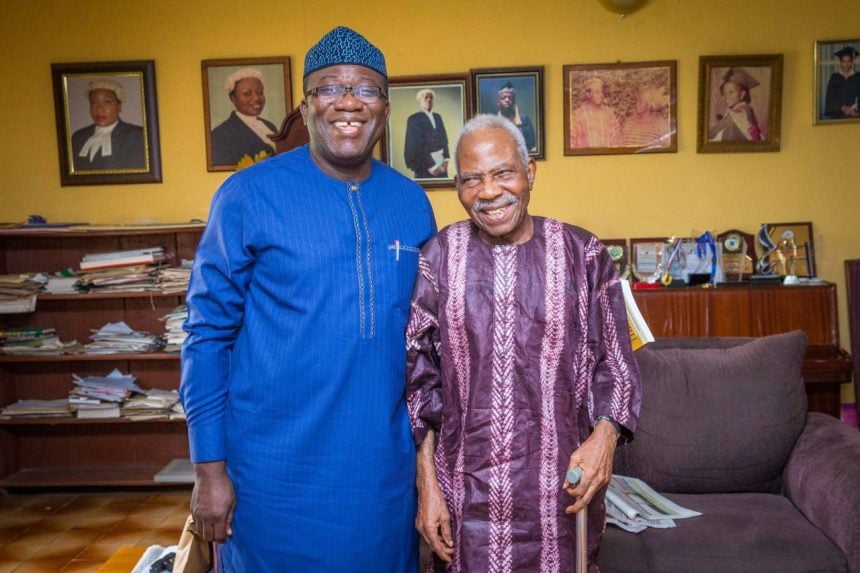
The Omolere Gathering: Power, Protocol, and the Politics of Presence
On a Monday morning when the tropical sun hung high over the red-earth streets of Akure, the ancient capital of Ondo State surrendered its rhythms to a single, stately purpose. Along the modest corridor of Omolere Nursery and Primary School, where the laughter of children usually marks the hours, a different kind of congregation gathered—one defined not by youth but by the weight of years, not by innocence but by the hard-earned wisdom of survival. It was the 11th of May 2026, and Pa Reuben Famuyide Fasoranti, national leader of the Pan-Yoruba socio-political group Afenifere, elder statesman, democracy activist, and living witness to nearly every chapter of Nigeria's turbulent history, had reached the summit of a century. From the marble halls of Abuja to the palaces of Ile-Ife, from the governor's mansions of Lagos and Abeokuta to the humblest homesteads of the Ekiti hills, they came: Vice President Kashim Shettima leading a high-powered federal delegation on behalf of President Bola Ahmed Tinubu; governors Lucky Aiyedatiwa of Ondo, Dapo Abiodun of Ogun, and a host of traditional rulers including the Ooni of Ife, represented by Olori Aderonke Ademiluyi-Ogunwusi, the Olowo of Owo, the Deji of Akure, and the Osemawe of Ondo. The atmosphere, as THISDAY reported, was one of profound reverence, a temporary suspension of partisan rivalries in favour of a collective genuflection before a man who has become, in the words of The Guardian Nigeria News, an "enduring voice for Nigeria's unity" and a "beacon of integrity" in an age of spectacular moral collapse.
The Political Calculus of a Centenary: Zoning, Unity, and the Unfinished Business of Federalism
To understand the political gravity of Fasoranti's centenary is to grasp the intricate choreography of power in contemporary Nigeria, where the personal and the geopolitical are inseparably entwined. As reported by Channels Television, President Tinubu—who has himself navigated the treacherous waters of Afenifere politics from his days as a Lagos governor to the apex of national leadership—chose not to attend in person but dispatched his vice president, a gesture that spoke volumes about the symbolic capital Fasoranti still commands in the calculations of the ruling class. Tinubu's message, relayed through Shettima and echoed in Punch Nigeria's account, described the centenarian as a "moral compass" whose life symbolises "courage, sacrifice and principled commitment to public service," language that strategically aligned the presidency with the elder's legacy while subtly asserting the continuity of Yoruba political pre-eminence. Yet the presence of former Ondo Governor Olusegun Mimiko, a figure from the opposition orbit, alongside Governor Abiodun of the ruling All Progressives Congress, suggested something more nuanced than mere partisan theatre; it hinted at a broader consensus across the ideological spectrum that Fasoranti represents a vanishing breed of Nigerian leadership, one untainted by the transactional cynicism that has come to define the country's democratic culture. According to The Nation Newspaper, the gathering was as much about "the Yoruba nation and the challenge of unity" as it was about birthday candles, raising the implicit question of whether Fasoranti's moral authority can still serve as a binding agent for a people increasingly fragmented by class, religion, and generational disillusionment.
The Long Arc: From Colonial Subject to National Patriarch
Fasoranti's biography is, in essence, the biography of modern Nigeria itself, a parallel narrative of hope, betrayal, resilience, and stubborn idealism that stretches from the twilight of British colonial rule to the precarious present. As Vice President Shettima noted in his remarks, reported by Vanguard News and THISDAY, the elder's lifetime spans "Nigeria's colonial era, independence, military rule, interrupted democratic transitions, and the present constitutional order," a sweeping arc that few living Nigerians can claim. Born into a world where his people were subjects of a distant empire, Fasoranti came of age during the heady optimism of the 1960s independence movement, endured the trauma of civil war and the long winter of military dictatorship, and emerged in the Fourth Republic as both a guardian of Afenifere's progressive ethos and a vocal critic of governance failures. Kayode Fayemi, the former Ekiti governor who penned a deeply personal tribute in Vanguard News, recalled how Fasoranti served as "a father figure, teacher, mentor, counselor, and moral compass," anchoring younger leaders through moments of "political uncertainty and national turbulence." This intergenerational transmission of values is the cultural sinew of Yoruba political life, where age is not merely a biological category but a metaphysical office, and where the opinions of elders like the Olowo of Owo and the Deji of Akure—both of whom graced the Omolere residence—carry weight not because of electoral mandates but because of their presumed proximity to ancestral wisdom.
In this cosmology, Fasoranti's hundred years are not simply a personal triumph but a collective inheritance, a reminder that the community's memory resides in the bodies of its oldest citizens.
The Technological and Informational Battlefield: Media, Memory, and the Making of a Living Legend
Beyond the choreography of chiefs and the poetry of eulogies, the centenary exposed the fault lines of a society grappling with the tension between tradition and the dizzying velocity of modernity. While traditional rulers and politicians exchanged pleasantries in Akure, the digital sphere was already metabolising the event, with Premium Times Nigeria reporting a security beef-up across the city ahead of the vice president's arrival, a reminder that even celebrations of national unity unfold under the shadow of contemporary threats. The presence of Google News aggregators, the instantaneous translation of physical homage into digital tribute—exemplified by TheCable's headline calling Fasoranti a "towering symbol of integrity"—demonstrates how the architecture of Nigerian public life has been fundamentally altered by information technology, compressing distance and collapsing the boundary between local ceremony and global audience. Yet this technological mediation also carries risks; as one Lagos-based media analyst noted, the saturation of social media with encomiums can flatten the complex political history of Afenifere into a series of viral soundbites, stripping away the movement's radical edges and its historical commitment to federalism, free education, and welfarist economic policies. For the younger generation, whose primary encounter with Fasoranti may come through compressed video clips and Twitter threads rather than the oral traditions of town hall meetings, the challenge is to see beyond the hagiography and engage with the substantive ideological battles that defined the elder's long career.
Governor Aiyedatiwa's challenge to the youth—to emulate Fasoranti's "discipline, truthfulness, and selfless service"—thus lands in a cultural environment where the mediums of transmission may be undermining the very message they carry.
The Economic Backdrop: Patronage, Regional Capital, and the Political Economy of Homage
The economic undertones of the Akure gathering, though less visible than the political theatre, were nonetheless unmistakable, embedded in the material logistics of hosting a national icon and the implicit economic geography of Yoruba political power. The deployment of federal security assets, the temporary conversion of a residential neighbourhood into a high-security zone, and the influx of dignitaries from across the country represented a significant injection of capital into the local economy, however fleeting—a phenomenon that one Abuja-based political economist described as the "patronage tourism" that accompanies any major gathering involving the Nigerian elite. More structurally, the celebration underscored the enduring economic centrality of the South-West, a region that serves as the country's financial and technological hub and generates a disproportionate share of national wealth, yet whose political leaders continue to leverage cultural events like Fasoranti's centenary to reinforce their claim to national leadership. The presence of Ogun State Governor Dapo Abiodun, who described the occasion as a "privilege" for his state, and the representation of the Ooni of Ife, the spiritual head of the Yoruba people, highlighted the symbiotic relationship between economic investment and cultural capital in the region's political calculus. For Afenifere itself, an organisation that has historically championed welfarist economic policies and the empowerment of the agrarian masses, the centenary offered an opportunity to reassert its relevance in a Nigeria where market reforms have widened inequality and left millions of Yoruba youth unemployed.
Whether the organisation can translate the moral authority of its centenarian leader into concrete economic advocacy for the region's poor remains one of the most pressing questions hanging over the festivities.
Tomorrow's Ancestors: Between Institutional Memory and the Coming Vacuum
As the final guests departed Omolere and the security barricades were dismantled, the question that lingered in the humid evening air was not whether Reuben Fasoranti deserves the accolades—his century of service has earned him that—but whether the Nigeria he fought to build can survive his eventual passing. The Guardian Nigeria News, in its report on the UNIMED Vice Chancellor's tribute, framed Fasoranti as a "beacon of integrity," a phrase that now serves as both tribute and taunt in a political landscape where integrity is treated as an endangered species. Analysts across Lagos and Ibadan suggest that the centenary may mark a tipping point for Afenifere, forcing the organisation to either rejuvenate itself with younger leadership capable of addressing twenty-first-century challenges—climate change, youth unemployment, digital governance—or risk becoming a historical society devoted to the memory of its departed giants. President Tinubu's alignment with Fasoranti's legacy, while politically expedient, also places a burden of proof on his administration to deliver the "unity" and "citizens' rights" that the elder has long championed, particularly as the 2027 electoral cycle begins to cast its long shadow. For the Yoruba people, whose demographic and economic weight ensures they will remain kingmakers in Nigerian politics, the centenary is a mirror reflecting both their collective achievements and their unresolved contradictions: a people capable of producing world-class intellectuals and entrepreneurs, yet still struggling to translate cultural cohesion into regional prosperity.
If Fasoranti's hundred years have taught anything, it is that the arc of Nigerian history bends only when conscience and power find common cause; the tragedy, his admirers fear, is that such moments of convergence are becoming ever more rare.
📰 Sources Cited
- THISDAY: Tinubu, Aiyedatiwa, Abiodun, Mimiko, Others Celebrate Pa Fasoranti at 100
- Punch Nigeria: Tinubu, govs eulogise Fasoranti at 100
- Vanguard News: Tribute to Chief Reuben Famuyide Fasoranti on his centenary celebration
- Google News Nigeria: ‘A towering symbol of integrity’ — Fayemi pays tribute to Reuben Fasoranti at 100 - TheCable
- Channels TV: Tinubu, Aiyedatiwa, Mimiko, Others Eulogise Pa Fasoranti At 100
- Google News Nigeria: Tinubu hails Pa Fasoranti as enduring voice for Nigeria’s unity, citizens’ rights - The Guardian Nigeria News
- Google News Nigeria: UNIMED VC hails Afenifere leader Fasoranti as ‘beacon of integrity’ at 100 - The Guardian Nigeria News
- Google News Nigeria: Tribute to Chief Reuben Famuyide Fasoranti on his centenary celebration - Vanguard News
- Google News Nigeria: Tinubu, Aiyedatiwa, Abiodun, Mimiko, Others Celebrate Pa Fasoranti at 100 - THISDAYLIVE
0 Comments
Sign in to commentNo comments yet. Be the first to share your thoughts!