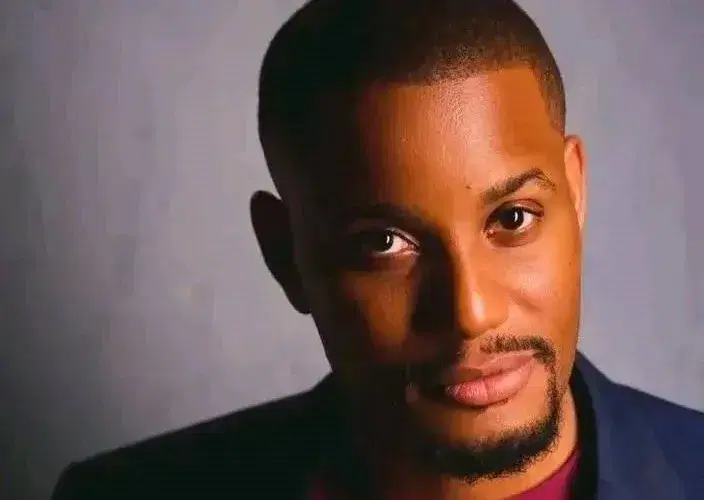
The fluorescent lights of Evercare Hospital in Lekki, Lagos, burned with the sterile indifference of modern medicine, offering no comfort to the man who had spent his career illuminating screens across a continent. It was here, in the early hours of a Monday night, that Alex Ekubo—born on April 10, 1986, in the oil-soaked city of Port Harcourt and raised in the shadow of Arochukwu's ancient hills—drew his final breath, succumbing at forty to an enemy he had fought in the lonely corridors of secrecy for over a year. Across the megacity of Lagos, where the humid air already hung heavy with the political tensions of an election cycle that never truly ends, the news arrived like a sudden power outage in a crowded theater, plunging Nigeria's entertainment industry into a darkness that felt both immediate and impossible to process. Within hours, as Vanguard News would report through the anguished testimony of colleagues, the digital landscape became a cascade of grief: Funke Akindele wept publicly for the friend who called her Ore mi; Mo Abudu mourned the son who called her Mum; Kate Henshaw recalled a kindness she could never now repay. The actor, who in 2020 had been named by the United Nations as one of the Most Influential People of African Descent under forty, who stood tall with a charisma that seemed to bend the camera toward him, had vanished not in a dramatic climax but in the quiet surrender of a body finally overwhelmed by stage four liver cancer.
For an industry that manufactures illusion for a living, the reality proved too brutal to script. As the sun rose over Lagos on Tuesday, Nollywood found itself confronting not merely the absence of one of its most recognizable faces, but the uncomfortable question of how a man so universally adored could have suffered so completely unseen. Political analysts and cultural observers alike have noted that Ekubo's death represents more than a personal tragedy; it marks a watershed moment in which Nigeria's most vibrant creative sector must reckon with the human cost of its own relentless production machine.
The Anatomy of a Star: Charisma, Arochukwu, and the Architecture of Belonging
To understand the seismic nature of this loss, one must first understand the architecture of the man himself, a figure who seemed to have been constructed by some divine casting director with an eye for the exact proportions of modern Nigerian stardom. As chronicled by Vanguard News, Lancelot Imasuen, the veteran filmmaker who gave Ekubo his first movie role, recalled meeting the young man as a neighbor in Surulere, where every Saturday, while still in school, Ekubo would visit film locations with the quiet persistence of someone who understood that destiny required not just talent but tenacity. That tenacity paid dividends over the past decade, as Ekubo grew into one of Nollywood's most recognizable faces, his height and screen presence making him a natural leading man in an industry that has become Nigeria's second-largest employer and one of its most potent cultural exports, generating billions of naira annually and projecting Nigerian stories to audiences from Accra to Atlanta. Born in Port Harcourt to parents from Arochukwu in Abia State, Ekubo embodied a particular kind of cosmopolitan Nigerian identity—rooted in the Igbo highlands but fluent in the polyglot culture of Lagos, comfortable in traditional attire and modern suits alike, a bridge between the village and the metropolis that resonated deeply with a generation navigating similar transitions.
His United Nations recognition in 2020 as one of the Most Influential People of African Descent under forty was not merely a personal accolade but a validation of Nollywood's growing soft power, an acknowledgment that the faces on Nigerian screens were shaping global perceptions of African creativity and competence. Yet for all his public grandeur, those who knew him best remembered a man of uncommon kindness, as Mo Abudu, Chief Executive Officer of the EbonyLife Group, attested when she recalled his habit of calling her Mum and his reputation for being loving, real, and always respectful. Kate Henshaw, in her own anguished tribute, remembered how Ekubo had stood by her during the passing of her mother, offering a support system that now left her haunted by the impossibility of reciprocation. It is this duality—the public god and the private friend—that has made his absence feel less like the end of a career and more like the extinguishing of a communal hearth around which an entire industry had gathered for warmth.
The Secret Battle: Stage Four, Silence, and the Geography of Private Pain
But the warmth of that hearth concealed a private inferno that Ekubo had chosen, or perhaps been compelled, to endure in almost total silence, a decision that now casts a long shadow over how Nigeria's celebrity culture conceals vulnerability behind the armor of perpetual performance. According to filmmaker Stanley Ontop, who revealed the details in a now-trending Instagram post on Tuesday evening, Ekubo had been secretly battling stage four liver cancer since 2024, a diagnosis that arrived like a death sentence whispered in a country where healthcare infrastructure remains woefully inadequate and where even the affluent often find themselves at the mercy of medical systems that function better as symbols than as services. The actor underwent a liver transplant and, in a testament to his professional dedication that now reads as almost unbearably poignant, briefly returned to work before complications arose and the transplanted organ failed again, his condition deteriorating until his passing at Evercare Hospital after hours on life support. As Daily Post Nigeria reported, Ekubo had been largely absent from public view and social media since December 2024, a withdrawal that coincided with the end of his engagement and that colleagues like Yvonne Jegede now recognize, with the cruel clarity of hindsight, as the silhouette of a man preparing for his own departure.
Jegede recalled that whenever she checked on him, Ekubo repeatedly assured her he was fine, a small act of consideration that now breaks the hearts of those who realize he was shielding them from the full weight of his prognosis. Ruth Kadiri, another colleague, admitted she had feared this day despite making regular efforts to check on him, suggesting that within the tight-knit ecosystem of Nollywood, there were tremors of concern that never quite crystallized into collective action. The social dimension of this tragedy cannot be overstated, because in Nigerian society, illness—particularly terminal illness—carries a stigma that encourages concealment, and for a leading man whose brand depended on vitality, the pressure to maintain the illusion of invincibility may have been medically catastrophic. Cultural anthropologists studying West African performance traditions note that the mask is never just a prop but a sacred obligation, and Ekubo's decision to wear the mask of wellness until the final curtain speaks to a cultural script that demands strength even at the cost of survival.
The Political Weight of Grief: Obi, Sowore, and the Politician's Elegy
In a nation where the boundaries between entertainment and politics have always been permeable, the mourning of Alex Ekubo assumed a political gravitas that transcended the usual condolences, turning a private tragedy into a public reckoning about value, visibility, and the currency of national grief. Peter Obi, the former governor of Anambra State and Labour Party presidential candidate, did not merely offer a standard tribute when he expressed sadness over the actor's death; he framed it explicitly as a painful loss for the Nigerian entertainment industry and his fans, language that elevated Ekubo from celebrity to national asset and implicitly critiqued a political establishment that often fails to protect its most luminous human capital. Omoyele Sowore, the human rights activist and politician, went further, describing Ekubo as a rare talent and recalling a film performance that left a lasting impression, a statement that carried the weight of someone who understands that culture is politics by other means and that the loss of a storyteller is tantamount to the loss of a historical archive. Their interventions matter because Nollywood is not merely an entertainment complex but an economic and political force, employing over a million Nigerians directly and indirectly, contributing approximately 2.3 percent to the nation's GDP, and serving as one of the country's most effective tools of cultural diplomacy in an era when oil revenues fluctuate and global regard for Nigeria often hinges on its creative output rather than its governance.
When a figure like Obi—a man who built his political brand on empathy and systematic thinking—mourns an actor with the same rhetorical weight he brings to policy failures, he signals that Nigeria's brain drain and health crises are not abstractions but lived realities that claim the lives of the celebrated and the obscure alike. Political strategists in Abuja have observed that such high-profile deaths create rare moments of national unity, brief truces in the country's perpetual ethnic and partisan warfare, but they also expose the government's failure to invest in healthcare infrastructure that might have caught Ekubo's cancer before it reached its terminal stage. The economic calculus is equally stark: every premature death in Nollywood represents not just a personal loss but the erasure of intellectual property, brand value, and future earnings that could have employed hundreds of crew members, makeup artists, and location managers. In this light, the political mourning of Alex Ekubo becomes less an act of sentiment and more an accusation dressed in the language of elegy.
The Digital Dirge: Instagram, Information, and the New Rituals of Public Mourning
If the political class used Ekubo's death to make abstract arguments about governance, the technological ecosystem transformed it into an immediate, visceral experience for millions, demonstrating how social media has become both the funeral parlor and the town square for modern Nigerian grief. Within hours of Boma Akpore, the former BBNaija star and Director of Communication for the Actors Guild of Nigeria, confirming the news to Vanguard, Instagram and Twitter became digital wakes where colleagues, fans, and strangers gathered to light virtual candles and share memories that spanned the geography of his forty years. Funke Akindele, reacting via her Instagram handle as reported by Daily Post Nigeria, wrote with the raw immediacy of someone who had lost not a coworker but a brother, expressing regret that she had not managed to see him one last time despite her efforts, while Peter Okoye offered the stark, universal shorthand of the digital age: RIP. The speed of this technological mourning is itself a subject of analysis, because while it allowed for an unprecedented democratization of grief—permitting a fan in Kano to mourn alongside a star in Lagos within seconds—it also created the conditions for the very speculation that Stanley Ontop later urged the public to avoid when he asked Nigerians to refrain from spreading unverified claims about the actor's illness.
Media scholars at the University of Lagos note that the Nigerian digital public sphere operates on an economy of virality that rewards sensationalism over sensitivity, and that the pressure to post, trend, and monetize grief often overwhelms the quieter work of private mourning. Yet there is something undeniably powerful about this technological ritual, as evidenced by the way Omoni Oboli, who called Ekubo her bestie, used the platform to voice a devastation that felt communal, asking how she could possibly move forward without him and transforming a personal question into a public cry. Oseni Rufai, the broadcaster, joined the chorus with the brief elegy Rest well Alex, proving that in the attention economy of Nigerian social media, brevity can carry as much emotional weight as paragraph-long tributes. The informational architecture of this moment reveals a society in transition, caught between the old traditions of wake-keeping and the new rituals of trending topics, hashtag memorials, and screenshot eulogies that outlast the news cycle but rarely outlast the grief.
The Morning After: Legacy, Health, and the Unfinished Reckoning of Nollywood
As the digital tributes slow and the hashtags fade from Nigeria's trending lists, the void left by Alex Ekubo's passing will continue to expand in the quieter spaces where the industry actually operates: casting calls that will no longer feature his name, film sets that will feel his absence in the unclaimed chair, and an Abia-Arochukwu cultural axis that has lost one of its most glamorous ambassadors. The future implications of this death are both personal and systemic, beginning with the urgent need for Nigeria's creative industries to confront the healthcare crisis that claims their practitioners with disturbing regularity, a crisis that demands not merely individual health insurance schemes but collective bargaining power that can force both public and private sectors to invest in preventive care for the country's most visible workers. Nollywood, which produces over two thousand films annually and competes globally with Bollywood and Hollywood in raw output if not yet in budgets, cannot afford to treat its stars as disposable inputs in an entertainment machine that grinds forward regardless of who falls beneath its wheels. Industry analysts predict that Ekubo's death may catalyze a long-overdue conversation about mental health, regular medical check-ups, and the toxic culture of silence that surrounds illness in an industry where youth and vitality are the primary currencies of employment.
There is also the question of legacy, for Ekubo leaves behind not merely a filmography but a template for the modern Nigerian male lead—tall, cosmopolitan, culturally grounded, and unfailingly kind—that will influence casting decisions and aspirational narratives for years to come. His United Nations recognition in 2020 now reads as a prophecy fulfilled too soon, a reminder that influence is not insulation and that even the most celebrated lives can be cut short by systems that fail to value prevention as much as they value profit. For the politicians who mourned him, the challenge is to transform the language of elegy into the architecture of policy, to build the hospitals and fund the research that might spare the next generation of Ekubos from similar fates. And for the friends who called him Ore mi, bestie, and son, the future is simply the impossible arithmetic of learning to measure time in the before and after of a loss that feels, in the words of Richard Mofe-Damijo, like a life well lived but ended far too soon. In the end, the true measure of Alex Ekubo's impact will not be found in the films he made but in the silence he leaves behind, a silence that asks Nigeria whether it is finally ready to care for those who have spent their lives making the nation feel seen.
📰 Sources Cited
- Punch Nigeria: Peter Obi mourns Alexx Ekubo, says death painful loss to industry
- Vanguard News: Fresh details emerge on Alexx Ekubo’s death as colleagues, friends mourn
- Daily Post Nigeria: Real cause of Alex Ekubo’s death revealed
- Daily Post Nigeria: Funke Akindele reacts to death of Nollywood actor, Alex Ekubo
0 Comments
Sign in to commentNo comments yet. Be the first to share your thoughts!