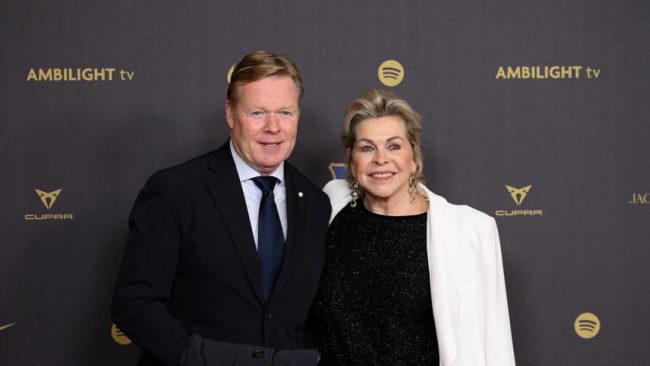
The news arrived not with the roar of a packed Camp Nou but with the quiet tremor of an Instagram post, a digital epitaph that slipped into the feeds of millions just as the sun dipped behind the Dutch skyline on a Wednesday evening. Ronald Koeman, the former Barcelona and Netherlands manager whose name once echoed through the corridors of European football, broke the silence with a heartfelt tribute that painted his wife Bartina as the “beautiful wife” and the family’s “dearest mother and grandmother,” a phrase that carried both the weight of grief and the warmth of a lifelong partnership. According to TVC News, the announcement came with an intensity of sadness tempered by pride, a duality that mirrored Koeman’s own career—marked by triumphs on the pitch and the steady, unseen support of a partner who stood beside him through managerial storms and personal battles. Complete Sports revealed that Bartina, aged 65, had succumbed to a relentless return of breast cancer, a disease she had first conquered over a decade ago only to see it resurface in 2024, a cruel reminder of how illness can rewrite even the most steadfast narratives. Punch Nigeria and Vanguard News echoed the same sorrowful note, noting that the Koeman family had asked for privacy as they gathered to mourn, a request that underscored the intimate nature of loss even for public figures whose lives are constantly scrutinized.
The Sun News Online added that Barcelona itself had issued a condolence message, declaring that “FC Barcelona and its supporters send their deepest condolences and affection to Ronald Koeman and his family for the passing of his wife, Bartina Koeman; may she rest in peace,” a gesture that linked the club’s storied past with the present sorrow of one of its former stewards. In the midst of this grief, the Netherlands national team also extended its sympathy, wishing Ronald, their grandchildren, and the wider family “a great deal of strength and support in the face of this great loss,” a collective embrace that highlighted how football, despite its competitive fervor, can become a conduit for communal empathy.
The Whisper of White Jerseys: Football's Grief Meets Personal Loss
Within the hallowed halls of football, where tactics are dissected and victories celebrated, the death of Bartina Koeman resonated as a reminder that behind every manager’s whistle lies a human story woven with love, sacrifice, and vulnerability. As reported by Vanguard News, Koeman’s managerial journey—spanning stints at Everton, Southampton, Ajax, and the Netherlands national team—had been defined by a relentless pursuit of excellence, yet the Instagram tribute revealed a softer side, describing Bartina as the family’s “dearest mother and grandmother,” a matriarch whose influence extended far beyond the touchline. The Dutch football community, known for its stoic pragmatism, responded with an outpouring of solidarity; the Netherlands national team’s message, cited by multiple outlets, emphasized not only condolences but also a wish for strength for Koeman’s children and grandchildren, underscoring the intergenerational bonds that sustain families amid public scrutiny. This collective mourning was not merely ceremonial; it reflected a deeper cultural shift within sport, where the personal lives of athletes and coaches are increasingly acknowledged as integral to the narrative of the game itself. Analysts of football sociology note that such moments humanize the often‑mythologized figures of managers, allowing fans to see them not just as tacticians but as husbands, fathers, and grievers navigating the same emotional terrain as anyone else.
The outpouring also highlighted the role of social media as a modern mourning platform, where a single post can condense decades of shared history into a few poignant lines that travel instantly across continents, transforming private sorrow into a shared, global experience.
The Pink Ribbon Playbook: Cancer, Resilience, and the Dutch Diaspora
Bartina Koeman’s battle with breast cancer, which had first been diagnosed over ten years prior and initially defeated, became a silent subplot to her husband’s high‑profile career, a subplot that resurfaced with devastating clarity in 2024 when the disease returned, ultimately claiming her life at the age of sixty‑five. According to Complete Sports, the revelation that Bartina had beaten the illness only to face its resurgence added a layer of poignancy to her story, echoing the experiences of countless women worldwide who confront the unpredictable nature of oncological relapse. The Dutch public health landscape, often lauded for its robust screening programs and high survival rates—statistics from regional health agencies indicate that the five‑year survival rate for breast cancer in the Netherlands exceeds eighty‑percent—nonetheless confronts the harsh reality that recurrence can overturn even the most optimistic prognoses. In the wake of her passing, commentators from various media outlets have begun to reframe Bartina’s struggle as an inadvertent advocacy campaign, suggesting that her visibility as the wife of a celebrated football figure could amplify awareness about the importance of continual vigilance, early detection, and support systems for those facing recurrent disease. This narrative aligns with broader cultural movements in Europe, where sports personalities frequently lend their platforms to health causes, turning personal tragedy into public pedagogy.
Moreover, the Koeman family’s request for privacy, while understandable, also sparked conversations about the balance between public interest and personal grief, a tension that is especially acute in an era where every Instagram story can be dissected, shared, and memorialized by millions within minutes.
The Digital Mourning: Instagram, Condolences, and the Modern Football Fan
The manner in which Ronald Koeman chose to announce Bartina’s death—through an Instagram post replete with tender descriptors and a link to a longer tribute—exemplifies how contemporary grief is increasingly mediated through digital channels, transforming the traditional obituary into an interactive, globally accessible memorial. TVC News highlighted that the post was shared on a Wednesday, a timing that allowed it to capture the attention of both European and African audiences as news cycles overlapped, thereby amplifying its reach across continents. The accompanying image, featured prominently by Vanguard News, showed a candid portrait of Bartina, her smile capturing a lifetime of warmth that contrasted starkly with the solemnity of the caption. This visual element, coupled with Koeman’s words—“With intense sadness, but also with great pride and love, we say goodbye to my beautiful wife, our dearest mother and grandmother”—created a multimodal narrative that engaged readers on both emotional and aesthetic levels. The response from Barcelona and the Netherlands national team, as reported by Sun News Online and Punch Nigeria, arrived in the form of official statements that were themselves disseminated via the clubs’ websites and social media feeds, illustrating a feedback loop where personal expression triggers institutional acknowledgment, which in turn fuels further public commentary.
Scholars of digital communication observe that such events generate what can be termed “communal mourning threads,” where fans, journalists, and former players contribute memories, condolences, and anecdotes, thereby constructing a collective digital archive that preserves the deceased’s legacy beyond the ephemeral nature of a news cycle. Moreover, the incident underscores the growing expectation that public figures not only perform their professional duties but also navigate personal crises under the gaze of an ever‑watchful online audience, a reality that reshapes the boundaries between private life and public persona.
Future Implications: A Legacy Beyond the Touchline
Looking ahead, the passing of Bartina Koeman invites reflection on how the intertwining worlds of sport, health advocacy, and digital media might evolve to honor both personal loss and public inspiration. Football analysts suggest that Koeman’s managerial legacy—marked by his tenure at Barcelona from 2020 to 2021, his time with the Netherlands national team, and his stints at Everton, Southampton, and Ajax—will forever be viewed through the lens of this personal chapter, potentially influencing how future coaches balance professional ambition with familial responsibility. In the realm of health, Bartina’s story may catalyze renewed emphasis on breast cancer survivorship programs, particularly those that address the psychological toll of recurrence; experts in oncology note that narratives like hers can improve patient engagement with follow‑up care and encourage funding for research into preventing relapse. Culturally, the episode could reinforce a trend wherein sports institutions formalize support mechanisms for players’ and staff’s families, offering counseling, leave policies, and community networks that acknowledge the human dimension behind the jerseys. Technologically, the event highlights the power of platforms like Instagram to serve as modern-day memorials, prompting discussions about ethical guidelines for sharing grief online, the permanence of digital footprints, and the potential for AI‑driven sentiment analysis to gauge public mourning in real time.
Ultimately, Bartina Koeman’s life and death remind us that behind every tactical formation, every victory chant, and every transfer rumor lies a tapestry of relationships that shape, sustain, and sometimes break the individuals who give the sport its soul. As the football world continues to turn its gaze toward the next match, the echo of her presence will linger—a quiet, enduring reminder that the game’s greatest victories are often measured not in trophies, but in the love that endures beyond the final whistle.
📰 Sources Cited
- TVC News: Former Barcelona Coach Ronald Koeman Announces Death of Wife Bartina
- Complete Sports: Koeman’s Wife Dies After Battle With Breast Cancer
- Punch Nigeria: Ex-Barcelona coach Koeman’s wife dies
- Vanguard News: Ex-Barca coach Ronald Koeman announces death of wife
- Sun News Online: Former Barcelona boss Koeman announces wife Bartina’s death
0 Comments
Sign in to commentNo comments yet. Be the first to share your thoughts!