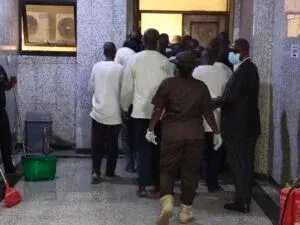
The imposing structure of the Federal High Court in Abuja stood tall and steadfast, its imposing façade a testament to the gravity of the proceedings that were about to unfold within its walls. As the Federal Government commenced another batch of mass trials for suspected terrorists facing terrorism-related charges, the atmosphere was electric with anticipation. Heavy security was deployed in and around Abuja's Central Business District, with all roads leading to the court blocked by armed security personnel, creating a sense of foreboding and unease. According to TVC News, the proceedings, which were moved from Kainji in Niger State to the nation's capital for logistical reasons, were expected to be a complex and challenging exercise. The trial, taking place in all the courtrooms in the FHC, was expected to last for several days, with some of the trial judges being Justices Binta Nyako, Emeka Nwite, Musa Liman, James Omotosho, Obiora Egwuatu, and Ekerete Akpan, among others. As reported by Vanguard News, the Federal Government began a mass trial of suspected terrorists charged with terrorism-related offences in Abuja on Monday, with the prosecution of the defendants being led by the Attorney-General of the Federation (AGF), Mr Lateef Fagbemi, SAN. The Director-General, Legal Aid Council, Mr Aliyu Abubakar, led the team of lawyers for the defence, highlighting the complexity and significance of the case.
The sheer number of suspects, over 400, as reported by Premium Times, was a staggering indication of the scale of the challenge facing the Nigerian justice system.
The Courtroom as a Battlefield: Security and Suspense
As the trial commenced, the courtroom was transformed into a veritable battlefield, with security personnel deployed in large numbers to ensure the smooth conduct of the proceedings. The air was thick with tension, as the suspects, many of whom were alleged to be members of terrorist organizations, were brought before the court. According to Channels TV, the Attorney General of the Federation and Minister of Justice, Lateef Fagbemi, was leading the prosecution, while the Director-General of the Legal Aid Council, Aliyu Abubakar, led the team of lawyers for the defence. The trial, which usually takes place in Kainji, Niger, was moved to the Abuja Division of the court, highlighting the government's determination to tackle the scourge of terrorism. As the proceedings got underway, the courtroom was filled with the sound of murmured conversations, as lawyers, security personnel, and court officials went about their duties. The atmosphere was one of heightened suspense, as the suspects, many of whom were alleged to have committed heinous crimes, faced the possibility of severe punishment. No fewer than 58 suspected terrorists were listed for trial on Monday before Justice Nwite, as reported by THISDAY, highlighting the complexity and scale of the challenge facing the court.
The Economic Backdrop: Terrorism and its Costs
The trial of the suspected terrorists comes against the backdrop of a country grappling with the economic and social costs of terrorism. The impact of terrorist activities on the Nigerian economy has been significant, with many businesses and individuals affected by the violence and instability. According to analysts, the cost of maintaining security in the country has been running into billions of naira, with significant resources being diverted from development projects to security-related expenditures. The trial, therefore, represents a crucial step in the government's efforts to tackle the scourge of terrorism and restore stability to the affected regions. As experts point out, the successful prosecution of the suspects will not only bring justice to the victims of terrorism but also serve as a deterrent to others who may be contemplating similar actions. The economic costs of terrorism are not limited to the direct impact of violence but also include the indirect costs of lost investment, reduced economic activity, and decreased economic growth.
The Cultural and Social Dimension: Identity, Faith, and the Grassroots
The trial of the suspected terrorists also raises important questions about the cultural and social dimensions of terrorism in Nigeria. Many of the suspects are alleged to have been motivated by extremist ideologies, which have been fueled by a complex mix of factors, including poverty, unemployment, and social exclusion. According to officials, the government's efforts to tackle terrorism must be accompanied by a deeper understanding of the root causes of the problem, including the role of identity, faith, and cultural narratives. The trial, therefore, represents an opportunity for the government to engage with the broader social and cultural context in which terrorism is taking place. As community leaders point out, the successful prosecution of the suspects will require a nuanced understanding of the complex social dynamics at play, including the role of traditional and religious leaders in shaping public opinion. The cultural and social dimensions of terrorism are critical to understanding the root causes of the problem and developing effective solutions.
The Future Implications: A Blueprint for Justice or a Band-Aid?
As the trial of the suspected terrorists continues, the outcome is likely to have significant implications for the future of Nigeria's justice system. According to analysts, the successful prosecution of the suspects will represent a major milestone in the government's efforts to tackle terrorism, but it will also raise important questions about the need for a more comprehensive approach to addressing the root causes of the problem. The trial, therefore, represents a critical test of the government's commitment to justice and the rule of law, as well as its ability to balance security concerns with the need to protect human rights. As experts point out, the outcome of the trial will have significant implications for the future of Nigeria's justice system, including the need for reforms to the country's laws and institutions to better address the challenges of terrorism. The trial is just the beginning of a long and complex process, and its outcome will be closely watched by stakeholders both within and outside Nigeria. In the end, the trial of the suspected terrorists represents a crucial step towards building a more just and secure society, but it is only one part of a broader effort to address the complex challenges facing Nigeria.
📰 Sources Cited
- THISDAY: FG Begins Trial of Second Batch of Suspected Terrorists in Abuja
- Channels TV: FG Begins Mass Trial Of Terrorism Suspects
- TVC News: Heavy Security as FG Begins Fresh Mass Trial of Terror Suspects in Abuja
- Vanguard News: FG begins trial of 2nd batch of suspected terrorists in Abuja
- Politics Nigeria: BREAKING: FG Arraigns Over 400 Terrorism Suspects in Abuja
- Premium Times: FG arraigns over 400 terrorism suspects in Abuja
- PM News Nigeria: FG begins another mass trial of suspected terrorists in Abuja
0 Comments
Sign in to commentNo comments yet. Be the first to share your thoughts!