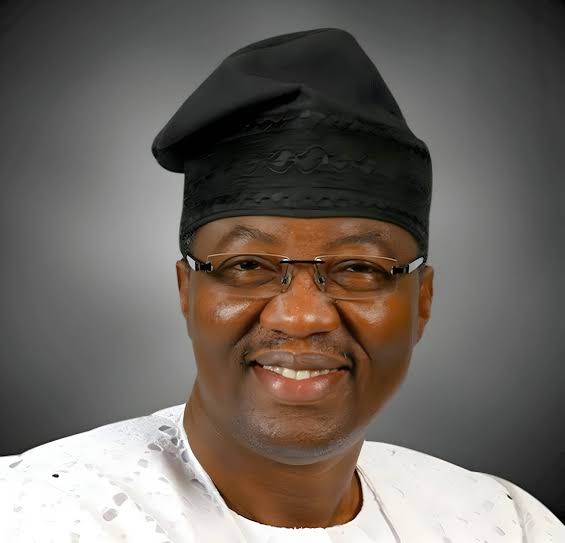
In the ancient corridors of Ijebu Ode, where the rustle of palm fronds has witnessed the rise and fall of kingdoms long before the Nigerian state drew its first borders, a modern political drama unfolded with all the theatricality of a Shakespearean tragedy staged beneath the unforgiving West African sun. The town, historically revered as the administrative heartbeat of Ogun East Senatorial District, became the unlikely theater for a confrontation that would expose the raw nerves of Nigeria's ruling party at the state level. On a day that would crystallize the widening fissures within the All Progressives Congress in Ogun State, two parallel spectacles commanded the attention of the faithful in precisely choreographed defiance of one another. In one arena, Governor Dapo Abiodun stood adorned with the garlands of consensus, anointed by party chieftains including Senator Olamilekan Adeola, former deputy governors Yetunde Onanuga, Segun Adesegun, and Gbenga Kaka, as well as State APC Chairman Chief Yemi Sanusi, all converging to present him as the zone's anointed candidate for the 2027 senatorial contest. Yet just kilometers away, as confirmed by Vanguard News reports, former Governor and current Senator Otunba Gbenga Daniel rallied his own battalion of supporters during the BAT/OGD Movement Mid-Term Assessment Tour, his voice rising in thunderous rejection of the consensus model that had, ironically, facilitated his own emergence as senator just two years prior.
The symmetry was impossible to ignore—two men, once bound by the invisible threads of political patronage, now locked in a collision course that threatens to fracture not merely a party's unity but the delicate social contract between leaders and the led in Nigeria's southwestern heartland. As James Ogunnaike reported for Vanguard and James Sowole chronicled for THISDAY, the stage was set not merely for a contest of personalities but for a profound referendum on the meaning of loyalty, performance, and democratic legitimacy in an era where political consensus increasingly wears the mask of imposition. For the residents of Ijebu Ode and the broader Ogun East Senatorial District, caught between the governor's infrastructural promises and the senator's searing accusations of neglect, the day marked not just another episode in the endless cycle of Nigerian politicking, but a moment of reckoning that would reverberate through the wards, local governments, and ultimately, the ballot boxes of 2027. The question hanging heavy in the humid air was not simply who would claim the senatorial ticket, but whether the All Progressives Congress could survive the civil war erupting in one of its most strategically vital strongholds without hemorrhaging the grassroots goodwill that had delivered electoral victory after victory.
Political analysts watching from Abuja and Lagos alike have noted that what began as a whispered disagreement over development priorities has metastasized into an open rupture, one that could redefine the power dynamics of the entire Southwest if left unresolved.
The Two Courts of Ijebu Ode: Parallel Power and the Myth of Unity
The fault lines became unmistakable when the formal machinery of party endorsement ground into motion, transforming the humid political atmosphere of Ijebu Ode into a pressure cooker of competing ambitions. According to THISDAY's James Sowole, All Progressives Congress stakeholders in Ogun East Senatorial District moved with deliberate precision to present Governor Dapo Abiodun as the consensus candidate for the 2027 senatorial election, a designation that would theoretically clear the field of challengers and preserve the party's fragile unity heading into the electoral cycle. The occasion bore all the hallmarks of a coronation, drawing an impressive roster of party nobility including the party's consensus governorship candidate Senator Olamilekan Adeola, former deputy governors Yetunde Onanuga, Segun Adesegun, and Gbenga Kaka, alongside State APC Chairman Chief Yemi Sanusi and Deputy Chairman Chief James Dina, their collective presence intended to signal an irreversible tide of institutional support. Yet even as these chieftains spoke of ensuring quality representation and sustaining party unity, the ground beneath their feet was shifting, because Otunba Gbenga Daniel had already planted his flag on the opposite shore, declaring emphatically that only a primary election among true senatorial aspirants could legitimately determine the party's standard-bearer. As Vanguard News documented, Daniel's declaration did not emerge from a vacuum of ambition but from a calculated wager that his popularity and grassroots support across Ogun East remained formidable enough to withstand any challenge at the ward level, where he insisted the ultimate decision rightfully belonged.
The bitter irony of this standoff was not lost on observers, for it was the very consensus arrangement of 2023—engineered, according to the Ogun State Government, through Governor Abiodun's personal intervention—that had reportedly persuaded other aspirants including the then-incumbent senator to step aside and clear Daniel's path to the National Assembly. Now, that same political architecture has become the object of Daniel's fiercest criticism, prompting the governor's Special Adviser on Media and Strategy, Honorable Kayode Akinmade, to lash out with unusual ferocity, describing the senator's recent broadsides as the rantings of a drowning politician who demonizes the very ladder he climbed to power. For political scientists studying the arc of Nigerian democracy, this collision encapsulates the inherent fragility of consensus politics, where the exclusion of competitive primaries often stores up resentment that explodes at the most politically inconvenient moments, yet beneath these procedural maneuverings lies a deeper contest over the tangible evidence of governance that ultimately decides whether such narratives resonate with an electorate battered by economic hardship.
The Refinery and the Roads: Developmental Arithmetic in an Age of Depreciated Dreams
Yet beneath the theater of political accusations lies a tangled web of economic claims and counterclaims that reveals how deeply the battle over perception has become a battle over Nigeria's developmental arithmetic. Senator Daniel, speaking during his Midterm Assessment and Empowerment Tour in Ijebu Ode, leveled one of his most damaging charges against the Abiodun administration by accusing the governor of causing Ogun State to lose the proposed Dangote Refinery project, a claim that, if accepted by the electorate, would represent a catastrophic failure of industrial diplomacy for a state positioning itself as Nigeria's industrial capital. He did not stop there, alleging that Governor Abiodun had frustrated federal projects attracted by him during his legislative tenure and had actively opposed the establishment of a naval base in Abigi, accusations that painted a portrait of systematic neglect toward the Ijebu corridor that forms the demographic backbone of Ogun East. But the governor's office responded with a blistering counter-narrative that sought to reframe the debate entirely, with Akinmade dismissing the refinery allegation as baseless and politically motivated, even invoking remarks allegedly made by Aliko Dangote himself during a visit to Abeokuta where the industrialist reportedly commended the administration's investor-friendly policies. The government pointed to ongoing expansions at Dangote cement plants in Itori and Ibeshe as tangible evidence of renewed investor confidence, while highlighting the completion of approximately twenty-nine major road projects in Ijebu Ode alone as proof that the current administration has not abandoned the district to decay.
Where Daniel sought to compare federal allocations received during his gubernatorial tenure ending in 2011 with those of the present day, the governor's team unleashed a devastating economic rebuttal, noting that the senator had governed when the naira exchanged at between one hundred and fifty to one hundred and seventy naira to the dollar, whereas the current administration operates in an era where the same dollar commands over one thousand three hundred and seventy naira on the parallel market. As one Lagos-based macroeconomic analyst noted, attempting to compare project execution across such divergent exchange rate realities without adjusting for purchasing power parity represents either a profound misunderstanding of fiscal mathematics or a deliberate strategy to mislead constituents who feel the daily crush of inflation. The subtext of this economic warfare is impossible to miss: both men understand that in a state where industrial investment and infrastructural delivery form the twin pillars of political legitimacy, controlling the narrative around development is not merely a matter of pride but a survival imperative as 2027 approaches, and it is within the lived experience of the communities themselves—far from the statistical abstractions—that the true weight of these claims must be measured.
The Echoes of Ijebu Land: Grassroots, Godfathers, and the Geography of Grievance
Beyond the macroeconomic abstractions and the cold calculus of party constitutions, the Daniel-Abiodun feud is rooted in a visceral contest for the soul of Ijebu land and the broader Ogun East cultural sphere, where historical grievances about marginalization can ignite electoral wildfires with terrifying speed. Daniel's decision to anchor his rebellion in Ijebu Ode, the historic headquarters of the senatorial district, was itself a cultural signal as potent as any political manifesto, a declaration that he intended to fight his battle not in the air-conditioned halls of Abuja but on the dusty streets where his grassroots support has been cultivated over decades of political entrepreneurship. His supporters, speaking at the empowerment program as chronicled by Vanguard News, pointedly recalled his developmental strides during his gubernatorial tenure and his current legislative work, framing him as a son of the soil who understands the district's aspirations in ways that a consensus candidate imposed from above never could. Yet the Abiodun administration has sought to weaponize a different narrative of cultural betrayal, with Akinmade alleging that Daniel engaged in anti-party activities during the 2023 governorship election and other contests, openly supporting opposition elements in a manner that violated the unwritten but sacred code of political brotherhood within the APC. According to the governor's office, the leadership and stakeholders of the APC in Ogun East became increasingly uncomfortable with Daniel's repeated disregard for party structures and due process, culminating in an incident at a recent stakeholders' meeting where he allegedly arrived with supporters and media personnel to create unnecessary tension around collective decisions.
The accusation that he opposed a naval base in Abigi carries particular cultural resonance, because for coastal communities in Ogun East, such federal installations represent not merely security infrastructure but symbolic recognition of their place in the national mosaic, and their perceived loss feeds into a deeper narrative of administrative neglect. Anthropologists of Yoruba political culture have long observed that in southwestern Nigeria, political legitimacy derives not simply from the delivery of concrete projects but from the performance of belonging—the ability of a leader to convince the grassroots that he feels their pulse, shares their anxieties, and fights their battles. It is precisely this intangible currency of cultural connection that Daniel is attempting to mine, and that the Abiodun machine is trying to devalue by painting the senator as a self-serving renegade who places personal ambition above party discipline and communal interest, which is precisely why the battle for the public imagination has become as fierce as the battle for the party's soul.
The Machinery of Perception: Tours, Statements, and the War for Narrative
In an era where political contests are increasingly won and lost in the theater of perception long before the first ballot is cast, the Daniel-Abiodun confrontation has escalated into a sophisticated exercise in information warfare, with both camps deploying the machinery of media and mass mobilization to capture the imaginations of party delegates and ordinary voters alike. Daniel's weapon of choice has been the relentless roadshow—the Mid-Term Assessment and Empowerment Tour, later rebranded under the BAT/OGD Movement banner—which transforms every local government visit into a media spectacle complete with speakers who extol his developmental credentials and project him as the inevitable choice of the people. These tours are not mere political picnics; they are carefully orchestrated information operations designed to create visual evidence of grassroots enthusiasm that can be disseminated through social media platforms, WhatsApp broadcast channels, and sympathetic news outlets, creating an echo chamber that makes his candidacy appear organically inevitable. The Abiodun administration, recognizing the existential threat posed by this narrative insurgency, has responded not with silence but with a barrage of official statements that seek to deconstruct Daniel's allegations in real time, with Akinmade leading the charge from the governor's media office by labeling the refinery claims and neglect accusations as symptomatic of a politician allegedly battling declining influence within the party.
As reported by Vanguard News, the government's communications strategy has been notably aggressive, dismissing Daniel's comparisons as cheap propaganda and outright falsehood while actively countering with its own data points about road construction, investor confidence, and macroeconomic constraints. Independent media analysts in Lagos note that this represents a new frontier in Ogun State politics, where the old model of relying solely on traditional rulers and party elders to control information flows has been supplemented by rapid-response media teams capable of issuing detailed rebuttals within hours of an opponent's attack. The technological dimension of this conflict extends beyond press releases to the granular level of voter database management, with Daniel urging party faithful to go to their wards with membership cards to vote freely, a call that implicitly acknowledges the digital and logistical infrastructure required to turn passive supporters into primary-day combatants. Whoever controls the narrative in the months ahead will likely determine not merely the outcome of a senatorial primary but the broader trajectory of the APC's hold on power in one of Nigeria's most economically strategic states, yet the final arbiter of this conflict will not be the media consultants or the party elders, but the unforgiving calculus of electoral politics that awaits in 2027.
Beyond the Wards of Ijebu Ode: A Reckoning for Consensus and the Soul of the APC
As the dust settles over the parallel events of Ijebu Ode and the combatants retreat to their respective war rooms to plot the next phase of engagement, the implications of this rupture extend far beyond the borders of Ogun East Senatorial District, casting a long shadow over the future of intra-party democracy in Nigeria's ruling party. Daniel's insistence that the decision on who flies the party's flag must rest with APC members at the ward level represents more than a tactical maneuver to outflank a consensus arrangement; it amounts to a philosophical rejection of the top-down political culture that has long defined candidate selection in Nigerian parties, where governors and elders handpick successors in smoke-filled rooms far from the gaze of ordinary members. If he succeeds in forcing a free and fair primary—and particularly if he wins—the shockwaves would reverberate through governorship and legislative contests nationwide, emboldening other aggrieved aspirants to challenge the consensus model that has kept political godfathers in power for generations. Yet the risks for the APC are equally profound, because an unresolved conflict between a sitting governor and a former governor-turned-senator could fracture the party's structures in Ogun State precisely when national cohesion is needed to navigate the treacherous electoral terrain of 2027, potentially ceding ground to opposition parties hungry for opportunity in the Southwest.
Political risk consultants familiar with the region warn that the Abiodun administration's strategy of branding Daniel as an ungrateful beneficiary turned saboteur may play well within the party's central command, but it risks alienating the very grassroots voters who view the senator's defiance as a courageous stand against imposition. The coming months will test whether the All Progressives Congress can evolve beyond its reliance on consensus politics toward a more robust primary system, or whether the gravitational pull of patronage will prove too strong for even the most determined rebel to resist. For the people of Ogun East, watching from the sidelines as their leaders trade accusations over refineries that never came and roads that may or may not have been built, the ultimate question is not who deserves the senatorial ticket, but whether Nigerian democracy can finally transcend the politics of personal loyalty to embrace a system where the ward, the vote, and the voter matter more than the quiet bargains struck in the corridors of power. Whatever the outcome, the battle lines drawn in Ijebu Ode have already redrawn the map of southwestern politics, and history will remember this season as the moment when a consensus candidate and a defiant senator forced Nigeria's ruling party to confront the limits of its own democratic pretensions.
📰 Sources Cited
- Vanguard News: Gbenga Daniel benefitted from consensus process he now attacks — Ogun govt
- THISDAY: 2027: Ogun East APC Presents Abiodun as Consensus Choice, Daniel Insists on Primary
- Punch Nigeria: Daniel demands primaries as Ogun East APC adopts Abiodun
- Punch Nigeria: 2027: Gbenga Daniel tackles Abiodun over Dangote refinery, performance
- Vanguard News: 2027: I’m ready to face any aspirants in primaries — Senator Daniel
0 Comments
Sign in to commentNo comments yet. Be the first to share your thoughts!