DEEP DIVE
| February 20, 2026
From the Niger Delta to the Sahel, a nation grapples with monumental ambition, systemic leakage, and the high-stakes gamble of centralizing its oil wealth.
The sprawling, sun-bleached complex of the National Theatre in Lagos stands as a monument to a different era of Nigerian ambition. Conceived in the 1970s oil boom, its sweeping concrete curves were meant to herald an African cultural renaissance. Today, as lawmakers on the House of Representatives Committee on Culture and Tourism recently noted, it operates at a fraction of its potential, a underutilized asset in a country desperate for revenue. According to a report in Premium Times Nigeria, the committee lamented that the center is not operating at its full potential as a revenue-generating cultural and tourism asset. This scene—grand vision hamstrung by execution—encapsulates the central paradox of Africa’s largest economy in 2026. Nigeria is a nation simultaneously launching billion-naira scholarships, commissioning critical infrastructure, and declaring itself a new economic hub, all while wrestling with profound questions of fiscal discipline, institutional integrity, and the very architecture of its most vital industry.
This is the story of an economy at a crossroads, pulled in multiple directions by the competing forces of reform, rent-seeking, and regional aspiration. It is a tale told not in broad macroeconomic indicators, but in the granular details of state budgets, executive orders, and the fraught politics of continental unity. From the extra-budgetary spending in Edo State to the groundbreaking for new markets in Bauchi, and from the high-stakes fight over oil revenues to the quiet struggle of a cultural icon in Lagos, Nigeria is conducting a vast, uncoordinated, and high-risk experiment on itself. The outcome will determine not only the welfare of its 220 million citizens but will also send a powerful signal about the viability of democratic governance and economic management in a continent facing what the African Union itself has termed a "vile grip of insecurity."
## The Leaking Bucket: Fiscal Discipline and the Shadow Budgets
The theory is elegant: subnational governments, closer to the people, can drive tailored development, compete for investment, and become laboratories of innovation. The reality, as a forensic investigation in Edo State reveals, is often messier and fraught with the old ghosts of patronage and opacity. A SPECIAL REPORT by Premium Times Nigeria has uncovered a staggering N14.15 billion in extra-budgetary expenditures under the administration of Governor Monday Okpebholo. These funds, spent across several arms and departments of the state government, were disbursed outside the legislative approval mandated by Nigeria’s fiscal responsibility laws.
This is not merely a bureaucratic lapse; it is a direct puncture in the vessel of public trust and a case study in the challenges of economic decentralization. When such significant sums—enough to build hundreds of primary healthcare centers or thousands of classrooms—move without the scrutiny of the people’s representatives, it creates a shadow economy within the official one. It undermines planning, distorts priorities, and fosters an environment where accountability is optional. The Edo case raises a fundamental question echoing across Nigeria’s 36 states: how can a nation build a resilient, transparent economy when the basic frameworks of budgetary discipline are so easily bypassed at the subnational level? This "leaking bucket" syndrome ensures that no matter how much revenue is generated at the federal level or how many reforms are passed in Abuja, a significant portion of the nation’s wealth is lost to unaccountable processes before it can ever reach public services.
## The Builders: Infrastructure, Education, and the Politics of Legacy
Contrasting sharply with the opacity in Edo are the highly publicized, brick-and-mortar initiatives unfolding in other states, where governors are keen to frame their tenures around tangible deliverables. In Ogun State, Governor Dapo Abiodun is on a deliberate infrastructure drive. According to Premium Times Nigeria, he recently commissioned the Lantoro–Oke-Yidi Road and rolled out a new infrastructure plan for the Ogun Central Senatorial District, describing it as a project aimed at deepening connectivity and economic growth. This focus on roads—the arteries of commerce—is a direct, if traditional, response to economic stagnation. Improved logistics lower the cost of business, connect farmers to markets, and attract industry.
Hundreds of miles to the north, in Bauchi, Governor Bala Mohammed is making an even grander claim. During the groundbreaking ceremony for six new modern markets along the Atiku Abubakar Bypass, he declared Bauchi “a fast growing economic hub in Northern Nigeria.” As reported by Premium Times Nigeria, this statement is part of a broader narrative of northern economic revival, attempting to shift the region’s profile from one of security challenges to one of investment potential. Modern markets are not just places of trade; they are envisioned as organized centers for tax collection, SME development, and formalization of the massive informal economy.
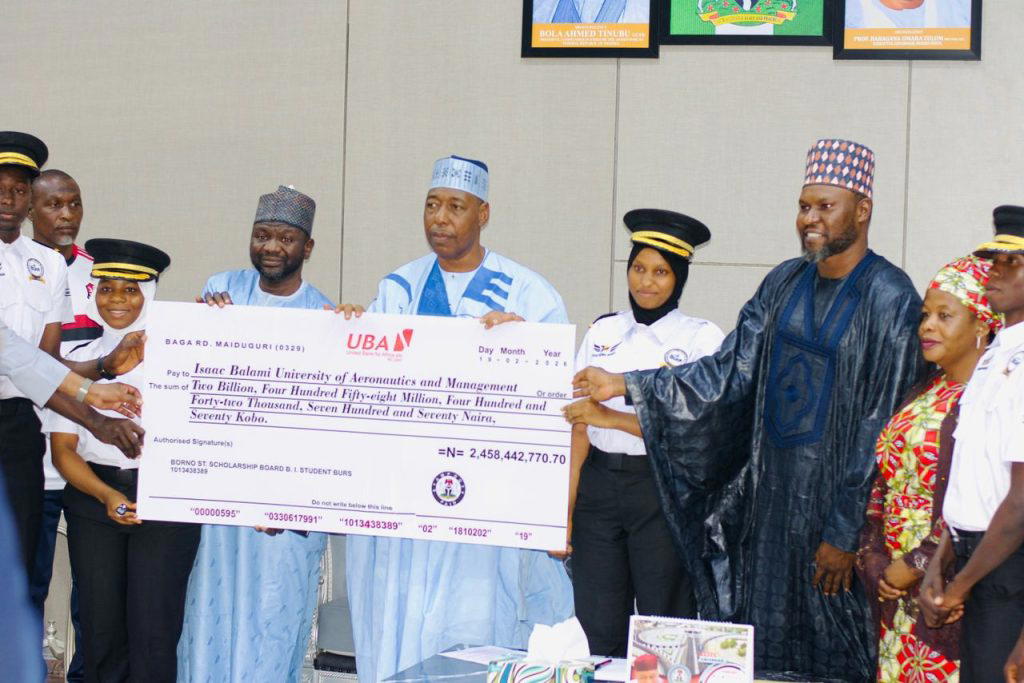
Perhaps the most poignant investment in the future is occurring in Borno State, the epicenter of Nigeria’s long war against insurgency. Here, Governor Babagana Umara Zulum is betting on human capital as the ultimate infrastructure. In a remarkable move, Vanguard Nigeria reported that Governor Zulum unveiled 54 successful candidates for a state scholarship to study at the Isaac Balami University of Aeronautics and Management (IBUAM), Africa’s first indigenous aviation university. The state government presented a cheque of N2.5 billion to cover the beneficiaries' annual school fees. Furthermore, the governor announced an additional N500,000 in resettlement support for each student, directing immediate disbursement.
The symbolism is profound. From a pool of over 3000 applicants, these 54 students represent a conscious investment in high-tech, specialized skills for a region rebuilding from devastation. Governor Zulum commended the founder, Isaac Balami, for “returning home” with the initiative. This act—using scarce state resources to fund aviation education—is a powerful statement of ambition. It seeks to leapfrog traditional development pathways and plant the seeds for a post-conflict economy anchored in technical excellence and global connectivity. Yet, it also highlights the staggering disparities in educational investment across the federation and the pressure on state governors to act as direct patrons in the absence of robust, nationwide social welfare systems.
## The Billion-Dollar Fault Line: Oil, Power, and the PIA War
If state-level projects represent the dispersed engines of growth, the nation’s primary economic engine—the oil and gas sector—is currently the site of a seismic institutional battle. In July 2024, President Bola Tinubu issued an Executive Order (EO) directing the direct remittance of oil and gas revenues to the federation account. This move, aimed at increasing transparency and federal revenue capture, has ignited a firestorm. The Petroleum and Natural Gas Senior Staff Association of Nigeria (PENGASSAN) has demanded the immediate withdrawal of the order, warning it could endanger about 4,000 jobs and destabilize the entire industry.
In a briefing covered by Vanguard Nigeria, PENGASSAN President, Festus Osifo, described the directive as “a direct attack on key provisions of the Petroleum Industry Act (PIA),” the landmark 2021 legislation designed to reform and depoliticize the sector. Osifo’s argument is technical and dire: “The actual percentage [of revenue] that gets there eventually is somewhere below two percent and the 30 percent Frontier Exploration Fund does not go directly to NNPC Limited but into a designated Frontier Exploration Account.” He warns that the EO upends the careful corporate governance and funding mechanisms established by the PIA, scaring away the capital-intensive investment the sector desperately needs. “What are we telling the investors?” he asked pointedly.
The stakes are astronomical. Osifo framed it in starkly national terms: “If production is impacted and foreign exchange earnings reduce, it will affect our exchange rate, and once the exchange rate is impacted, it will affect our pockets.” He reminded the public that this is “not a one-dollar business,” citing daily rig costs as high as $1.5 million. This clash is more than a labor dispute; it is a fundamental struggle over the soul of Nigeria’s oil sector. On one side is the executive’s desire for centralized control and immediate fiscal relief. On the other is the institutional logic of the PIA, which sought to create a commercially driven, independent National Oil Company (NNPC Limited) insulated from the short-term cash grabs of political cycles. The outcome will determine whether Nigeria can finally attract the sustained investment needed to reverse declining production and fund its future, or whether it will remain trapped in the cycle of revenue crisis and political interference that has plagued it for decades.
## The Unraveling Tapestry: Nigeria in a Broken African Mirror
Nigeria’s internal economic contradictions are mirrored in the fracturing continental institutions it has long sought to lead. A searing commentary by Owei Lakemfa in Vanguard Nigeria, reflecting on the African Union’s 39th Summit in February 2026, lays bare the crisis. The AU Heads of State concluded that Africa is in the “vile grip of insecurity,” yet, as Lakemfa notes, it was “business as usual.” The Peace and Security Council, the AU’s vehicle for conflict resolution, is paralyzed. Its last full summit was 32 years ago, in April 1994.
The dysfunction is epitomized by the long-running Western Sahara conflict and Morocco’s role. Lakemfa recounts that the “Moroccan monarchy had pulled the country out of the OAU/AU for 33 years because it was told that it cannot colonise Western Sahara, a sister African country.” Even after Morocco’s return, tensions persist, chilling relations with Mauritania and stymying regional cohesion in the Maghreb. By 2024, Lakemfa reports, other member countries began discussing a new regional body that would exclude both Mauritania and “troublesome Morocco.”
This continental disunity has direct economic consequences for Nigeria. A broken AU means a weaker collective voice on global trade terms, a less effective platform for negotiating debt relief, and a more difficult environment for pan-African investment and the African Continental Free Trade Area (AfCFTA), which Nigeria is central to. Nigeria’s ambition to be a regional economic hegemon and a global player is intrinsically linked to the strength and unity of African institutions. As those institutions falter, Nigeria’s external economic environment becomes more hostile and unpredictable, undermining its efforts to diversify away from oil and integrate into continental value chains.
## Future Implications: Convergence or Collapse?
The threads of this story—fiscal leakage in Edo, infrastructure pushes in Ogun and Bauchi, human capital investment in Borno, the oil sector showdown, and continental instability—do not exist in isolation. They are interconnected forces shaping Nigeria’s economic destiny, pointing toward several potential futures.
1. The High-Stakes Centralization Gamble: President Tinubu’s oil revenue EO is a high-risk bet. If it succeeds in boosting federal coffers in the short term without crippling investment, it could strengthen the central government’s capacity to fund national projects and stabilize the macroeconomy. However, if PENGASSAN’s warnings prove prescient and investment flees, production could fall, leading to a devastating double blow: less foreign exchange and even lower government revenue. This would trigger a deeper naira crisis, higher inflation, and potentially social unrest. The future of the PIA itself hangs in the balance.
2. The Inequality Engine: The current model of state-led development, while showcasing pockets of excellence, risks becoming a powerful engine of inequality. States with reform-minded, competent governors (like Borno’s focus on scholarships or Ogun’s on infrastructure) may pull ahead, while those mired in governance failures (as alleged in Edo) will fall further behind. This could exacerbate regional tensions and fuel internal migration pressures, straining the social fabric of faster-growing cities and states.
3. The Human Capital Time Bomb vs. Opportunity: The Borno scholarship represents a visionary, long-term investment. If these students graduate and find opportunities, they could catalyze a new tech-aviation cluster in the North-East. But this is a micro-solution. Nationally, Nigeria’s education system is in crisis, and its population is soaring. The failure to systematically scale up quality education and vocational training is creating a demographic time bomb—a youth bulge without skills—that could overwhelm any economic gains from infrastructure or oil.
4. Continental Anchor or Isolated Giant? Nigeria’s economic fate is tied to Africa’s. A fragmented, insecure continent is a poor market for Nigerian goods and a risky destination for its investors. Nigeria must decide whether to pour its diplomatic capital into revitalizing the AU and making the AfCFTA work, or to retreat into a more insular, protectionist stance. Its leadership—or lack thereof—on continental security and economic integration will be a major determinant of its own economic resilience.
5. The Unfinished Cultural Economy: The neglect of the National Theatre is a metaphor for a missed opportunity. In a world where the creative economy is a multi-trillion-dollar sector, Nigeria’s soft power—through its music, film, and art—is arguably its most successful export after oil. Failing to strategically invest in and monetize this sector through modernized venues, intellectual property protection, and tourism linkages is an act of economic self-sabotage.
The path forward is narrow and fraught. It requires enforcing fiscal discipline at all levels of government without stifling local innovation. It demands resolving the oil sector impasse in a way that respects both the need for revenue and the laws governing investment. It necessitates a quantum leap in educational investment and job creation. And it calls for a reinvigorated Nigerian foreign policy that actively mends the fraying tapestry of African unity.
Nigeria stands at a pivotal moment. It can be a nation where grand visions like the National Theatre are finally realized, where state-level ambition is channeled through transparent governance, where oil wealth finally funds a diversified future, and where its young people are equipped to lead. Or, it can remain a place of brilliant, disjointed experiments, where progress in one corner is undone by leakage in another, and where the potential of a continent waits indefinitely on the sidelines. The fractured engine is still running. The question for 2026 and beyond is whether its parts can be made to work in concert, or whether the vibrations of contradiction will eventually tear it apart.
The Fractured Engine: Can Nigeria’s Contradictions Forge a Future or Fuel Its Decline? (Continued Analysis)
The critical challenge for Nigeria is not a lack of identifiable problems or even potential solutions, but a systemic failure to execute coherent, sustained strategies across its federated structure. The nation operates as a collection of competing impulses—radical decentralization versus central control, economic liberalization versus protectionist instincts, grandiose federal projects versus decaying local infrastructure. This internal friction consumes immense energy and capital, leaving a trail of unfinished initiatives and squandered goodwill.
The Governance Paradox: Autonomy Without Accountability
The drive for state-level fiscal autonomy, while constitutionally grounded, has created a dangerous paradox. States are increasingly assertive in revenue generation, as seen with Lagos State’s property tax expansions and multiple inland revenue schemes, yet this has not uniformly translated into improved public service delivery or transparency. According to the BudgIT Nigeria’s 2023 State of States report, over 60% of state governments still allocate less than 15% of their budgets to education and health combined, despite internally generated revenue (IGR) increases in many jurisdictions.
This suggests that autonomy is being used more for political consolidation and patronage than for transformative investment. For instance, while Lagos State invests in metro lines and tech hubs, many states in the Niger Delta, despite receiving derivation funds and IGR from local business taxes, remain plagued by infrastructural decay. The Nigeria Governors’ Forum often speaks with one voice on demanding more resources from the Federation Account, but presents a fractured front on standardizing governance benchmarks, anti-corruption safeguards, or human capital development priorities. This creates a patchwork nation where a citizen’s quality of life is disproportionately determined by their state governor’s competence and priorities—a lottery of geography that undermines national cohesion.
The Security-Development Nexus: A Vicious Cycle
The crisis of insecurity, particularly banditry in the northwest and persistent farmer-herder clashes in the Middle Belt, directly throttles the economic potential outlined in state-level agricultural and mining plans. The Kaduna State government, for example, has ambitious agro-industrial plans, but according to the Farmers’ Association of Nigeria, nearly 40% of arable land in the state’s southern region remained uncultivated in the 2024 season due to fear of attacks and kidnapping.
Security is not merely a law enforcement issue; it is the foundational prerequisite for investment. No state-level “Ease of Doing Business” committee can attract serious agro-processing factories if raw materials cannot be safely transported from farms. The federal government’s security apparatus remains overstretched and often reactive, while state-level security initiatives, like the sub-national Amotekun in the southwest and the Benue State Community Volunteer Guard, face legal limitations and funding constraints. This security vacuum becomes a permanent drain on economic potential, scaring off the very investors that state governments are courting. The contradiction is stark: governments are advertising economic opportunities in regions where they cannot guarantee the basic safety of assets and personnel.
The Human Capital Time Bomb
Beneath the debates over oil blocks and tax rates lies Nigeria’s most pressing contradiction: a rapidly growing, youthful population that is simultaneously its greatest potential asset and its most volatile liability. The National Bureau of Statistics (NBS) puts the national unemployment rate at 33.3% for Q4 2024, with youth unemployment significantly higher. Each year, Nigerian universities and polytechnics produce over 500,000 graduates into an economy that creates only a fraction of that number in formal jobs.
This creates a perverse dynamic. State governments, like Rivers and Edo, invest in building new universities and innovation hubs (like the Edo Tech Park), while the federal education sector, from primary to tertiary levels, is crippled by underfunding, strikes, and outdated curricula. The result is a generation often educated in theory but unskilled for the practical demands of a 21st-century economy. The vibrant tech ecosystem in Lagos, Nigeria’s commercial capital, and Abuja, which attracted over $1.5 billion in venture capital between 2021-2024 according to Africa: The Big Deal, is an outlier that absorbs only a tiny fraction of the annual graduate output. The majority are left in a precarious informal sector or seek escape through dangerous migration routes. No amount of oil revenue or tax reform will yield stability if this demographic bulge is not productively engaged.
The Continental Leadership Dilemma: Rhetoric vs. Reality
Nigeria’s foreign policy stagnation mirrors its domestic contradictions. It champions African unity and the African Continental Free Trade Area (AfCFTA) in rhetoric, but its actions often betray a protectionist and insular mindset. Persistent border closures, most notably the prolonged closure with Benin Republic from 2019 to 2022, and cumbersome customs processes undermine its credibility as a free trade champion. While the federal government promotes AfCFTA, local manufacturers in Lagos and Ogun State lobby for higher tariffs to protect domestic industries, highlighting the unresolved tension between continental ambition and local economic pressures.
Furthermore, Nigeria’s ability to lead on continental security, a role expected of its size and military capacity, is hamstrung by its domestic insurgencies. Its substantial contributions to peacekeeping in The Gambia, Sudan, and elsewhere are laudable, but the image of a regional hegemon is tarnished when it cannot secure its own countryside. This reduces its diplomatic leverage and allows rivals and external powers to expand their influence on the continent. The choice is clear: Nigeria can either invest the diplomatic and economic capital to shape a functional, integrated Africa that amplifies its own prosperity, or it can retreat into a fortress Nigeria mentality, ceding strategic ground and leaving the AfCFTA’s promise unfulfilled.
Conclusion: The Imperative for Coherent Action
The fractures in Nigeria’s engine are deep, but not irreparable. The solutions, however, require moving beyond isolated experiments and ad-hoc responses. They demand a grand, national bargain—a coherent social contract that aligns federal and state priorities. This would involve a binding framework where increased fiscal autonomy for states is coupled with mandatory, transparent investment in universal human capital metrics and security collaboration. It requires depoliticizing the oil sector and treating the creative and digital economies with the same strategic seriousness as hydrocarbons.
The alternative is the continued trajectory of a high-potential, low-performance nation. A place where the success of a film like The Black Book or the global ascent of artists like Burna Boy showcases breathtaking potential, while the dilapidation of the National Theatre symbolizes chronic institutional failure. The year 2026 and the next electoral cycle loom as a decisive test. Will Nigeria’s leadership, at all levels, finally synchronize its fractured systems, or will the vibrations of contradiction tear the engine apart for good? The nation is not yet broken, but it is straining under the weight of its own unmanaged contradictions. The time for coherent action is now.
0 Comments
Sign in to commentNo comments yet. Be the first to share your thoughts!