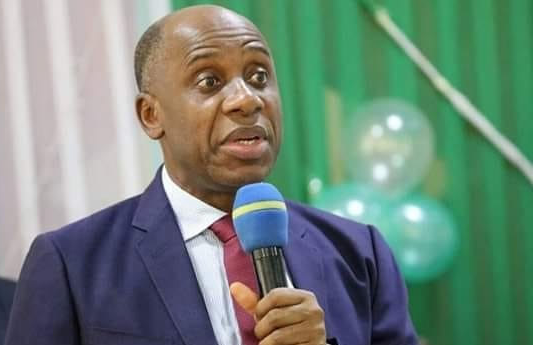
Rotimi Amaechi stood before the cameras of Channels Television, his voice steady yet edged with the kind of challenge that only a former governor can muster when the nation’s pulse is measured in litres rather than in ballots. The studio lights caught the silver in his hair as he recalled the Independence Day address of President Bola Tinubu, a speech that had proclaimed an “age of prosperity” while ordinary Nigerians still queued at filling stations, watching the numbers on the pump climb higher than their hopes. Amaechi’s proposition was simple, almost theatrical: if petrol fell to six hundred naira per litre by the next morning, he would withdraw his vice‑presidential bid on the African Democratic Congress ticket alongside former Vice President Atiku Abubakar and openly campaign for Tinubu. The statement was not merely a policy pledge; it was a dare wrapped in the language of personal verification, a promise to visit a filling station himself, camera in tow, to prove whether the government’s reforms had truly trickled down to the pump. In that moment, the interview became more than a political soundbite; it transformed into a cultural ritual, a test of credibility that resonated with commuters who calculate their daily survival by the cost of moving from Nyanya to Abuja or from Ubima to Port Harcourt.
As the nation digested his words, the ripple spread across print, online, and broadcast platforms, each outlet framing the episode through its own lens—some highlighting the audacity of the challenge, others probing the deeper economic anxieties that fuel such a spectacle.
The Economic Backdrop: Pump Prices and Public Trust
Nigeria’s economy has long been tethered to the volatile rhythm of its fuel market, a relationship that dates back to the era of fixed subsidies and the painful adjustments that followed their removal in 2023. According to Vanguard News, the president’s Independence Day speech had sought to reframe the narrative, asserting that structural reforms were finally yielding dividends and that citizens were entering a period of renewed economic vigor. Yet, as Amaechi pointed out during his Channels Television appearance, the lived reality for many Nigerians remained starkly at odds with that proclamation; transport fares on key corridors had not shown the promised decline, and the price of petrol continued to hover well above the six‑hundred‑naira threshold he had set as his benchmark. Premium Times Nigeria noted that the former governor’s reference to the cost of travelling from Nyanya to Abuja—and from Ubima to Port Harcourt—served as a tangible metric for households grappling with inflation that erodes wages and squeezes disposable income. TheCable, in a separate investigative piece, highlighted how the removal of the petrol subsidy had intensified pressure on small businesses, particularly those reliant on generators and motorbikes for last‑mile delivery, thereby amplifying the socioeconomic stakes of any price movement at the pump.
Analysts interviewed by Legit News suggested that Amaechi’s conditional support was less about partisan allegiance and more about a broader demand for transparency: a call for the government to substantiate its macro‑economic claims with micro‑level evidence that ordinary citizens could verify without relying on opaque statistical aggregates. In this context, the six‑hundred‑naira figure emerged not as an arbitrary number but as a symbolic line in the sand, a quantitative promise that, if met, could potentially recalibrate public trust in the administration’s reform agenda.
The Political Stage: ADC, Tinubu and the 2027 Chessboard
The announcement arrived at a critical juncture in Nigeria’s electoral calendar, as parties began to position themselves for the 2027 presidential contest. The African Democratic Congress, having nominated Atiku Abubakar as its presidential candidate with Amaechi as his running mate, found itself suddenly thrust into a spotlight that illuminated the fragility of coalition politics in a multipolar environment. Punch Newspapers reported that Amaechi’s declaration to withdraw from the ADC ticket should the fuel price meet his condition introduced a volatile variable into the party’s internal calculations, forcing leaders to weigh loyalty against the prospect of aligning with a sitting president whose popularity remains deeply contested. Channels Television’s coverage emphasized that the former Rivers State governor’s willingness to abandon his running mate was not merely a tactical maneuver but a reflection of his long‑standing reputation for political independence—a trait that had previously seen him “technically resign” from the Buhari administration over unmet expectations, as recalled by Premium Times Nigeria. Meanwhile, Vanguard News framed the episode as a strategic overture: by tying his support to a verifiable economic indicator, Amaechi positioned himself as a broker who could potentially deliver a bloc of voters disillusioned with both the opposition and the incumbent, should the administration succeed in delivering tangible relief at the pump.
TheCable added a layer of historical resonance, noting that similar conditional pledges have punctuated Nigerian political discourse, from the subsidy debates of the early 2000s to the more recent exchanges over exchange‑rate stability, each serving as a barometer of how economic performance shapes electoral calculus. As the political class digested the implications, observers speculated whether Amaechi’s move might catalyze a broader realignment, prompting other opposition figures to consider similar litmus tests that tether political allegiance to measurable socio‑economic outcomes.
The Social Pulse: Transport Woes and Everyday Nigerians
Beyond the boardrooms and campaign rallies, the reverberations of Amaechi’s fuel‑price challenge were felt most acutely in the bustling motor parks and informal transit hubs where Nigerians negotiate the daily grind of movement. Legit News recounted how commuters traveling from the satellite town of Nyanya to the federal capital Abuja often spend a significant portion of their meager earnings on fares that have remained stubbornly high despite official claims of economic improvement. TheCable’s field interviews revealed that motorbike operators, popularly known as “okada” riders, frequently cite fuel costs as the primary determinant of their daily takings, with any fluctuation at the pump directly translating into altered pricing for passengers and, consequently, altered access to markets, schools, and health facilities. Premium Times Nigeria highlighted that the price of petrol also influences the cost of goods transported by road, meaning that a drop to six hundred naira per litre could potentially alleviate inflationary pressures on staple items such as rice, garri, and vegetables, thereby affecting household budgets across the socioeconomic spectrum. Vanguard News noted that Amaechi’s pledge to personally verify the price at a filling station introduced an element of grassroots accountability, inviting citizens to participate in a collective act of witnessing that transcends the usual top‑down dissemination of economic data.
In this social tableau, the fuel pump became a communal altar where promises of prosperity are either affirmed or refuted, and where the simple act of buying a litre of gasoline can serve as a referendum on the efficacy of governmental policy. The narrative thus shifted from abstract macro‑economic indicators to the concrete experiences of traders, students, and families whose livelihoods hinge on the affordability of movement—a dimension that any political actor seeking legitimacy must inevitably confront.
The Cultural Lens: Symbols of Subsidy and Sovereignty
Fuel pricing in Nigeria is not merely an economic variable; it carries deep cultural resonance, evoking memories of eras when subsidized petrol was heralded as a tangible expression of national sovereignty and collective welfare. TheCable’s historical retrospect traced the symbolism back to the 1970s oil boom, when low pump prices were celebrated as a dividend of the nation’s resource wealth, fostering a sense of entitlement that later generations inherited as a baseline expectation. When subsidies were withdrawn, the resulting price shocks were interpreted by many not just as fiscal adjustments but as a rupture in the social contract, a perception that Premium Times Nigeria echoed in its analysis of public sentiment surrounding the Tinubu administration’s reform agenda. Amaechi’s invocation of the six‑hundred‑naira benchmark tapped into this cultural memory, framing the price point as a modern‑day litmus test for whether the state could still deliver on the implicit promise of affordable energy—a promise that, in the popular imagination, is intertwined with national pride and the belief that Nigeria’s oil wealth should benefit its people directly. Legit News observed that the former governor’s challenge also carried a performative quality reminiscent of traditional rites of passage, wherein a leader proves his mettle by undertaking a visible, verifiable act—here, a trip to the filling station—thereby inviting the populace to judge his sincerity through direct observation rather than partisan rhetoric.
Vanguard News added that the media’s amplification of the episode turned the fuel station into a makeshift public square, where opinions were exchanged, debates ignited, and the symbolic weight of the pump was renegotiated in real time. In this cultural interplay, the humble act of purchasing fuel became a stage upon which broader questions of governance, accountability, and the moral economy of resource distribution were enacted, revealing how deeply intertwined material conditions are with the narratives that societies tell themselves about justice and prosperity.
Future Implications: A Litmus Test for Leadership
Looking ahead, the conditional endorsement proffered by Amaechi may herald a new paradigm in Nigerian political discourse, one where allegiance is increasingly tethered to verifiable, short‑term economic indicators rather than abstract party platforms or historical loyalties. Should the pump price indeed dip to six hundred naira by the stipulated deadline, the ensuing realignment could reshape the opposition landscape, potentially energizing a centrist bloc that prioritizes pragmatic outcomes over ideological purity, a shift that analysts at Legit News suggest might encourage other politicians to adopt similar performance‑based pledges in future electoral cycles. Conversely, if the price remains above the threshold, the episode could reinforce public skepticism toward grandiose pronouncements of prosperity, deepening the credibility gap between the administration and the citizenry—a dynamic that Premium Times Nigeria warns could fuel further social unrest if economic relief continues to elude the masses. TheCable posits that the episode underscores the growing demand for transparent, real‑time data dissemination, advocating for the expansion of citizen‑led monitoring initiatives that leverage mobile technology to track fuel prices and transport costs across regions, thereby empowering voters with the tools to hold leaders accountable. Vanguard News anticipates that the media’s role will evolve from mere reportage to facilitation of such verification processes, transforming newsrooms into hubs for collaborative fact‑checking that bridge the gap between policy claims and lived experience.
In the broader socio‑political arena, the episode may stimulate a reexamination of how subsidy reforms are communicated and implemented, urging policymakers to pair macro‑economic adjustments with targeted mitigations that directly alleviate the cost burdens felt at the pump and in the market stall. Ultimately, Amaechi’s fuel‑price challenge stands as a microcosm of Nigeria’s ongoing negotiation between aspiration and reality—a moment when a single litre of gasoline becomes a conduit through which the nation measures the sincerity of its leaders, the resilience of its people, and the possibility of a future where prosperity is not merely proclaimed but palpably felt at the very point where the rubber meets the road.
📰 Sources Cited
- Leadership Newspaper: If Fuel Drops To ₦600, I’ll Quit Atiku’s Ticket, Campaign For Tinubu – Amaechi
- Google News Nigeria: I’ll Withdraw From Atiku, Campaign For Tinubu If Fuel Drops To ₦600 Tomorrow – Amaechi - Channels Television
- PM News Nigeria: 2027: ‘I’ll withdraw from Atiku, campaign for Tinubu if…’ – Amaechi
- Vanguard News: 2027: If fuel comes down to ₦600 tomorrow, I will campaign for Tinubu — Amaechi
- Vanguard News: 2027: If fuel comes down to ₦600 tomorrow, I will campaign for Tinubu — Amaechi
- Google News Nigeria: I’ll Withdraw From Atiku, Campaign For Tinubu If Fuel Drops To ₦600 Tomorrow – Amaechi - Channels Television
0 Comments
Sign in to commentNo comments yet. Be the first to share your thoughts!