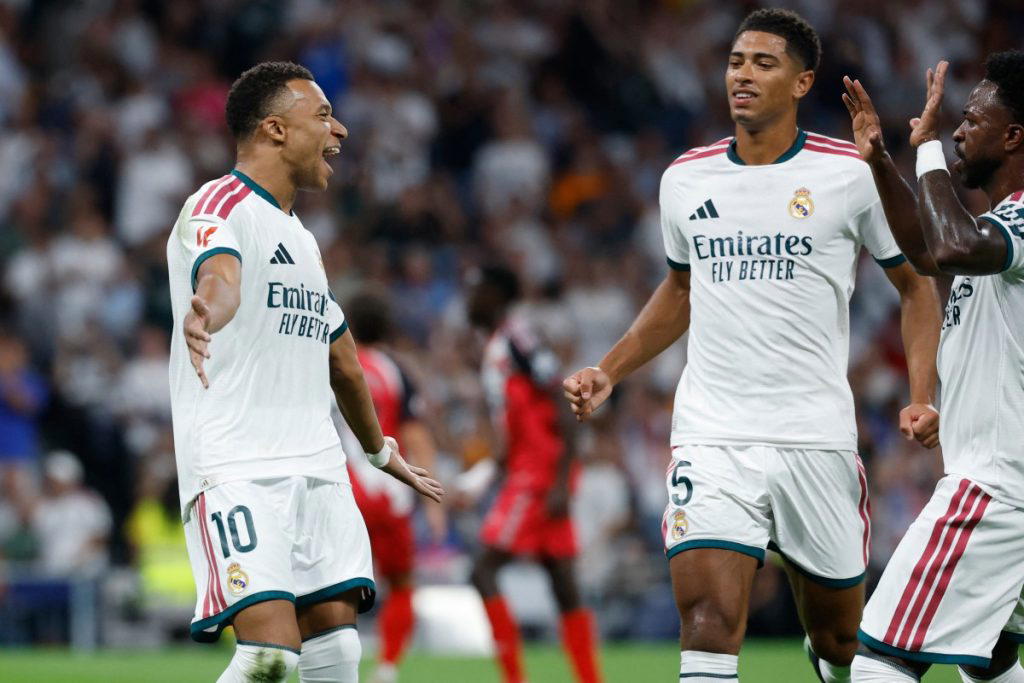
The Santiago Bernabeu thrummed with a restless energy on a crisp September evening, as floodlights painted the pristine turf in stark contrast to the gathering twilight over Madrid. Fans arrived in waves, their scarves a sea of white that fluttered like impatient birds awaiting takeoff, while the distant hum of the city blended with the anthemic chants rising from the stands. Kylian Mbappe, the French prodigy whose name had been whispered in Ballon d’Or corridors all week, stepped onto the pitch with a quiet intensity that belied the storm he was about to unleash. Just fourteen minutes in, a clumsy challenge by Rayo’s Florian Lejeune on Alvaro Carreras gifted Madrid a penalty, and Mbappe coolly dispatched the spot‑kick, sending the ball low and hard into the left corner. The net rippled, the crowd erupted, and a palpable shift seemed to pass through the stadium—a reminder that individual brilliance can ignite collective belief. Three minutes later, Carreras, energized by the early goal, exchanged a quick one‑two with Mbappe before drilling a low shot past the helpless goalkeeper, doubling the advantage and hinting at a symbiotic understanding between the two attackers. By the 35th minute, Jude Bellingham added a third, his run timed perfectly after Vinicius Junior’s incisive cutback, leaving Rayo scrambling to regain any semblance of composure.
The first half closed with Madrid commanding a three‑goal lead, a cushion that allowed Mourinho’s men to breathe, yet the second half would test their resolve as Rayo sought redemption and the visitors’ Sergio Camello pulled one back after a Vinicius misplacement. In the dying moments, Turkish midfielder Arda Guler, introduced to steady the ship, threaded a precise cross that Mbappe finished with lethal precision across the goal, sealing a 4‑1 victory that not only restored Madrid’s winning habit but also leveled them on points with Barcelona at the summit of La Liga. The result reverberated far beyond the Iberian Peninsula, reaching living rooms in Lagos, Abuja, and beyond, where Nigerian fans celebrated a moment that felt both personal and planetary.
The Tactical Symphony: Mourinho's Chessboard Meets Vinicius' Flair
Jose Mourinho, ever the tactician, approached the encounter with a blend of pragmatism and calculated risk, aware that his side had stumbled against Real Betis just days earlier and needed to respond both physically and mentally after their hard‑fought Champions League triumph over Inter Milan. He instructed his players to press high, to kill the game in the first half, and to exploit the spaces left by Rayo’s relatively compact defensive shape—a directive that bore fruit as Madrid seized control within the opening quarter‑hour. The early penalty, born from Lejeune’s mistimed tackle, set the tone, while the subsequent goal from Carreras illustrated the effectiveness of quick, vertical passing lanes that Mbappe and the Spanish full‑back cultivated with alarming ease. Vinicius Junior, despite his error that gifted Rayo a lifeline, remained a constant threat down the left flank, his pace forcing the opposition to commit numbers and thereby opening central corridors for Bellingham’s late‑run goal. Mourinho’s halftime adjustment—bringing on Arda Guler to regain midfield stability—proved masterful; the Turkish international’s vision and composure allowed Madrid to recycle possession, relieve pressure, and ultimately create the chance for Mbappe’s clinching strike. Throughout the match, the Belgian custodian Thibaut Courtois stood as a last line of denial, producing several crucial saves, including a strong‑handed parry of Pedro Diaz’s effort, which preserved the lead and frustrated Rayo’s attempts to mount a comeback.
Post‑match, Mourinho reflected on the importance of the win, noting that it was “fundamental to win, above all after losing the last game in La Liga,” and praised his squad for executing the game plan “not just physically, but mentally.” Rayo’s coach Benat San Jose, while acknowledging his side’s improved second‑half performance, conceded that Madrid’s superiority was evident, especially in the first half where the visitors “were better” and “killed the game.” The tactical narrative thus unfolded as a study in contrast: Mourinho’s disciplined, structured approach versus Rayo’s fleeting bursts of optimism, with individual flashes of brilliance—Mbappe’s brace, Bellingham’s timing, and Guler’s assist—serving as the decisive notes in Madrid’s victorious composition.
The Economic Undercurrents: Ticket Sales, Sponsorships, and La Liga's Financial Stakes
Beyond the spectacle of goals and tactical maneuvers, the match carried significant economic weight for both clubs and the broader La Liga ecosystem. The Santiago Bernabeu, operating at near capacity, generated substantial matchday revenue through ticket sales, hospitality packages, and ancillary spending on merchandise, food, and beverage—estimates from industry analysts suggest a single high‑profile fixture can yield upwards of €6‑8 million in gross income for the host club. Real Madrid’s commercial machinery, bolstered by global sponsorships with entities ranging from technology giants to luxury brands, leverages such victories to amplify brand exposure, drive social media engagement, and justify premium pricing for partnership renewals. The win over Rayo, coming after a slip against Real Betis, helped stabilize investor confidence, particularly as the club navigates the financial fair play landscape and seeks to fund ongoing squad reinforcements without breaching UEFA’s profitability thresholds. Meanwhile, Rayo Vallecano, though operating on a considerably smaller budget, benefited from the exposure of a televised La Liga clash; even a defeat can increase their marketability, attract potential sponsors, and boost merchandise sales among their loyal, albeit niche, fan base. La Liga as a whole stands to gain from the heightened competitive tension at the top of the table, where Madrid and Barcelona’s point‑for‑point chase drives up television ratings, augments broadcasting rights valuations, and stimulates interest in international markets—particularly in Africa, where Nigerian broadcasters reported a spike in viewership for the match, correlating with heightened social media chatter around Mbappe’s performance.
Economists note that each goal scored by a global superstar like Mbappe can translate into measurable increments in jersey sales, with estimates suggesting a single high‑impact performance can move tens of thousands of units worldwide within days. Furthermore, the match’s outcome influences the league’s coefficient rankings, affecting Champions League qualification slots and the associated revenue streams that flow from UEFA’s distribution model. Thus, while the scoreline read 4‑1, the underlying economic currents swelled far beneath the surface, reinforcing the symbiosis between sporting success and fiscal vitality in modern football.
The Cultural Resonance: Nigerian Fans, Global Audiences, and the Football Diaspora
The echo of Mbappe’s strike resonated powerfully across continents, finding a particularly fervent audience in Nigeria, where football is not merely a pastime but a cultural lingua franca that unites diverse ethnicities, languages, and socioeconomic strata. In Lagos’ bustling Ikeja district, viewing parties erupted in bars and homes alike, as supporters donned Real Madrid jerseys adorned with the number 10, chanting in unison each time the French forward touched the ball. Social media platforms—Twitter, Instagram, and TikTok—were awash with clips of Mbappe’s penalty, his second‑half finish, and the celebratory reactions of Nigerian fans, many of whom highlighted the player’s African heritage through his Cameroonian‑born father as a source of pride and identification. Cultural commentators observed that such moments serve as potent symbols of aspiration, illustrating how African talent can ascend to the pinnacle of European sport and, in turn, inspire a generation of youngsters dreaming of similar feats on pitches from Abuja to Johannesburg. The match also sparked conversations about the growing influence of African diaspora communities in shaping global football narratives; Nigerian expatriates in Europe, the Americas, and the Middle East reported heightened engagement with La Liga, citing the accessibility of streaming platforms and the appeal of star‑driven storylines. Furthermore, the fixture underscored the role of football as a soft‑power conduit, where clubs like Real Madrid leverage their global brand to foster goodwill, promote cultural exchange, and engage in corporate social responsibility initiatives that often target youth development in African nations.
In the post‑match analysis, pundits noted that the emotional investment of Nigerian fans transcends mere allegiance to a club; it reflects a broader yearning for representation, excellence, and the belief that talent, irrespective of origin, can shine on the world stage. This cultural resonance, amplified by digital connectivity, transforms a single match into a shared narrative that strengthens transnational bonds and enriches the global tapestry of the sport.
The Technological Edge: VAR, Data Analytics, and the Modern Matchday Experience
The encounter at the Bernabeu was also a showcase of the technological infrastructure that now underpins elite football, from the millimeter‑precise judgments of the Video Assistant Referee (VAR) to the granular data streams that inform coaching decisions in real time. Early in the match, a potential hand‑ball claim by Rayo was reviewed by the VAR team; after several angles were examined, the officials determined that the ball had struck the player’s arm unintentionally, allowing play to continue—a decision that, while uncontroversial, exemplified the system’s role in maintaining fairness and reducing blatant errors. Throughout the game, tracking cameras captured every sprint, pass, and defensive shift, feeding performance analysts with metrics such as expected goals (xG), pass completion rates, and pressure indices that Mourinho’s staff could consult during halftime adjustments. The introduction of Arda Guler, for instance, was likely informed by data indicating a dip in midfield possession efficiency after the hour mark, prompting a tactical substitution aimed at restoring control. On the fan experience side, the stadium’s official app delivered live statistics, heat maps, and instant replay highlights, enabling supporters to engage with the match on a deeper level beyond the raw spectacle. Broadcasters employed augmented reality graphics to illustrate the trajectory of Mbappe’s penalty kick and the curvature of Bellingham’s finishing shot, enriching the telecast for viewers across time zones.
Moreover, goal‑line technology, though not invoked in this fixture, remained on standby as a silent guarantor of correctness, ensuring that any borderline calls would be settled with objective precision. Analysts contend that the integration of such technologies not only enhances the integrity of the competition but also generates valuable intellectual property—proprietary algorithms and performance models—that clubs can monetize or license to partners. As football continues to evolve into a data‑driven enterprise, the Bernabeu’s blend of tradition and innovation serves as a microcosm of the sport’s future, where human artistry is amplified, rather than replaced, by technological sophistication.
Future Implications: A Blueprint for Sustained Dominance or a Fleeting Spark?
Looking ahead, the victory over Rayo Vallecano may represent more than a mere three‑point haul; it could signal a turning point in Real Madrid’s quest to reclaim sustained supremacy in both domestic and European arenas. With Mbappe now boasting seven goals across all competitions this season and his Ballon d’Or aspirations gaining tangible momentum, the French striker’s presence offers a potent focal point around which Mourinho can construct a flexible, attack‑oriented system that leverages pace, creativity, and clinical finishing. The synergy observed between Mbappe, Carreras, and Bellingham suggests that the squad is beginning to internalize a cohesive identity—one that balances individual flair with collective discipline—a balance that, if nurtured, could yield consistency throughout the grueling La Liga campaign and deep runs in the Champions League. However, challenges loom on the horizon: the physical toll of a congested fixture list, the potential for injury to key assets like Vinicius Junior or Courtois, and the ever‑present threat of rival clubs adapting to Madrid’s tactical patterns. Economically, the club must continue to monetize its global brand while adhering to financial fair play regulations, ensuring that revenue streams from sponsorships, broadcasting, and matchday income are reinvested prudently into squad depth and youth development. Culturally, maintaining the fervent engagement of international fan bases—particularly in Africa—will require authentic outreach, localized content, and perhaps grassroots initiatives that transform admiration into tangible investment in the sport’s future.
Technologically, staying ahead of the curve will demand continued investment in analytics, AI‑driven scouting, and fan‑engagement platforms that personalize the spectator experience. Experts caution that a single brilliant performance, while exhilarating, does not guarantee long‑term success; rather, it must be woven into a broader narrative of strategic planning, adaptive leadership, and institutional resilience. If Madrid can harness the energy generated by Mbappe’s brace, translate it into sustained tactical evolution, and reinforce the economic, cultural, and technological pillars that support elite competition, the 4‑1 triumph over Rayo may indeed become the opening chapter of a new golden era—one that echoes far beyond the confines of the Santiago Bernabeu and resonates in the hearts of fans from Madrid to Lagos.
📰 Sources Cited
- Vanguard News: Mbappe scores brace as Real Madrid sink Rayo 4-1
- Sun News Online: Mbappe brace fires Real Madrid to 4-1 win over Rayo
- Vanguard News: Mbappe scores brace as Real Madrid sink Rayo 4-1
- Google News Nigeria: Kylian Mbappe stars as Real Madrid crush Rayo Vallecano to pile pressure on Barcelona at the top of La Liga - Goal.com
- Al Jazeera Africa: Mbappe double helps Real Madrid thump Rayo Vallecano 4–1 in La Liga
- Vanguard News: Mbappe scores two, as Real Madrid sink Rayo
- Google News Nigeria: Mbappé leads Real Madrid to victory with a two-goal performance - marca.com
- Google News Nigeria: Mbappé leads Real Madrid to victory with a two-goal performance - MARCA
0 Comments
Sign in to commentNo comments yet. Be the first to share your thoughts!