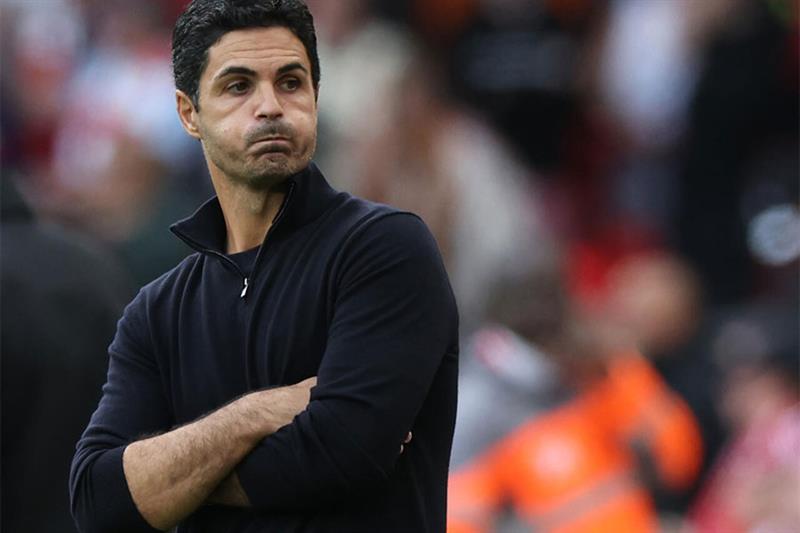
The Amex Stadium roared with a ferocity that belied its modest size, as Brighton & Hove Albion unleashed a relentless tide that swept aside the defending Premier League champions in a shocking 3‑0 verdict. Arsenal, having begun the season with an immaculate seven‑game winning streak across all competitions, found themselves uncharacteristically nervy, their usually resolute defence punctured by long‑range strikes from Pascal Gross and Charalampos Kostoulas before the half‑hour mark. The visitors’ midfield, accustomed to dictating tempo, appeared disjointed, allowing the Seagulls to dominate possession and force errors that culminated in Chema Andres’ towering header from a corner early in the second period. Manager Mikel Arteta, his face a mixture of disbelief and resolve, conceded that the defeat was a “big lesson” against complacency, acknowledging that his side had fallen short of the basic tenets required to survive in England’s top flight. According to Vanguard News, Arteta lamented that certain basics — pressing intensity, defensive shape, and clinical finishing — were conspicuously absent, a stark contrast to the fluid, high‑pressing football that had delivered the Gunners their first league title in 22 years just months prior. The loss not only ended Arsenal’s perfect start but also surrendered the top spot on goal difference to Manchester City, a twist that underscored how narrowly margins separate triumph from turmoil in modern football.
As the final whistle blew, the away fans’ muted groans mingled with the home supporters’ jubilant chants, a vivid tableau of a footballing order momentarily upended.
The Economic Backdrop: Title Aspirations, Market Movements, and Sponsor Sentiment
The financial ramifications of Brighton’s triumph rippled through the Premier League’s commercial ecosystem, where Arsenal’s status as a global brand amplifies every fluctuation in performance. Prior to the match, the club’s market valuation hovered around £2.2 billion, a figure bolstered by lucrative sponsorship deals with Emirates, Adidas, and various regional partners across Asia and the Americas; a slip in the title race threatens to dilute the perceived value of those assets, potentially triggering renegotiations or performance‑based clauses. According to Complete Sports, the defeat left Arsenal second on the table with a goal difference inferior to Manchester City’s, a scenario that could affect bonus structures tied to league position, Champions League qualification, and merchandising revenue streams that rely on the prestige of being champions. Analysts from Al Jazeera Africa noted that Manchester City’s silent ascent to the summit — achieved without playing a match due to fixture congestion — highlighted the league’s increasing reliance on scheduling nuances, a factor that clubs must now factor into financial forecasting and risk management. Moreover, the loss prompted a brief dip in Arsenal’s share price on the London Stock Exchange, with traders reacting to the heightened uncertainty surrounding the club’s short‑term prospects, while Brighton’s victory sparked a surge in local merchandise sales and a spike in match‑day attendance projections for the Seagulls’ upcoming fixtures.
Sponsors, ever attuned to narrative momentum, began to recalibrate their messaging, emphasizing resilience and community engagement over pure dominance, a subtle shift that could influence long‑term brand alignment. In the broader economic landscape, the result served as a reminder that the Premier League’s financial model, predicated on competitive unpredictability, thrives on such upsets, ensuring that broadcast rights and advertising revenues remain buoyant despite the dominance of traditional powerhouses.
The Cultural and Social Dimension: Nigerian Fans, Media Echoes, and the Spirit of the Underdog
Across Nigeria, the Arsenal‑Brighton clash reverberated through living rooms, bustling cafés, and social media timelines, where supporters dissected every pass, tackle, and missed opportunity with a fervor that mirrored the intensity on the pitch. Punch Nigeria reported that Arteta’s characterization of the loss as a “big lesson” struck a chord with local pundits, who framed the defeat as a necessary humbling for a side that had grown accustomed to recent success. The Peoples Gazette highlighted the historical resonance of Brighton’s achievement — noting it marked the third time the Seagulls had toppled the defending champions at home — a statistic that Nigerian commentators likened to the giant‑killing feats often celebrated in domestic cup competitions. Meanwhile, Channels Television emphasized the emotional weight of the moment, describing how Arsenal’s normally composed fanbase exhibited visible frustration, with tweets flooding under the hashtag #ArsenalOut as fans questioned tactical rigidity and player selection. The defeat also sparked conversations about the broader cultural import of football in Nigeria, where the sport serves as a unifying lingua franca across ethnic and religious lines; the unexpected result prompted discussions in community centers about the virtues of perseverance, the dangers of overconfidence, and the merit of celebrating underdog triumphs. In Lagos, youth football academies used the match as a teaching tool, urging young players to emulate Brighton’s high‑energy pressing and tactical discipline rather than idolizing solely the flair of star‑laden squads.
The social media buzz extended beyond matchday, with influencers posting analytical breakdowns that juxtaposed Arsenal’s expected goals (xG) of 1.2 against Brighton’s 2.8, a quantitative narrative that reinforced the qualitative observations of pundits. Ultimately, the encounter reinforced a cultural narrative that resonates deeply in Nigerian sporting consciousness: that greatness is not a permanent state but a continual pursuit, vulnerable to complacency and revitalized by humility.
The Technological and Informational Battlefield: Data, VAR, and Managerial Decision‑Making
Behind the visible drama of goals and tackles lay an intricate technological substratum that shaped both the match’s outcome and its subsequent analysis. Sky Sports’ live commentary detailed how Brighton’s tactical setup leveraged data‑driven insights, positioning their midfield to exploit the half‑spaces that Arsenal’s full‑backs frequently vacated when pushing forward. Advanced metrics, accessed through performance analytics platforms, indicated that Brighton completed 62 % of their passes in the final third, a figure that surpassed Arsenal’s 48 % and directly contributed to their ability to create high‑quality chances from wide areas. The match also reignited debates over the efficacy of VAR, particularly concerning a contentious moment when Bukayo Saka’s potential equalizer was ruled out for a marginal off‑side; although the decision stood, pundits from BBC Sport questioned whether the technology’s marginal thresholds were stifling the flow of the game. Arteta’s post‑match press conference, as reported by Vanguard News, revealed that he had opted not to make any halftime adjustments, a choice informed by his trust in the pre‑game tactical plan but subsequently scrutinized by analysts who argued that real‑time data feeds should have prompted a shift in formation or personnel. The defeat prompted Arsenal’s backroom staff to intensify their use of wearable GPS trackers and heart‑rate monitors during training, aiming to identify lapses in intensity that had manifested on the pitch.
Furthermore, the club’s digital media team accelerated the rollout of an interactive fan app that offered real‑time xG visualizations and heat maps, a technological response designed to bridge the gap between performance analysis and supporter engagement. In an era where milliseconds and millimeters can dictate outcomes, the Brighton encounter underscored that success increasingly hinges on the seamless integration of analytical rigor, technological tools, and the human intuition of those who wield them.
Future Implications: A Blueprint for Resilience or a Fleeting Cautionary Tale?
Looking ahead, the lessons extracted from Brighton’s 3‑0 triumph may serve as either a enduring blueprint for Arsenal’s resurgence or a fleeting cautionary tale that dissipates once the next wave of victories arrives. Arteta’s insistence that the defeat reminded the squad of “how tough every game” is suggests a potential recalibration of mindset, wherein the Gunners could adopt a more humble, process‑oriented approach akin to the relentless pressing schemes that propelled Leicester City’s historic title run. Economically, a renewed focus on consistency could stabilize sponsorship revenues and protect the club’s market valuation, while socially, the episode may deepen the bond between Arsenal’s global fanbase and local Nigerian supporters who value authenticity over invincibility. Technologically, the match is likely to accelerate investments in predictive analytics, injury‑prevention wearables, and VAR refinement, as clubs seek to minimize the fine margins that separate triumph from defeat. Politically, the result may influence league‑wide discussions about fixture congestion and competitive balance, prompting governing bodies to consider adjustments that reduce the advantage of teams benefiting from scheduling quirks. Ultimately, the true test will be observed in the weeks following the international break, when Arsenal returns to action with a renewed sense of purpose; if the squad channels the disappointment into heightened intensity, improved defensive cohesion, and clinical finishing, the Brighton loss could be remembered as the catalyst that fortified their title defence.
Conversely, should the old patterns of complacency resurface, the defeat might fade into a mere footnote, a reminder that in the unforgiving theater of the Premier League, learning is perpetual and humility is the most enduring asset.
📰 Sources Cited
- Complete Sports: How Brighton ‘Absolutely Battered’ Arsenal — Shearer
- Punch Nigeria: EPL: Brighton defeat big lesson for Arsenal, says Arteta
- Peoples Gazette: Brighton upset Arsenal with 3-0 victory, Coventry City secure first EPL win in 25 years
- Channels TV: Brighton Defeat A ‘Big Lesson’ Against Complacency For Arsenal —Arteta
- Complete Sports: I’m Extremely Disappointed —Arteta Laments Arsenal’s 3-0 Defeat To Brighton
- Google News Nigeria: Live Commentary - Brighton vs Arsenal | 19.09.2026 - Sky Sports
- THISDAY: Brighton Stun Arsenal 3-0 to Halt Gunners’ Perfect Premier League Start
- Google News Nigeria: Brighton beat Arsenal 3-0 as Man City top Premier League without playing - Al Jazeera
- Vanguard News: Brighton defeat a ‘big lesson’ against complacency for Arsenal, says Arteta
- Al Jazeera Africa: Brighton beat Arsenal 3-0 as Man City top Premier League without playing
0 Comments
Sign in to commentNo comments yet. Be the first to share your thoughts!