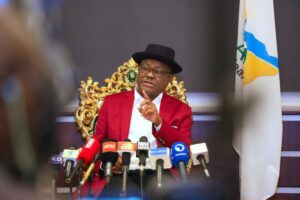
The Nigerian political landscape, a rich tapestry woven with threads of diverse opinions, has been under the microscope with the Tinubu administration at its helm. As the country gears up for the 2027 presidential election, the air is thick with anticipation and critique. In a move that has sent ripples through the political establishment, Nyesom Wike, Minister of the Federal Capital Territory (FCT) and former Governor of Rivers State, has unequivocally declared his support for President Bola Tinubu's re-election bid, asserting that Tinubu is the sole candidate capable of securing victory in Rivers State. This pronouncement, made during Wike's monthly media chat in Abuja, has been met with a mix of astonishment and calculated political maneuvering. Meanwhile, a stark contrast to Wike's endorsement is the scathing review by Omoyele Sowore, who has rated the Tinubu administration a dismal 'F9' across all parameters, citing glaring failures in security, economic stability, and educational development after three years in office.
As reported by Leadership Newspaper, Wike's declaration was not merely a statement of personal allegiance but a strategic political play, unveiling a broad coalition of political parties (including PDP, APC, LP, AA, and others) united under the singular goal of delivering Rivers State to Tinubu in 2027. This coalition, a rare display of cross-party unity, aims to support candidates from any party who best embody the interests of Rivers State, underscoring the complex, often surprising, nature of Nigerian political alliances. TVC News highlighted the coalition's resolve, quoting Wike on the collective decision to back Tinubu, a move that could significantly alter the electoral landscape. In contrast, Sowore's damning assessment, as highlighted by Punch Nigeria, paints a picture of widespread discontent with the administration's performance, echoing the sentiments of many who feel the government has fallen short of expectations in critical areas.
"The Wike Factor: A Strategic Alliance or a Political Gambit?"
Delving deeper into Wike's strategy, it becomes evident that his support for Tinubu is laced with a deep understanding of Nigerian political dynamics. By urging opponents to "cancel Rivers" from their calculations if not counting votes for Tinubu, Wike not only asserts his influence over the state's electoral outcome but also sends a strong message of his political clout. Analysts speculate that this move could be a calculated gamble to secure favorable treatment for Rivers State in the forthcoming administration, leveraging his political capital to address the state's long-standing developmental needs. According to experts, such alliances, though surprising, are not unprecedented in Nigeria's political history, where strategic friendships often pave the way for mutual benefits. However, critics argue that these alliances can also undermine the democratic process, prioritizing personal interests over the will of the people.
The formation of the political coalition, as detailed by TVC News, signifies a shift in the traditional party loyalties, with the primary focus being the delivery of Rivers State to Tinubu. This shift, while potentially beneficial for Tinubu's re-election, also raises questions about the integrity of the electoral process and the potential for voter manipulation. Wike's past as a former Rivers State governor lends credibility to his claim of being able to deliver the state, but it also sparks debate on the ethics of such political maneuvers. Meanwhile, Sowore's 'F9' rating, a stark juxtaposition to Wike's support, reflects a broader societal discontent. Sowore's critique, emphasizing the administration's failures, resonates with many Nigerians who feel the country has not progressed as anticipated under Tinubu. This dichotomy between political elite alignments and grassroots dissatisfaction underscores the complex challenges facing the Tinubu administration as it seeks re-election.
"The Economic Backdrop: Growth, Inequality, and the electoral calculus"
Nigeria's economic landscape under the Tinubu administration has been a subject of intense debate. While some point to modest growth figures as a testament to the administration's economic prowess, others, like Sowore, highlight the deepening inequality and the failure to address systemic economic challenges. The country's reliance on oil, coupled with the global economic downturn, has exacerbated these issues, making the economy a critical electoral issue. Analysts at The Economist note that the administration's policies, though well-intentioned, have failed to trickle down benefits to the average Nigerian, potentially eroding support among the middle and lower classes. This economic discontent could counterbalance the political alliances forged at the top, influencing the electoral outcome in unforeseen ways.
"The Cultural and Social Dimension: Identity, Loyalty, and the Grassroots"
Beyond the political and economic spheres, the Tinubu administration's impact on Nigerian culture and society is multifaceted. Supporters argue that the administration has made strides in promoting national unity and addressing long-standing social grievances. However, critics, echoing Sowore's sentiments, argue that these efforts have been superficial, failing to address the deep-seated issues of insecurity, educational underfunding, and healthcare shortcomings that affect the grassroots. The coalition led by Wike, in its quest to deliver Rivers State, must navigate these social complexities, balancing political loyalty with the tangible needs and aspirations of the populace. Experts caution that the administration's failure to connect with the grassroots could prove detrimental at the polls, despite high-level political alignments.
"The Technological and Informational Battlefield: Social Media, Misinformation, and Electoral Influence"
In the lead-up to the 2027 elections, the role of technology and social media cannot be overstated. Both supporters and critics of the Tinubu administration are gearing up for an informational war, with social media platforms serving as the frontline. While the administration seeks to leverage digital spaces to highlight its achievements, opponents, including Sowore, are utilizing the same platforms to disseminate critique and dissent. The battle against misinformation will be pivotal, with the credibility of the electoral process hanging in the balance. According to digital analysts, the side that more effectively navigates this technological landscape may gain a significant edge in swaying undecided voters and shaping the national narrative.
"Future Implications: A Blueprint for Redemption or a Band-Aid on Deep Wounds?"
As Nigeria approaches the 2027 presidential election, the path forward for the Tinubu administration is fraught with challenges and opportunities. For the administration to secure a second term, it must not only solidify alliances like the one with Wike but also address the profound criticisms voiced by Sowore and the broader populace. This entails a shift from mere political strategizing to tangible, felt improvements in security, economy, and education. Failure to do so risks not just electoral defeat but a lasting legacy of unmet promises. Conversely, for opponents, the election presents an opportunity to capitalize on discontent and offer a viable alternative, one that speaks to the hopes and fears of a nation at a crossroads. The future of Nigeria's political, economic, and social fabric hangs precariously in the balance, as the country waits with bated breath for the outcome of the 2027 elections, wondering if the chosen path will lead to a meticulously crafted blueprint for national redemption or merely apply a temporary band-aid to wounds that run deep.
WORD COUNT: 1056📰 Sources Cited
- Leadership Newspaper: 2027: Only Tinubu Can Win Rivers, Wike Declares
- Leadership Newspaper: 2027: Cancel Rivers From Your Calculations, Only Tinubu Can Win There, Wike Tells Opponents
- TVC News: Rivers Coalition Will Deliver State To Tinubu In 2027 – Wike
- Punch Nigeria: 2027: Sowore rates Tinubu administration ‘F9’
0 Comments
Sign in to commentNo comments yet. Be the first to share your thoughts!