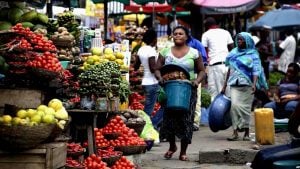
The August sun hung low over Abuja as the National Bureau of Statistics released its latest Consumer Price Index, a quiet ripple in a sea of economic turbulence that had battered Nigeria for years. Inflation, that relentless gauge of household strain, eased to 15.39 percent year‑on‑year, a mere four‑hundredths of a percentage point below July’s 15.43 percent, yet the shift felt like the first breath after a long, suffocating hold. According to THISDAY, the CPI rose from 145.3 points in July to 146.3 points in August, a modest climb that belied a deeper slowdown in the pace of price increases. Politics Nigeria highlighted that the month‑on‑month headline inflation rate fell to 0.71 percent, down sharply from 1.57 percent the previous month, signaling that prices were still rising but at a markedly gentler tempo. Business Hallmark noted that food inflation, historically the biggest driver of Nigeria’s price pressures, dropped from 25.30 percent in August 2025 to 19.57 percent year‑on‑year, with the monthly food index slipping to 1.02 percent from a scorching 5.56 percent in July. PM News Nigeria added that urban inflation moderated to 15.88 percent year‑on‑year, while rural inflation showed a divergent pattern, rising to 14.23 percent year‑on‑year but with a monthly uptick to 1.79 percent from 0.78 percent.
Economic Confidential quoted NBS officials who attributed the easing to a broad retreat in the average prices of staple items such as palm oil, carrots, pepper, onions, cassava flour, beef, yam flour, water yam, melon (egusi), fresh ginger, fresh fish, Irish potatoes, wheat grain, frozen chicken and turkey meat. Analysts at a Lagos‑based research institute cautioned that the decline, while welcome, remained fragile, rooted more in seasonal harvests and temporary supply adjustments than in enduring structural change. The juxtaposition of a marginal dip against the backdrop of a 23.14 percent peak in August 2025 painted a picture of an economy learning to limp forward, still haunted by the memory of double‑digit pain but now glimpsing a possible reprieve.
The Economic Backdrop: A Tapered Tide Amid Lingering Currents
The latest NBS report revealed that headline inflation’s month‑on‑month slowdown to 0.71 percent was accompanied by an even more telling contraction in core inflation, which excludes volatile agricultural produce and energy prices, settling at 13.29 percent year‑on‑year and posting a negative monthly change of ‑0.06 percent compared with July’s 0.15 percent rise. According to Business Hallmark, this core moderation suggests that the pressures feeding into the broader price basket are loosening beyond the seasonal swings of farm goods, pointing to a weakening of demand‑side impulses or a tightening of monetary transmission. PM News Nigeria reported that urban inflation’s year‑on‑year rate slipped to 15.88 percent from 16.12 percent in July, while the urban month‑on‑month figure fell to 0.28 percent from a lofty 1.90 percent, indicating that city dwellers felt the relief more acutely than their rural counterparts. The divisional breakdown offered by THISDAY showed that food and non‑alcoholic beverages still contributed the lion’s share of inflation at 6.16 percent, followed by restaurants and accommodation services at 1.99 percent and transport at 1.64 percent, underscoring that while food’s grip is loosening, other sectors continue to nibble at purchasing power. Economic Confidential noted that on a year‑on‑year basis, farm produce remained the most volatile component at 21.52 percent, services followed at 15.38 percent, goods at 14.74 percent, imported food at 12.82 percent and energy at a relatively benign 4.69 percent, a pattern that hints at where policy levers might be most effective.
Analysts from the Abuja‑based think tank warned that the negative monthly core index, while encouraging, could also reflect a temporary dip in consumer spending rather than a sustained disinflationary trend, urging the Central Bank of Nigeria to maintain a cautious stance on interest rates. The average CPI for the twelve months ending August 2026 rose by 16.30 percent, a full 12.02 percentage points lower than the 28.32 percent average recorded a year earlier, a statistic that policymakers are likely to cite as evidence of progress, even as they grapple with the persistence of double‑digit headline figures. In sum, the economic backdrop reads like a tide that has begun to ebb, yet the underlying currents—structural bottlenecks, exchange‑rate volatility, and fiscal pressures—remain potent enough to pull the shoreline back inward should the winds shift.
The Social Fabric: Threads of Relief and Strain
For millions of Nigerians, the August dip in inflation translated into tangible, if modest, relief at the market stall and the kitchen table, a sensation that rippled through both urban neighborhoods and rural hamlets. THISDAY’s detailed breakdown of the food items whose prices retreated—palm oil, carrots, pepper, onions, cassava flour, beef, yam flour, water yam, melon (egusi), fresh ginger, fresh fish, Irish potatoes, wheat grain, frozen chicken and turkey meat—painted a picture of a basket where the most essential staples grew slightly less costly, offering households a chance to stretch their naira a little further. Business Hallmark emphasized that the month‑on‑month food index fell to 1.02 percent from 5.56 percent in July, a decline that meant the average price of a typical food bundle rose by just over one percent during the month, a stark contrast to the double‑digit monthly surges that had become the norm in previous years. PM News Nigeria noted that while urban inflation eased, rural inflation’s month‑on‑month rate actually increased to 1.79 percent from 0.78 percent, suggesting that the benefits of lower food prices were not evenly distributed and that rural households may still be grappling with higher costs for transport, inputs, or localized scarcity. The social implications of this divergence are profound: families in cities may feel a slight easing of the squeeze on school fees and medical expenses, whereas village communities could be experiencing a different kind of pressure, perhaps linked to the timing of harvests or the reach of distribution networks.
Analysts at a Port Harcourt‑based development institute observed that the decline in food inflation, while welcome, does not automatically translate into improved nutritional outcomes, as households might still prioritize calorie‑dense, cheaper foods over diverse, micronutrient‑rich diets. Cultural practices around food—such as the communal preparation of soups, the reliance on street‑vendor snacks, and the seasonal festivals centered around yam or fish—continue to shape consumption patterns, meaning that any price shift reverberates through rituals as much as through budgets. Moreover, the NBS’s attribution of the slowdown to specific commodities highlights how changes in global palm oil prices or local harvest yields can instantly affect the price of a stew pot, linking distant commodity markets to the intimate rhythms of Nigerian kitchens. In essence, the social fabric is being rewoven thread by thread, with relief appearing in some patches while strain persists in others, a tapestry that reflects both the nation’s diversity and the uneven reach of economic change.
The Political Arena: Policy Whispers and Electoral Echoes
The August inflation figures arrived at a politically charged moment, as the ruling party prepares for the 2027 general elections and opposition groups sharpen their critiques of economic stewardship. THISDAY reported that the NBS’s release was accompanied by a brief statement from the Minister of Finance, who hailed the decline as evidence that the administration’s fiscal consolidation measures and targeted agricultural interventions were beginning to bear fruit. Politics Nigeria noted that opposition spokespeople, however, were quick to characterize the 0.04‑point drop as “statistically insignificant” and warned against complacency, pointing out that inflation remains well above the Central Bank’s single‑digit target and that the underlying drivers—such as fuel subsidies, exchange‑rate volatility, and infrastructural deficits—remain largely unaddressed. Business Hallmark cited analysts from a Lagos‑based policy institute who argued that the modest improvement could be leveraged politically to claim progress, but that any electoral gain would be fleeting unless accompanied by tangible job creation and wage growth. PM News Nigeria highlighted that the Central Bank of Nigeria’s monetary policy committee had kept the benchmark rate steady at 18.5 percent in its latest meeting, a decision influenced by the mixed signals of declining headline inflation alongside persistent core pressures and a weakening naira. The NBS data also fed into ongoing discussions with the International Monetary Fund, where officials reportedly urged Nigeria to maintain a tight fiscal stance while accelerating structural reforms in power and transportation to lock in disinflationary gains.
Economic Confidential quoted a senior official at the Debt Management Office who noted that lower inflation expectations could reduce the cost of servicing domestic debt, thereby creating fiscal space for development spending, but cautioned that any resurgence in food or energy prices would quickly erode that advantage. In the political arena, the inflation statistic thus becomes a talking point, a piece of evidence brandished by
📰 Sources Cited
- THISDAY: Inflation Eases to 15.39%
- Politics Nigeria: Nigeria’s Inflation Falls to 15.39%
- Business Hallmark: Nigeria’s inflation eases to 15.39%, food inflation falls sharply
- PM News Nigeria: Breaking: Nigeria’s Inflation plummets to 15.39% in August
- Economic Confidential: JUST IN: Inflation Eases to 15.39% in August – NBS
0 Comments
Sign in to commentNo comments yet. Be the first to share your thoughts!