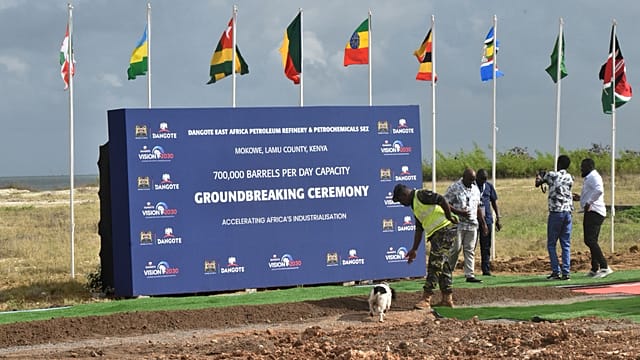
The sun rose over the arid plains of Lamu County, casting a golden hue on the mangrove-fringed coastline where the Indian Ocean meets the Kenyan hinterland. A convoy of dignitaries, their vehicles kicking up dust that settled like fine powder on the shoulders of onlookers, arrived at a sprawling stretch of scrubland earmarked for a transformation that could reshape Africa’s energy destiny. At the heart of the gathering stood Aliko Dangote, Africa’s richest man, his silhouette framed by a backdrop of fluttering flags from Kenya, Uganda, Ethiopia, Togo, Benin and the nostalgic presence of former Nigerian President Olusegun Obasanjo. The air buzzed with anticipation as journalists from Vanguard News, The Guardian Nigeria and AfricaNews.com strained their lenses to capture the moment when a shovel first broke the earth, signalling the start of a $16 billion refinery poised to churn 700,000 barrels of crude each day. Officials whispered that the project would not only be the largest of its kind in East Africa but also an integrated industrial complex boasting a 1,000‑megawatt power plant, plastics and fertiliser units, and a petrochemical hub designed to keep value addition within the continent. As the ceremonial ground was turned, a promise hung in the breeze: that Africa could finally process its own riches, export finished goods, and keep the jobs and wealth that have long slipped away to foreign refineries.
The scene was more than a construction kickoff; it was a symbolic reclamation of economic sovereignty, a narrative that would echo across ministries, marketplaces and the dreams of countless young engineers eager to trade import dependence for homegrown prosperity.
The Forge of Ambition: Where Vision Meets the Red Earth
From the moment the first excavator bit into the reddish Lamu soil, the project became a physical manifestation of a long‑held aspiration to move Africa up the value chain. According to the Kenya‑focused outlet Nairametrics, the Kenyan government has pledged to acquire a stake in the venture through its National Infrastructure Fund, signalling a commitment that goes beyond mere ceremonial support. This financial entanglement, reported also by Business Hallmark, ensures that the state will share in both the risks and the rewards, aligning national interests with the private vigor of Dangote Group. The scale of the undertaking is staggering: a $16 billion outlay that dwarfs most infrastructure efforts on the continent, yet the timeline is astonishingly tight—just forty months to bring a 700,000‑barrel‑per‑day facility online, a pledge repeated by TVC News and Peoples Gazette as evidence of Dangote’s reputation for delivering mega‑projects at breakneck speed. Observers from Reuters noted that the decision to locate the refinery in Lamu, rather than the originally mooted Tanzanian site of Tanga, was driven by the port’s deep‑water capacity, which can accommodate the massive crude carriers essential for such a venture, a point reinforced by the DW.com coverage of the groundbreaking ceremony. The strategic choice also reflects a broader geological advantage: the Lamu basin offers stronger ground conditions capable of bearing the weight of colossal refining units, a factor that reduces the risk of costly delays.
As the earth moved, the scent of diesel and possibility mingled, and onlookers could almost hear the hum of future turbines and the clatter of polypropylene pellets being forged in the nascent complex. This forge of ambition is not merely about concrete and steel; it is about rewriting the narrative of a continent that has long exported crude only to import refined products at a premium, a cycle that the project’s architects intend to break with every barrel that will eventually flow from the Lamu refinery.
The Tapestry of Livelihoods: Jobs, Skills, and the Promise of Local Talent
Beyond the towering columns and sprawling pipelines, the true measure of the refinery’s impact will be woven into the everyday lives of the people who call Lamu and its environs home. The Kenya‑based outlet Nairametrics highlighted President William Ruto’s projection that the construction phase alone will generate roughly 60,000 direct jobs, a figure that reverberated through the speeches of Ugandan President Yoweri Museveni and Ethiopian Premier Abiy Ahmed, who both lauded the initiative as a catalyst for regional employment. According to AfricaNews.com, Dangote has pledged to establish a training school for engineers in Lamu, ensuring that the skilled workforce needed to operate the sophisticated Honeywell‑licensed units is sourced locally rather than imported from distant shores. This commitment to indigenous capacity building was echoed by The Guardian Nigeria, which reported that the businessman emphasized his desire to “get expertise locally without having to employ people from China or India,” a sentiment that resonates with the broader African push for technology transfer and skill retention. The social ripple extends beyond the refinery fence: the integrated complex promises ancillary opportunities in plastics manufacturing, fertiliser production and chemical processing, each sector capable of spawning small‑and‑medium enterprises that will feed off the refinery’s output. Moreover, the National Infrastructure Fund’s stake, as detailed by Nairametrics, will allow Kenyan citizens to indirectly benefit from dividends and reinvestment into community projects such as schools, clinics and road improvements.
In the words of a senior development analyst quoted by Vanguard News, the project could become a “living laboratory” where technical vocations are nurtured, entrepreneurship is sparked, and the specter of youth unemployment begins to recede. As the first concrete foundations settle, the tapestry of livelihoods is already being threaded with hopes that the refinery will not just process oil but also process dreams into tangible prosperity for generations to come.
The Council of Nations: African Leaders Gather as Architects of Integration
The groundbreaking ceremony was less a solitary corporate event and more a convocation of continental leaders, each bringing their own vision of a united, industrialised Africa. President William Ruto of Kenya stood shoulder‑to‑shoulder with Ugandan President Yoweri Museveni, Ethiopian Prime Minister Abiy Ahmed, Togolese President Jean‑Lucien Savi de Tové, Beninese President Romuald Wadagni and the venerable former Nigerian President Olusegun Obasanjo, a gathering chronicled by THISDAY and AfricaNews.com as a testament to the project’s pan‑African significance. Museveni, known for his ardent advocacy of value addition, used the platform to decry the “70‑year betrayal” of exporting raw materials while importing finished goods, a refrain that found echo in the remarks of Abiy, who framed the refinery as a “new chapter in Africa’s industrial journey.” The presence of Obasanjo carried a particular symbolic weight; according to Dangote’s own recollection, the former Nigerian leader had once backed a daring cement venture when skeptics abounded, a story that the businessman shared to illustrate the kind of political courage needed to see mega‑projects through to completion. This historical anecdote, reported by The Guardian Nigeria, served to reinforce the message that strong leadership and policy certainty are as vital as financing and technology. The leaders also discussed the broader infrastructural canvas, notably the Lamu Port South Sudan and Ethiopia Transport (LAPSSET) Corridor, which the refinery is expected to anchor, a point highlighted by TVC News and Peoples Gazette.
By committing to the project, these heads of state are effectively pledging political will to streamline cross‑border trade, harmonise regulations and create a conducive environment for future industrial ventures. The council’s communiqué, though not released in a formal statement, was evident in the shared enthusiasm and the mutual commitment to ensure that the refinery’s benefits ripple beyond Kenya’s borders, fostering a sense of shared ownership that could become a template for other resource‑rich nations seeking to leap up the value chain.
The Engine of Innovation: Honeywell, Technology, and the Race Against Time
At the technical core of the Lamu refinery lies a partnership that could dramatically compress the usual gestation period for such facilities: the alliance with Honeywell Technologies. As reported by Reuters, Honeywell will provide engineering services, licensing and critical equipment for the 700,000‑barrel‑per‑day plant under a $300 million deal, a figure confirmed by The Guardian Nigeria News and AfricaNews.com. The significance of this collaboration extends beyond mere supply; Honeywell President Rajesh Gattupalli explained that the company’s proven large‑train engineering designs, honed through years of work with Dangote, will enable the project to shave nearly two years off the typical construction schedule—a reduction of almost thirty percent. This acceleration is crucial given the ambitious forty‑month deadline set by Dangote himself, a timeline that would be extraordinarily challenging without such technological shortcuts. The refinery’s design will leverage Honeywell’s refining and petrochemical processing solutions to produce a slate of products ranging from gasoline and diesel to jet fuel and polypropylene, ensuring that the complex can meet both domestic demand and export specifications. Moreover, the integration of a 1,000‑megawatt power plant, as outlined by Business Hallmark, will be guided by Honeywell’s expertise in energy efficiency, allowing the refinery to operate with a lower carbon footprint than many legacy facilities.
The technological edge also extends to digital monitoring and control systems, which will provide real‑time data on throughput, emissions and safety parameters—a feature that industry analysts from Vanguard News suggest could set a new benchmark for operational excellence across African refineries. As the first pieces of Honeywell‑supplied equipment are expected to dock at Lamu Port within the next sixty days, the countdown has truly begun, and the marriage of African ambition with cutting‑edge engineering stands poised to redefine what is possible when local vision meets global expertise.
Future Implications: A Blueprint for Africa’s Industrial Rebirth
Looking beyond the immediate fanfare, the Lamu refinery carries the potential to act as a catalyst for a broader industrial awakening across the continent. If the project meets its forty‑month target and reaches full operational capacity, it could reduce Kenya’s reliance on imported refined petroleum products by a substantial margin, a shift that President Ruto estimated would boost the national economy by roughly twelve percent annually, a figure cited by Nairametrics. The ancillary industries sprouting from the refinery—plastics, fertilisers, chemicals—could generate billions in downstream revenue, creating a multiplier effect that extends far beyond the refinery’s fence line. Moreover, the decision to allocate up to thirty percent equity to participating East African governments, as disclosed by THISDAY, introduces a novel model of resource nationalism where states retain a tangible stake in the profits derived from their hydrocarbons, encouraging reinvestment in local infrastructure and social programs. The project’s success could also inspire similar ventures in other resource‑rich nations, prompting a wave of refineries, petrochemical complexes and integrated industrial parks that prioritize value addition over raw‑material export. Technologically, the Honeywell collaboration may serve as a proving ground for adapting advanced refining techniques to African contexts, potentially lowering the barrier for future entrants seeking to harness similar efficiencies.
Socially, the emphasis on local training and employment could help alleviate youth unemployment, a persistent challenge that has long plagued the region. Politically, the visible unity of African leaders at the groundbreaking may strengthen regional blocs, fostering easier negotiations on trade harmonisation, customs protocols and cross‑border energy grids. In essence, the Lamu refinery is not merely a concrete and steel edifice; it is a living prototype of what a self‑sufficient, industrially vibrant Africa could resemble. Should it deliver on its promises, it will stand as a testament to the power of visionary leadership, strategic partnerships and the unwavering belief that the continent can indeed process its own wealth, create its own jobs, and chart a future where prosperity is homegrown rather than imported.
📰 Sources Cited
- THISDAY: African Leaders in Attendance as Dangote Launches $16 Billion Kenya Refinery
- Google News Nigeria: Dangote seals $300m Honeywell deal, sets 40-month deadline for Lamu refinery - The Guardian Nigeria News
- AfricaNews.com: Dangote's $16bn Kenya refinery 'new chapter' for Africa
- TVC News: Dangote to Deliver $16bn East Africa Refinery in 40 Months
- Peoples Gazette: Dangote to deliver $16 billion East Africa refinery in 40 months
- Business Hallmark: Dangote begins construction of 700,000bpd refinery in Kenya
- Nairametrics: Kenyan government to buy stake in $16 billion Dangote Lamu oil refinery – Ruto
0 Comments
Sign in to commentNo comments yet. Be the first to share your thoughts!