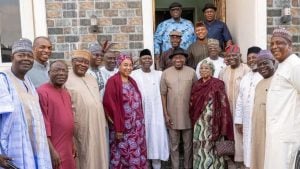
The morning light spills over the rolling hills of Osun State, catching the glint of campaign posters that flutter like restless birds along the dusty roads of Osogbo, Ilesa, and Ila. Voters stir in their homes, the scent of roasted corn mingling with the low hum of generators as they prepare for a day that could tilt the balance of power in this southwestern heartland. On August 15, the air will be thick with anticipation, as Governor Ademola Adeleke of the Accord Party urges citizens to ignore threats and troop out to vote, a plea echoed by his party’s national chairman Maxwell Mgbudem and reinforced by the presidential candidate of Accord, Dr Gbenga Olawepo‑Hashim, who calls on supporters to close ranks and mobilise massively for victory. Across the political divide, the APC’s candidate Oyebamiji has unveiled a “Prosperity Agenda” manifesto, promising economic growth, social inclusion, and lasting development through prudent leadership and private‑sector driven investment, a vision presented in PM News Nigeria as a covenant with the people. Meanwhile, the national political arena hums with speculation, as the House of Representatives Minority Leader Fred Agbedi told Arise Television’s Morning Show that the Peoples Democratic Party could reclaim power in 2027 if former President Goodluck Jonathan eventually appears on the ballot, a comment that reverberates through local calculations about party loyalty and future alliances.
In this charged atmosphere, the electorate faces not only a choice of personalities but a contest over competing visions of prosperity, security, and identity that will shape Osun’s trajectory for years to come.
The Tide of Allegiance: Party Loyalty in a Shifting Landscape
According to Politics Nigeria, Fred Agbedi’s confidence in a PDP resurgence hinges on the potential return of Goodluck Jonathan, a figure whose name still carries weight among certain constituencies in Osun who recall the era of federal largesse and infrastructural pushes under his administration. This national speculation intersects with local realities where the Accord Party, bolstered by the urging of Dr Gbenga Olawepo‑Hashim, seeks to solidify its base by reminding voters that the actions of a few individuals must not derail the party’s mission, a sentiment reported in the Nigerian Tribune as Hashim called on Accord stakeholders and supporters to remain loyal and mobilise massively for victory. Simultaneously, Sun News Online notes that the Accord Party’s national chairman Maxwell Mgbudem has charged voters to resist threats and inducements, warning that the integrity of the vote hinges on citizens’ ability to make informed decisions based on the achievements of Governor Adeleke, whose tenure has been marked by efforts to pay salaries, revive local markets, and improve rural road networks. The APC, meanwhile, attempts to peel away disaffected voters by framing its Prosperity Agenda as a fresh alternative, a narrative that Oyebamiji presented in PM News Nigeria as a strategic blend of public investment and private‑sector partnership aimed at unlocking Osun’s latent economic potential.
These overlapping messages create a dynamic where voters must weigh personal experiences of governance against broader party narratives, a calculus that will be tested on the ground as party agents navigate the delicate terrain of persuasion, pressure, and promise.
The Economic Backdrop: Growth Promises and Ground‑Level Realities
The economic dimension of the Osun governorship race is anchored in the contrasting blueprints offered by the two major contenders. Oyebamiji’s Prosperity Agenda, detailed in PM News Nigeria, outlines a plan to attract strategic investments, boost agro‑processing zones, and foster small‑and‑medium enterprises through tax incentives and improved access to credit, a strategy that analysts suggest could lift the state’s GDP growth rate by an estimated 1.5 percentage points over the next four years if implemented effectively. Complementing this, the Accord Party points to Adeleke’s record of paying overdue salaries, clearing pension backlogs, and initiating the Osun Rural Access Project, which has reportedly rehabilitated more than 300 kilometres of feeder roads, facilitating market access for farmers in the cocoa and oil palm belts. Yet, despite these claims, independent observers note that unemployment remains stubbornly high, with youth joblessness hovering around 22 percent according to recent labor surveys, and that the state’s internal revenue generation still lags behind fiscal needs, forcing reliance on federal allocations. Experts warn that without a concrete framework for revenue diversification—perhaps through expanded tourism around the Osun‑Osogbo Sacred Grove or the development of solid mineral deposits—any prosperity agenda risks remaining aspirational. The electorate thus faces a pragmatic question: whether the promise of private‑sector driven growth outweighs the tangible, if incremental, gains delivered by the incumbent administration, a debate that will unfold in market squares, town halls, and the digital forums where Osun’s artisans and traders exchange views.
The Social Fabric: Threats, Inducements, and the Quest for Authentic Voice
Socially, the election is unfolding against a backdrop of intimidation and inducement that has become a recurring theme in Nigerian off‑cycle contests. Sun News Online’s report that the Accord Party has charged voters to resist threats and inducements underscores a palpable fear among citizens that political actors may resort to coercion—whether through late‑night visits, the distribution of cash gifts, or the spreading of rumors designed to suppress turnout. Adeleke’s direct appeal, broadcast via Google News Nigeria’s aggregation of THISDAYLIVE, urges Osun voters to “ignore threats, troop out to vote Accord on August 15,” a rallying cry that seeks to transform fear into civic courage. Complementing this, Dr Gbenga Olawepo‑Hashim’s call for supporters to close ranks, as reported in the Nigerian Tribune, functions as an attempt to forge a united front capable of withstanding external pressures, reinforcing the idea that electoral legitimacy depends not merely on numbers but on the moral fortitude of the electorate. Cultural dimensions further enrich the contest: Osun’s deep‑rooted traditions of communal deliberation, exemplified by the monthly town‑hall meetings held under the shade of the ancient iroko trees, provide a informal arena where elders, religious leaders, and youth groups discuss the merits of each candidate’s platform. In these spaces, the notion of “omoluabi”—the ideal of a person of good character—frequently surfaces, with voters weighing not only policy proposals but the perceived integrity and humility of those seeking office.
The interplay of traditional authority and modern campaign tactics creates a nuanced social battlefield where respect for heritage must contend with the allure of immediate material benefits, a tension that will shape the moral texture of the vote.
The Informational Arena: Digital Mobilisation and the Battle for Narratives
Technologically, the Osun governorship contest has become a testing ground for how information flows—and is manipulated—in the digital age. The Google News Nigeria snippet highlighting Adeleke’s plea to ignore threats illustrates how campaign messages are now disseminated instantly across platforms such as WhatsApp, Facebook, and Twitter, allowing supporters to circulate videos of rallies, audio clips of speeches, and infographics detailing the Prosperity Agenda within minutes of their release. This rapid diffusion, however, is a double‑edged sword; analysts warn that the same channels can be weaponised to spread misinformation, from fabricated endorsements to doctored images suggesting violence at polling stations, thereby eroding trust in the electoral process. INEC’s deployment of the Bimodal Voter Accreditation System (BVAS) aims to bolster transparency, yet reports from past elections indicate that technical glitches and delayed transmission of results can fuel suspicions of tampering, especially when amplified by social media echo chambers. Moreover, the use of data‑driven micro‑targeting—where campaign teams analyse voter demographics to tailor messages—has raised concerns about privacy and the potential for exacerbating ethnic or religious cleavages. In this environment, the role of fact‑checking initiatives and civic tech groups becomes critical; organisations that verify claims and provide real‑time updates on polling station openings can serve as a bulwark against deception.
Ultimately, the electorate’s ability to discern signal from noise will hinge on media literacy, the resilience of independent journalism, and the extent to which political actors commit to ethical communication in a landscape where the line between persuasion and propaganda is increasingly blurred.
Future Implications: A Blueprint for Governance or a Fleeting Band‑Aid?
Looking ahead, the outcome of the Osun governorship election carries ramifications that extend far beyond the state’s borders, touching on the national political calculus and the evolving discourse on effective governance. Should Adeleke secure a second term, the Accord Party would consolidate its foothold in the Southwest, potentially emboldening its national leadership to push for a more aggressive stance in the 2027 presidential race, a scenario that aligns with Fred Agbedi’s optimism about a PDP resurgence contingent on Goodluck Jonathan’s candidacy—though any such realignment would require navigating the complex interplay of party structures, regional alliances, and voter sentiment that currently favours the APC in many Southern constituencies. Conversely, an Oyebamiji victory would validate the Prosperity Agenda as a viable template for state‑level development, offering a concrete example of how private‑sector partnerships can be harnessed to address infrastructure gaps, unemployment, and revenue shortfalls; success here could inspire similar models in other states grappling with fiscal constraints, while failure might deepen public scepticism toward market‑oriented solutions. Moreover, the election’s handling of threats and inducements will serve as a litmus test for Nigeria’s electoral integrity mechanisms; a peaceful, credible outcome could strengthen confidence in INEC’s reforms and encourage greater civic participation, whereas allegations of coercion or malfeasance might fuel calls for electoral judicial review and heightened civil society vigilance.
In either case, the social fabric of Osun—its blend of traditional reverence for communal deliberation and its burgeoning digital activism—will continue to shape how citizens hold leaders accountable, suggesting that the true measure of governance lies not only in policy blueprints but in the sustained capacity of the populace to demand transparency, uphold the omoluabi ethos, and transform the river of votes into a enduring current of progress.
📰 Sources Cited
- Politics Nigeria: PDP Will Win 2027 Election if Jonathan is on Ballot — Reps Minority Leader
- Sun News Online: Osun guber: Resist threats, inducements, Accord Party tells voters
- Nigerian Tribune: Osun guber: Gbenga Hashim urges Accord supporters, stakeholders to vote for Adeleke
- PM News Nigeria: Osun governorship poll: APC’s Oyebamiji unveils “Prosperity Agenda” manifesto
- Google News Nigeria: Adeleke to Osun Voters: Ignore Threats, Troop Out to Vote Accord on August 15 - THISDAYLIVE
0 Comments
Sign in to commentNo comments yet. Be the first to share your thoughts!