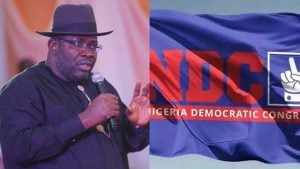
The air in Abuja hummed with a restless energy as September gave way to the early whispers of the 2027 campaign season, a period that has become a crucible for Nigeria’s evolving political alliances. On a sun‑drenched Tuesday, Senator Seriake Dickson, the National Leader of the Nigeria Democratic Congress, leaned forward in a plush reception hall, his voice tinged with both admonition and concern as he dismissed the newly formed 59‑member presidential campaign council of the Obi‑Kwankwaso Movement as “nonsensical.” His words struck a chord that reverberated through party headquarters and grassroots meeting points alike, framing the debate not merely as a procedural squabble but as a fundamental clash over who gets to shape the machinery that will propel Peter Obi and Rabiu Kwankwaso toward the presidency. Just days earlier, the movement’s Director‑General, John Ughulu, had fired back with a steadfast declaration that the OK Movement would not be collapsed, merged, or subsumed into the NDC or any other organisation, insisting that cooperation and political alignment do not extinguish the independent identity of the Movement. This standoff, rooted in a September 17 unveiling of a campaign council that the NDC swiftly disowned, has exposed a deeper tension between the desire for a unified party apparatus and the persistence of a homegrown network that claims 2.5 million registered members and coordinators across the nation’s wards, local governments, and states.
As the NDC moves to establish its own official Presidential Campaign Council, granting Obi and Kwankwaso authority to nominate key officers in consultation with party leadership, the OK Movement’s National Secretary, Saadatu Sani, has demanded an apology from NDC Chairman Moses Cleopas and warned that the movement will continue to support NDC candidates while preserving its own decision‑making process. The dispute is more than a spat over organizational charts; it is a reflection of Nigeria’s shifting political culture, where youthful enthusiasm, regional loyalties, and digital mobilization intersect with traditional party structures, setting the stage for a contest that could redefine coalition politics ahead of the 2027 general election.
The Roots of Dissent: Grassroots Networks and Ideological Fissures
Beneath the surface of the public quarrel lies a sprawling grassroots architecture that the OK Movement has painstakingly assembled over the past few years, a network that its leaders describe as a living tapestry woven from diverse political backgrounds united by admiration for Peter Obi’s reformist vision and Rabiu Kwankwaso’s populist appeal. According to internal disclosures shared with Politics Nigeria, the movement’s database boasts roughly 2.5 million registered members and coordinators, a figure that dwarfs the conventional membership rolls of many established parties and signals a formidable capacity for voter mobilization at the ward level. This claim is echoed by the ICIR Nigeria report, which quoted National Director‑General John Ughulu emphasizing that the movement operates its own leadership and mobilisation structures, independent of any party’s internal management. The economic implications of such a base are significant: political analysts estimate that a coordinated outreach effort by a network of this scale could influence swing votes in key states such as Lagos, Kano, and Rivers, potentially shifting the balance in a tightly contested election where even a few percentage points can determine victory. Socially, the movement has tapped into a vein of youthful disenchantment with the status quo, drawing in university students, tech‑savvy entrepreneurs, and civil society activists who view the Obi‑Kwankwaso tandem as a harbinger of a new ethical politics.
Culturally, the OK Movement has become a symbol of regional bridge‑building, merging the Obidient wave rooted in the Southeast with the Kwankwasiyya stronghold of the Northwest, thereby creating a pan‑ethnic coalition that challenges the historical dominance of ethno‑based party machines. Technologically, the movement has leveraged WhatsApp broadcast lists, Facebook groups, and a custom‑built SMS platform to disseminate campaign materials, coordinate rallies, and collect real‑time feedback from the field, a digital infrastructure that its leaders argue renders traditional party hierarchies obsolete. As Dickson warned that support groups should not operate as parallel structures to political parties, the OK Movement’s retort — that it brings together people from different political backgrounds united by a shared vision — underscores a belief that authenticity and grassroots legitimacy can coexist with, rather than be subsumed by, formal party organs.
The Battle Over Structures: Campaign Councils and Party Authority
The flashpoint of the current discord is the 59‑member presidential campaign council unveiled on September 17, a body that the OK Movement presented as the operational nerve centre for its 2027 election efforts, complete with a director‑general, a national secretary, and specialized directors for mobilisation, women’s affairs, strategy, security, and legal affairs. Sun News Online captured Senator Seriake Dickson’s scathing reaction, labeling the council “nonsensical” and insisting that support groups should not compete with the political party backing their candidates,” a sentiment he reiterated while receiving former Secretary to the Government of the Federation Babachir Lawal into the NDC. The NDC’s National Chairman, Senator Moses Cleopas, swiftly moved to disown the council, declaring that it had not originated from the party and was not authorised by its National Working Committee, and he referred Ughulu to the party’s disciplinary organ for alleged disregard of party authority during the Lagos State primary. In response, the OK Movement’s National Secretary, Saadatu Sani, insisted that the movement does not require the personal validation or approval of any individual before exercising its legitimate organisational functions, a stance she reinforced by demanding that Cleopas withdraw his statements and offer an apology. This tug of war over authority is not merely procedural; it carries economic weight, as control over campaign structures determines access to funding streams, advertising slots, and logistical support that can make or break a candidacy in a nation where campaign expenditures routinely run into hundreds of millions of naira.
Politically, the dispute exposes a fault line within the NDC between those who view allied movements as extensions of party discipline and those who recognize the strategic value of maintaining semi‑autonomous allies that can mobilize constituencies the party itself struggles to reach. The cultural dimension is evident in the way each side frames legitimacy: the NDC emphasizes party hierarchy and constitutional propriety, while the OK Movement invokes a narrative of popular sovereignty and bottom‑up legitimacy that resonates with a electorate weary of top‑down decision‑making. Technologically, the council’s composition includes a director for strategy who is tasked with harnessing data analytics to micro‑target voters, a capability that the NDC’s own campaign council is still in the process of building, thereby giving the OK Movement a potential edge in the information battlefield. As the NDC moves to establish its official Presidential Campaign Council, granting Obi and Kwankwaso authority to nominate several key officers in consultation with party leadership, the outcome of this structural contest will likely shape the balance of power within the broader alliance and determine whether the 2027 campaign runs as a synchronized machine or as a coalition of semi‑independent actors.
Future Implications: A Blueprint for Coalition or a Fracture Ahead?
Looking ahead, the resolution — or lack thereof — of this structural impasse will have far‑reaching consequences for Nigeria’s democratic landscape, influencing not only the 2027 election but also the evolution of party‑movement relations for years to come. Economically, if the OK Movement succeeds in maintaining its independent structure while still delivering robust support for NDC candidates, it could pioneer a hybrid model whereby parties retain formal control over policy platforms and nomination processes, while allied networks handle grassroots mobilization, fundraising, and voter education, thereby optimizing resource allocation in a environment where campaign finance regulations remain loosely enforced. Such a model could reduce the financial burden on parties, potentially lowering the barrier to entry for new political entrants and fostering a more competitive multiparty system. Socially, the persistence of a strong, identity‑driven movement like the OK Movement may deepen voter engagement among demographics that have historically felt alienated from traditional politics, particularly young urban voters and women’s groups, whose participation could shift the political discourse toward issues of governance, accountability, and social justice. Culturally, the episode highlights a growing demand for political organizations that reflect Nigeria’s pluralistic ethos, suggesting that future coalitions may need to accommodate multiple layers of identity — ethnic, regional, ideological — without forcing conformity to a single party line.
Technologically, the OK Movement’s early adoption of digital organizing tools offers a glimpse into how future campaigns will be fought not just on the streets but also in the virtual realm, where data‑driven outreach, real‑time sentiment analysis, and rapid response capabilities could become decisive advantages. Experts warn, however, that if the NDC insists on subsuming all allied structures under its central authority, the resulting alienation could drive key support bases toward alternative platforms or even spur the formation of new political movements, thereby fragmenting the opposition vote and inadvertently strengthening incumbent prospects. Ultimately, the path forward will depend on whether leaders like Dickson, Cleopas, Ughulu, and Sani can forge a pragmatic accommodation that respects both the need for party cohesion and the value of independent, mobilized constituencies — a delicate balance that, if achieved, might offer a blueprint for a more resilient and inclusive democratic politics in Nigeria. If not, the 2027 election could become a cautionary tale of how structural rigidity undermines the very coalitions it seeks to empower.
📰 Sources Cited
- PM News Nigeria: OK Movement fires at Dickson, vows not to surrender structure to NDC
- Politics Nigeria: 2027: OK Movement Rejects NDC Control, Vows to Keep Its Structure
- ICIR Nigeria: OK Movement independent, not subject to NDC internal management – DG
- Sun News Online: OK Movement has no business setting up campaign council – Dickson
- Politics Nigeria: It’s Nonsensical – Dickson Slams OK Movement Over Campaign Council
0 Comments
Sign in to commentNo comments yet. Be the first to share your thoughts!