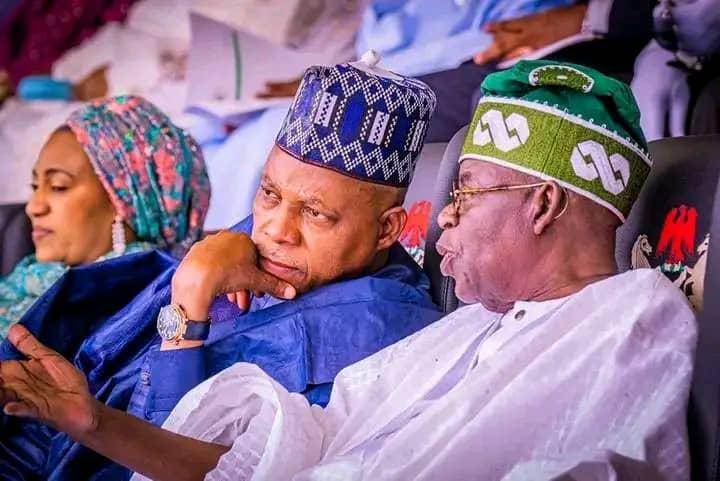
The humid afternoon air over Ilorin’s ancient palace seemed to hold its breath as Vice President Kashim Shettima stepped onto the marble steps, the turbaning of Kwara State Governor AbdulRahman AbdulRazaq as the new Sardauna unfolding like a centuries‑old ritual renewed for a modern political drama. Cameras flashed, murmurs rippled through the crowd of traditional rulers, party stalwarts and curious onlookers, each gesture weighted with the unspoken question of who truly stood behind Bola Ahmed Tinubu when he first dared to chase the APC presidential ticket. In that moment, Shettima’s voice cut through the ceremonial drumbeats, offering a clarification that was at once a rebuttal and a reconciliation: his oft‑quoted remark about “six northern governors” had referred not to the tumultuous 2023 election but to the quiet, back‑room consultations that preceded the June 2022 APC primary. As reported by Leadership Newspaper, the Vice President explained that the comment was rooted in the early alignments that shaped Tinubu’s emergence as the party’s candidate, a period when only a handful of northern leaders had openly pledged their belief in his vision. The statement, issued by his Senior Special Assistant on Media and Communications, Stanley Nkwocha, sought to dispel any impression that the remark questioned the governors’ later support during the general election, emphasizing instead that after the primary, APC governors in the North rallied around Tinubu and played pivotal roles in the campaign that delivered his victory.
By framing his words within this precise temporal window, Shettima attempted to turn a potential flashpoint into a lesson about context, urging the media to preserve accuracy as Nigeria approaches another political season.
The Echoes of June 2022: Primary Alignments and Silent Alliances
Digging into the layers of that June 2022 moment reveals a tableau of ambition, hesitation and calculated risk that few outside the inner circle have ever witnessed. According to Vanguard News, Shettima disclosed that only six out of the nineteen northern governors had backed Tinubu’s presidential ambition ahead of the 2023 election, a figure that starkly contrasts with the near‑unanimous show of unity that later emerged after the primary. The disclosure came during the same Ilorin turbaning ceremony, where Shettima, standing beside Governor AbdulRahman AbdulRazaq, recounted how the path to the APC nomination had been strewn with obstacles, some placed deliberately by fellow party members in the north who doubted Tinubu’s capacity to succeed Muhammadu Buhari. He recalled the whispered slogan “Baba bayan sunshi,” a phrase used by detractors to suggest that the former president did not desire Tinubu’s ascent, a sentiment that lingered like a shadow over the primary contests. Yet, as the Leadership Newspaper account notes, once the primary concluded, the northern APC governors shifted from skepticism to active participation, mobilizing grassroots structures, financing campaign rallies and leveraging their regional influence to secure votes across the Sahelian belt. This transformation, Shettima argued, was not a flip‑flop but a natural political evolution: initial reservations gave way to collective resolve once the party’s choice was ratified, illustrating how intra‑party dissent can be transmuted into electoral strength when leadership channels it toward a common goal.
The Forgiveness Ledger: Tinubu's Grace Amid Northern Dissent
If the primary season exposed the fissures within the northern APC, the aftermath of the 2023 presidential election revealed a different kind of leadership calculus—one rooted in forgiveness rather than retribution. Speaking at the Ilorin palace, Shettima highlighted President Tinubu’s magnanimous gesture toward those northern governors who had opposed his bid, describing the act as “a mark of good leadership” that should inspire politicians nationwide. Vanguard News captured this sentiment, quoting Shettima as saying that after the election, Tinubu “hugged and forgave all other northern governors that did not support him,” a declaration underscored by the Vice President’s own call for political actors to put differences behind them and work together for the collective good. The narrative of forgiveness is further enriched by the PM News Nigeria report, which noted that Shettima regretted any interpretation of his earlier remarks that might have suggested lingering animosity, hoping the clarification would place his comments in their proper context and foster a spirit of reconciliation. This emphasis on pardoning political rivals is not merely a moral exhortation; it carries strategic weight in a nation where electoral outcomes often trigger prolonged bouts of bitterness, undermining governance and development. By framing Tinubu’s post‑electoral outreach as a deliberate leadership tactic, Shettima invites a re‑examination of how political grace can stabilize fragile alliances, turning potential adversaries into stakeholders in the nation’s progress.
The Economic Crucible: Inherited Reserves and the Road to 2027
Beyond the realm of personalities and pardons, Shettima’s remarks at the Ilorin gathering also laid bare the stark economic realities that Tinubu inherited upon assuming office—a backdrop that intensifies the significance of political unity. He revealed that the national reserves stood at less than $3.9 billion, a figure that painted the economy as being on the verge of collapse, a detail reported by Vanguard News in its coverage of the same event. Rather than assigning blame to his predecessor, Tinubu chose to “inherit” the challenges, a stance that Shettima presented as emblematic of responsible leadership in the face of daunting fiscal headwinds. The economic context is crucial when considering the political calculus of the northern governors: with dwindling resources, the stakes of electoral support or opposition are amplified, as each governor’s constituency feels the immediate impact of fiscal policy, inflation and infrastructural neglect. Shettima’s appeal for politicians to eschew politics as a “game of death” and instead embrace reconciliation after contests can thus be read as a pragmatic response to an environment where political instability could further erode already thin economic buffers. The Vice President’s urging that the media maintain accuracy and provide proper context when reporting public remarks takes on added urgency, for misinformation in such a fragile fiscal climate could exacerbate uncertainty, deter investment and deepen the very vulnerabilities the administration seeks to overcome.
The Cultural Tapestry: Reconciliation, Bitterness, and the Sardauna Turbaning
The setting of Shettima’s clarification—the turbaning of Governor AbdulRahman AbdulRazaq as the Sardauna of Ilorin Emirate—offers a rich cultural metaphor that resonates far beyond the immediate political news cycle. The turban, a symbol of authority, wisdom and communal trust in the northern Nigerian tradition, was placed upon AbdulRazaq’s head amid chants and prayers, a visual affirmation of leadership that derives its legitimacy from both hereditary lineage and popular acquiescence. As TVC News reported, the ceremony served as a backdrop for Shettima’s call to unite in the political season and play politics without bitterness, a plea that echoed the very essence of the Sardauna role: to mediate, to heal and to steward the collective welfare of the emirate’s diverse populace. The Vice President’s reflection on the need to reconcile after political contests mirrors the cultural norm that disputes, once settled, should not become permanent fractures; instead, they ought to be woven into the broader social fabric, much like the intricate patterns of a hand‑woven agbada. By anchoring his message in this culturally resonant event, Shettima taps into a deep well of communal expectation that leaders rise above partisan rancor to serve the greater good—a expectation that, if honored, could transform the often‑volatile arena of Nigerian politics into a space where contestation fuels development rather than discord.
Future Implications: A Blueprint for Unity or a Band‑Aid on Fragile Trust?
Looking ahead, the interplay of Shettima’s clarifications, Tinubu’s post‑electoral forgiveness and the stark economic inheritance presents both a cautionary tale and a potential roadmap for Nigeria’s democratic maturation. If the Vice President’s appeal for accurate, contextual reporting is heeded, the media could become a stabilizing force that curbs the spread of inflammatory narratives, thereby reducing the likelihood that political disagreements calcify into enduring vendettas. Moreover, the emphasis on reconciliation after contests—underscored by the cultural symbolism of the Sardauna turbaning—suggests a model where electoral losers are not ostracized but invited into governance structures, a practice that could enhance inclusivity and mitigate the winner‑takes‑all mentality that has historically fueled instability. Economically, the acknowledgment of depleted reserves demands that any political unity be translated into concrete fiscal reforms: prudent resource management, anti‑corruption measures and targeted investments that rebuild confidence among citizens and investors alike. However, the risk remains that such appeals may amount to little more than a band‑aid if underlying power dynamics, patronage networks and entrenched interests are left unaddressed. The true test will be whether the northern governors, having moved from skeptical six to active campaigners, can sustain a collaborative ethos that transcends election cycles, transforming the “whispered six” into a enduring chorus of constructive opposition and loyal support.
Only then will the clarification of Shettima’s words evolve from a momentary clarification into a lasting legacy of political maturity for Africa’s most populous democracy.
📰 Sources Cited
- Leadership Newspaper: My ‘Six Northern Governors’ Comment Was About 2022 Primary- Shettima
- Vanguard News: 2023: Tinubu forgave northern govs who opposed him — Shettima
- Vanguard News: Only six governors supported Tinubu in 2023 — Shettima
- TVC News: Only Six Northern Governors Backed Tinubu In 2023 – Shettima
- PM News Nigeria: Shettima clarifies statement on Northern governors’ support for Tinubu
- Google News Nigeria: Only Six Northern Governors Believed, Supported Tinubu In 2023 – Shettima - channelstv.com
- Google News Nigeria: Shettima: Only Six Northern Governors Believed in and Supported Tinubu in 2023 - THISDAYLIVE
0 Comments
Sign in to commentNo comments yet. Be the first to share your thoughts!