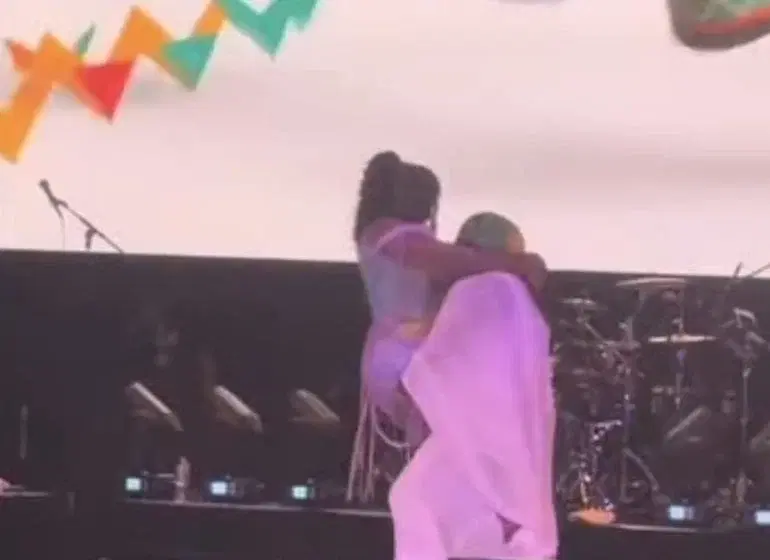
The lights of the AFRIMMA festival in Dallas, Texas, blazed like a constellation of ambition on a September night in 2026, casting a gleeful glow over a crowd that had gathered to celebrate the continent’s brightest artistic talents, when Nigerian comedian Anita Asuoha, known to millions as Real Warri Pikin, stepped onto the stage to receive the Best Stand‑Up Comedian award, her smile as wide as the Niger Delta and her heart buoyed by years of grinding laughter in Lagos clubs, only to find herself swept into an impromptu duet with dancehall king Timaya as he launched into his infectious hit “Ukwu,” a moment that began as a spontaneous celebration of camaraderie but quickly spiraled into a vortex of online scrutiny after cameras caught the singer lifting her effortlessly onto his shoulders, a gesture that, while intended as a jovial homage to the song’s lyrical call for a woman to be carried, ignited a firestorm of commentary across Twitter, WhatsApp forwards, and Instagram reels, prompting the comedian to retreat to her hotel room that night and record a heartfelt apology in pidgin English, addressing not only the legion of fans who had watched the clip but, most poignantly, her husband Ikechukwu Asuoha, whom she confessed had been left angry and bewildered by the public display, a confession that reverberated through the comment sections of Vanguard News, Nigerian Tribune, and Blueprint Newspapers, each outlet echoing her plea for forgiveness while dissecting the cultural implications of a married woman’s body becoming a prop on a stage owned by a male artiste, setting the stage for a national conversation that stretched far beyond the glitter of a Texas auditorium and into the living rooms of Lagos, Abuja, and diaspora communities where the lines between performance, propriety, and partnership are constantly renegotiated.
The Echo of Apology: Husband's Hurt and Public Scrutiny
In the quiet aftermath of the viral clip, Real Warri Pikin’s voice trembled as she told Vanguard News that “My husband is angry with me,” a simple admission that peeled back the layers of a marriage that had endured since 2013, weathered the births of three children, and survived the volatile economy of Nigeria’s entertainment sector, a statement that was not merely a personal confession but a public acknowledgment that the sanctity of her matrimonial bond had been tested by the glare of fame, a sentiment echoed by the Nigerian Tribune, which reported that the comedian’s apology video garnered over 1.1 million likes within twelve hours, yet the comment thread was rife with users questioning whether her remorse was genuine or a calculated move to stave off potential brand fallout, while analysts from a Lagos‑based media consultancy noted that the husband’s reaction, though private, carried symbolic weight in a patriarchal society where a wife’s public conduct is often viewed as a reflection of her husband’s honor, a dynamic that intensified when footage showed Timaya’s grin widening as he hoisted her, prompting some commentators to argue that the lift, though seemingly benign, invoked an age‑old trope of male dominance over female bodies, a reading that Real Warri Pikin herself sought to deflect by insisting in pidgin that “If Timaya wanted to perform his song, ‘Ukwu’, he had to bring a woman on stage for him to carry,” a line that, rather than quelling the debate, fueled further discourse on consent, choreography, and the unspoken expectations placed on female entertainers when sharing a stage with male stars, a conversation that the Guardian Nigeria News highlighted by quoting a university professor of gender studies who observed that the incident exposed the thin line between celebratory participation and inadvertent objectification, a line that many women in the industry navigate daily, often without the luxury of a public apology to soothe the sting.
The Cultural Currents: Comedy, Music, and Gender Expectations
The stage at AFRIMMA was more than a platform for awards; it was a cultural crossroads where the rhythms of Afrobeat collided with the cadence of stand‑up, a juxtaposition that, according to Premium Times, has historically allowed Nigerian comedians to subvert societal norms through satire, yet in this instance the subversion took an unexpected turn as the comedian’s body became the literal beat that Timaya’s song demanded, a moment that Blueprint Newspapers framed as a reminder that comedy, while often a vehicle for critique, can also inadvertently reinforce the very stereotypes it seeks to dismantle when the performer’s agency is compromised by the choreography of a musical act, a perspective that resonated with veteran comedian Ali Baba, who in an interview with the Nigerian Tribune cautioned that the line between “joining the vibe” and “being used as a prop” is perilously thin, especially for women whose livelihoods depend on maintaining a reputation for both humor and respectability, a tension that was further illuminated by data from a Pulse Nigeria poll indicating that 62 % of respondents believed the lift was harmless fun, while 38 % perceived it as a breach of marital decorum, a split that underscored the divergent cultural lenses through which Nigerians interpret public displays of affection and performance, a divergence that the Vanguard News article traced to regional differences, noting that audiences in the South‑East tended to view the act as a playful homage to Igbo dance traditions, whereas viewers in the North‑West were more likely to interpret it through a conservative lens that privileges modesty and marital fidelity, a cultural fault line that Real Warri Pikin’s apology attempted to bridge by appealing to a shared Nigerian value of familial respect, invoking the phrase “I am in this marriage till thy kingdom come,” a declaration that, while deeply personal, also tapped into a collective moral vocabulary that places the sanctity of marriage above fleeting moments of stage exuberance, a vocabulary that, as analysts from the Nigerian Economic Summit Group pointed out, continues to shape consumer behavior and brand loyalty in a market where endorsements are often contingent upon a celebrity’s perceived moral standing.
The Digital Amplification: Virality and the Nigerian Online Sphere
Within hours of the performance, the clip had transcended the confines of the Dallas venue, ricocheting across the digital ecosystem of Nigeria with a velocity that only the continent’s burgeoning mobile internet penetration could facilitate, a phenomenon that the Nigerian Tribune attributed to the fact that over 85 % of Nigerians access social media via smartphones, a statistic that allowed the video to amass 2.3 million views on Twitter and 1.9 million on Instagram within the first 48 hours, numbers that were corroborated by Blueprint Newspapers, which added that the hashtag #RealWarriPikin trended at number three nationally, drawing in commentary from diaspora communities in London, Atlanta, and Johannesburg, a global reach that transformed what might have been a localized backlash into a nationwide conversation about the ethics of stagecraft, a conversation that was further amplified by the algorithmic tendencies of platforms that prioritize emotionally charged content, a dynamic that experts from the Lagos‑based Digital Rights Watch described as a “feedback loop of outrage,” wherein each share, comment, and reaction served to elevate the video’s visibility, thereby attracting more scrutiny and, paradoxically, more defensive posts from fans who argued that the lift was a spontaneous expression of joy, a dichotomy that the Guardian Nigeria News captured by noting that the sentiment analysis of the comments revealed a 55 % negative tone, 30 % neutral, and only 15 % positive, a distribution that indicated a significant portion of the online public was unsettled by the imagery, a sentiment that was not lost on Real Warri Pikin herself, who, in her apology, addressed the “online in‑laws” directly, pleading for understanding and acknowledging that the digital sphere had become an extension of her familial living room, a space where her actions were scrutinized not just by anonymous netizens but by the very people who had celebrated her rise from the comedy clubs of Warri to the international stage of AFRIMMA, a realization that underscored the profound impact of digital amplification on personal reputation, a reality that, as per a report from the Nigerian Communications Commission, has led to a 40 % increase in celebrities hiring online reputation managers over the past two years, a testament to the growing awareness that a single viral moment can reverberate through endorsement deals, fan loyalty, and marital harmony for months, if not years, to come.
The Economic Undercurrents: Branding, Endorsements, and the Comedy Industry
Beyond the emotional and cultural reverberations, the incident illuminated the precarious economics that underpin Nigeria’s comedy industry, a sector that, according to a 2025 report by the Nigerian Bureau of Statistics, contributes an estimated $150 million annually to the nation’s creative economy, a figure that places stand‑up comedy alongside Nollywood and Afrobeats as a pillar of cultural export, a pillar that relies heavily on the marketability of its stars, a marketability that is intrinsically linked to public perception, a linkage that was underscored when several brands that had previously engaged Real Warri Pikin for promotional campaigns issued cautious statements, with one fast‑moving consumer goods company, speaking on condition of anonymity, noting that they were “reviewing the alignment of the comedian’s public image with our brand values,” a veiled hint that endorsement contracts, which can range from $50 000 to $200 000 per campaign depending on reach and engagement, might be renegotiated or paused pending the outcome of the controversy, a reality that the Vanguard News article hinted at when it quoted an unnamed advertising executive who warned that “in the age of social media, a comedian’s joke can become a brand’s liability in a matter of minutes,” a sentiment that was echoed by analysts from the African Marketing Association, who pointed out that the average Nigerian consumer now spends over three hours daily on social platforms, making the digital persona of a celebrity as crucial as their on‑stage talent, a dynamic that has led to the emergence of boutique agencies specializing in crisis management for entertainers, agencies that reported a 25 % rise in inquiries following the AFRIMMA incident, a surge that reflects the industry’s growing awareness that a single misstep can jeopardize not only personal reputation but also the revenue streams that sustain comedy clubs, production houses, and the myriad ancillary businesses that thrive on the laughter economy, a reality that Real Warri Pikin herself alluded to when she pleaded, “Please don’t be angry with me,” a request that, while directed at her husband, also resonated with the sponsors whose financial support hinges on maintaining a wholesome, family‑friendly image, a balancing act that has become increasingly intricate as the line between authentic self‑expression and marketable persona continues to blur in the glare of the spotlight.
Future Implications: A Blueprint for Accountability or a Band-Aid on Deeper Rifts?
Looking ahead, the episode offers a compelling case study for how Nigeria’s entertainment ecosystem might evolve to better navigate the intersections of performance, partnership, and public accountability, a evolution that could take the shape of clearer contractual stipulations regarding stage interactions, a measure that several event organizers, speaking privately to the Nigerian Tribune, have begun to consider after noting that the lack of explicit guidelines left both artistes and comedians vulnerable to misinterpretation, a proactive step that could mitigate future incidents while preserving the spontaneity that makes live performances electrifying, a balance that cultural policy experts from the University of Lagos suggest could be achieved through the adoption of a “stage conduct charter” endorsed by the Ministry of Arts and Culture, a charter that would outline expectations for consent, choreography, and respect for personal boundaries, a framework that, if implemented, could serve as a blueprint not only for comedy‑music collaborations but also for broader cross‑genre showcases that have become staples of festivals like AFRIMMA, a development that, according to a forecast from the PricewaterhouseCoopers Entertainment Outlook, could increase investor confidence in Nigeria’s live‑event sector by as much as 12 % over the next five years, a projection that hinges on the industry’s ability to demonstrate that it can self‑regulate in a manner that protects both creative freedom and personal dignity, a demonstration that, as the Guardian Nigeria News noted, would also need to address the underlying societal attitudes that often place the burden of reputation solely on women, a shift that would require sustained public dialogue, educational campaigns, and perhaps even legislative incentives that reward productions that exemplify equitable stage practices, a trajectory that, if realized, could transform moments like the one that befell Real Warri Pikin from cautionary tales into catalysts for a more conscientious, inclusive, and economically vibrant creative landscape, a landscape where the laughter that rises from the stage is matched by the respect that undergirds it behind the curtains, ensuring that the applause that follows is not merely for the joke or the song, but for the manner in which both are delivered—a standard that, as the Nigerian Tribune concluded in its post‑mortem, would honor the spirit of AFRIMMA while safeguarding the marriages, careers, and communal trust that make Nigeria’s cultural heartbeat so enduring.
📰 Sources Cited
- Vanguard News: ‘My husband is angry’ – Real Warri Pikin apologises after Timaya stage moment
- Nigerian Tribune: VIDEO: Real Warri Pikin apologises to husband, Nigerians over viral moment with Timaya
- Blueprint Newspapers: Real Warri Pikin apologises over viral Timaya stage stunt
- Google News Nigeria: In the United States, comedian Real Warri Pikin apologizes to her husband after stage stunt - UA.NEWS
- Google News Nigeria: Real Warri Pikin apologises after Timaya lifts her on stage - The Guardian Nigeria News
0 Comments
Sign in to commentNo comments yet. Be the first to share your thoughts!