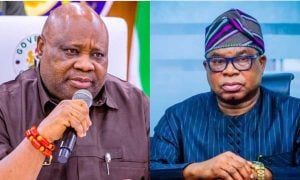
The humid air over Osogbo hangs thick with the scent of roasted corn and the low rumble of motorbikes weaving through streets plastered with posters that flash the faces of Ademola Adeleke and Bola Oyebamiji like competing constellations in a night sky. On August 15, 2026, the state will decide whether to renew the mandate of the incumbent governor, whose Accord Party rose to power on a wave of youthful optimism two years ago, or to hand the reins to the All Progressives Congress candidate backed by the machinery of President Bola Tinubu’s federal coalition. The contest is not merely a clash of personalities; it is a referendum on the direction of a state where oil revenues have dwindled, agricultural yields have faltered, and a generation of graduates waits for jobs that seem perpetually out of reach. In the weeks leading up to the vote, the atmosphere has shifted from lively campaign rallies to something resembling a low‑intensity conflict, with reports of tear gas canisters hissing in the early morning, a House of Representatives candidate left bleeding after an alleged assault, and senior politicians trading accusations that the police have taken sides. Amid this tension, civil society groups, religious leaders, and ordinary citizens whisper a shared plea: let the drum of democracy beat louder than the baton of intimidation, and let the people’s will be the only verdict that matters.
The Fractured Economy: Oil, Agriculture, and the Promise of Prosperity
Beneath the political pageantry lies an economy strained by the dual shocks of declining federal allocations and unpredictable weather patterns that have turned once‑fertile farmlands into patches of cracked earth. According to a recent analysis by the Nigerian Bureau of Statistics, Osun’s internally generated revenue fell by 18 percent in the fiscal year 2025, a shortfall that has forced the state government to delay salary payments for civil servants and to postpone several rural electrification projects. The governor’s administration points to a newly launched agro‑processing hub in Ilesa, which it claims will create 5,000 jobs and add ₦12 billion to the state’s gross domestic product by 2028, yet critics argue that the project remains underfunded and that the promised private‑sector partners have yet to sign binding agreements. Meanwhile, the APC’s campaign literature highlights a pledge to revive the state’s dormant limestone quarries, asserting that a renewed mining sector could generate ₦8 billion annually and reduce unemployment among youths from the current 27 percent to under 15 percent within two terms. These figures are echoed by a development economist at the University of Ibadan, who notes that without a clear framework for value‑addition and transparent licensing, mineral extraction risks repeating the pattern of resource‑rich communities seeing little improvement in living standards.
The disintegration of the Peoples Democratic Party, which many analysts say helped Adeleke secure his 2022 victory, has also left a vacuum in grassroots mobilization, making it harder for either major party to deliver on economic promises without resorting to patronage networks that siphon funds away from productive investment. As market women in Osogbo lament the rising cost of garri and the dwindling patronage at the Oja Oba market, the electorate’s calculations are increasingly shaped by pocketbook concerns rather than ideological loyalties, setting the stage for a contest where economic credibility may prove as decisive as any rallying cry.
The Ballot and the Baton: Security Forces, Political Thugs, and the Struggle for Order
The security landscape in Osun has become a mirror reflecting the broader anxieties of a nation where the line between protection and partisanship often blurs. In early August, a viral video circulating on X showed Senator Francis Fadahunsi of the APC addressing supporters in Yoruba and urging them to “defeat Accord” through votes, a statement that a human rights lawyer later condemned as reckless and capable of inciting violence, even though the senator claimed his words were metaphorical. The lawyer’s accusation that the Osun State Police Command had taken sides gained traction after the senator was invited to the Criminal Investigation Department, questioned, and released on administrative bail, a move the lawyer interpreted as a signal that politically connected figures could operate above the law. Compounding these fears, Omoyele Sowore, the presidential candidate of the Nigeria Democratic Congress for 2027, alleged that police officers fired tear gas at him and his entourage as they traveled toward Osogbo, insisting that the confrontation began after a peaceful dialogue and that the security agents had acted to intimidate rather than protect. Sowore’s claim was echoed by a resident of Osogbo who told a reporter from PM News Nigeria that the state “already looks like a war zone,” citing the omnipresence of armored personnel carriers, the frequent sight of armed men in civilian clothing, and the palpable tension that makes ordinary citizens think twice before stepping out after dark.
Earlier in the year, an APC member, Taofeek Mustapha, was shot in the Oluode‑Aranyin area after wearing a campaign cap, an attack blamed on suspected political thugs that left him wounded and the police promising an investigation that has yet to yield public results. The governor’s own call for the redeployment of the Osun State Commissioner of Police, made after a peace meeting boycotted by both the APC and the Accord Party, underscores a growing distrust in the security apparatus’s neutrality. As the election draws nearer, the presence of military trucks on major highways and the distribution of voter education flyers by civil society groups serve as competing symbols: one of enforced order, the other of a populace determined to safeguard the ballot from the baton.
Voices from the Marketplace: Civil Society, Religious Leaders, and the Cry for Peace
Amid the clatter of campaign horns and the whispered warnings of intimidation, a chorus of non‑partisan voices has risen from the bustling stalls of Osogbo’s Oja Oba market to the quiet sanctuaries of the state’s mosques and churches, urging restraint and emphasizing the sanctity of the vote. A coalition of faith‑based organizations, including the Imam of the Central Mosque and the Bishop of the Anglican Diocese, issued a joint statement on August 10 reminding believers that “the ballot is a trust from God, and any attempt to subvert it through fear is a sin against the community.” Their appeal was amplified by a local radio program that featured a veteran trader who recalled the 1993 annulment crisis and warned that repeating history would only deepen poverty and erode the social fabric that has held Osun’s diverse ethnic groups together for generations. Civil society groups such as the Osun Citizens’ Rights Network have deployed volunteers to polling units with the explicit mission of monitoring for voter intimidation, documenting incidents, and providing a rapid‑response hotline for citizens who feel threatened. According to the network’s coordinator, early monitoring in the LGAs of Irepodun and Orolu has already recorded three cases of alleged ballot box tampering and two instances where party agents attempted to dissuade voters from lining up by spreading rumors of violence at the polls.
These grassroots efforts have found an echo in the digital sphere, where a hashtag #OsunPeace2026 has trended on X, gathering over 120 000 posts that range from memes depicting a clenched fist holding a ballot paper to live streams of town hall meetings where candidates pledge to accept the outcome, whatever it may be. The resonance of these messages suggests that, despite the heated rhetoric emanating from party headquarters, a significant segment of the electorate remains committed to resolving their differences through dialogue rather than duplicity, a sentiment that could prove pivotal if the official results are contested.
The Digital Frontier: Social Media, Misinformation, and the Battle for Narratives
In the run‑up to the August 15 poll, smartphones have become both megaphones and minefields, shaping perceptions faster than any rally or newspaper could. A study by the Media Development Institute of Lagos estimated that 68 percent of Osun’s voting‑age population now receives political news primarily through platforms such as X, Facebook, and WhatsApp, a shift that has amplified the speed at which rumors travel and the difficulty of verifying claims before they solidify into perceived truth. One notable example emerged when a doctored video surfaced showing Bola Oyebamiji appearing to endorse a controversial policy on land redistribution; fact‑checkers from the AFP‑Nigeria desk debunked the clip within hours, yet the video had already been shared over 25 000 times, prompting many undecided voters to question the APC candidate’s authenticity. Conversely, a viral post accusing Governor Adeleke of misappropriating ₦3 billion in state funds gained traction after a pseudonymous account claimed to have leaked an audit report; the state’s auditor general later clarified that the document was a draft and that no final findings supported the allegation, but the damage to Adeleke’s image among certain youth groups lingered. The police’s alleged use of tear gas against Sowore’s convoy was likewise magnified by a live‑streamed video that garnered 1.2 million views, prompting international observers from the African Union’s Election Watch mission to issue a statement urging restraint and calling for an independent investigation into the incident.
In response, both major parties have deployed digital war rooms: the APC’s team employs data analysts to micro‑target messages to specific demographic slices, while the Accord Party relies on a network of youth influencers who disseminate short, emotive videos highlighting the governor’s infrastructure projects. The interplay of these tactics has created an environment where truth is often a casualty of velocity, yet it has also opened avenues for fact‑checking collectives and civil society hotlines to intervene in real time, offering a glimmer of hope that the digital battlefield might yet be steered toward transparency rather than tyranny.
Future Implications: A Blueprint for Democratic Resilience or a Band‑Aid on a Wound?
As the ballot boxes are sealed and the ink begins to dry on the Osun 2026 election results, the state stands at a crossroads that could either reinforce Nigeria’s democratic aspirations or expose the fragility of its institutions when confronted with entrenched patronage and polarized rhetoric. If the vote proceeds with minimal violence, transparent tabulation, and a swift acceptance of the outcome by all major contenders, Osun could become a case study in how subnational entities can mitigate election‑related conflict through robust civic engagement, proactive faith‑based mediation, and diligent oversight by independent observers—a template that other states grappling with similar tensions might emulate. Conversely, should the election be marred by credible allegations of fraud, sustained intimidation, or a refusal by the losing side to concede, the fallout could deepen public cynicism, discourage voter participation in future cycles, and provide fodder for those who argue that democracy in Nigeria remains a veneer over elite power‑sharing arrangements. The economic stakes are equally high: a government perceived as legitimate is more likely to attract investment, implement effective agricultural reforms, and harness the state’s mineral wealth for broad‑based development, whereas a cloud of illegitimacy may deter donors, exacerbate unemployment, and push more youths into the informal economy or, worse, into the ranks of political thugs.
The role of technology will continue to evolve; the lessons learned from monitoring misinformation, deploying real‑time fact‑checking, and leveraging social media for voter education could be institutionalized through a state‑level digital integrity framework, provided that political actors commit to non‑partisan enforcement. Ultimately, the legacy of Osun’s 2026 election will be measured not only by who occupies the governor’s chair but by whether the people of Osun can look back and say that the drum of their collective will rang louder than any baton, and that the promise of a peaceful, prosperous future was not merely a campaign slogan but a lived reality.
📰 Sources Cited
- Ripples Nigeria: Osun guber poll gets bloodier, as Rep candidate is injured in bloody attack
- PM News Nigeria: Bamidele: APC better positioned to defeat Adeleke in Osun Governorship election
- Politics Nigeria: Obi Sends Message To INEC, Security Agencies Over Osun Election
- Politics Nigeria: Osun Election: Sowore Accuses Police of Attacking Him, Supporters
- Politics Nigeria: Lawyer Accuses Police Of Taking Sides In Osun APC Senstor’s Case
- PM News Nigeria: Osun election: APC heavyweights storm Osogbo in final push for Oyebamiji (video)
- PM News Nigeria: Osun election: ‘State already looks like war zone’ – ADC
- PM News Nigeria: Osun election: Adeleke ‘utterly defeatable’ – APC
- PM News Nigeria: Osun election is between Adeleke and President Tinubu – Dele Momodu
- PM News Nigeria: Osun Poll: Sowore accuses police of teargassing him
0 Comments
Sign in to commentNo comments yet. Be the first to share your thoughts!