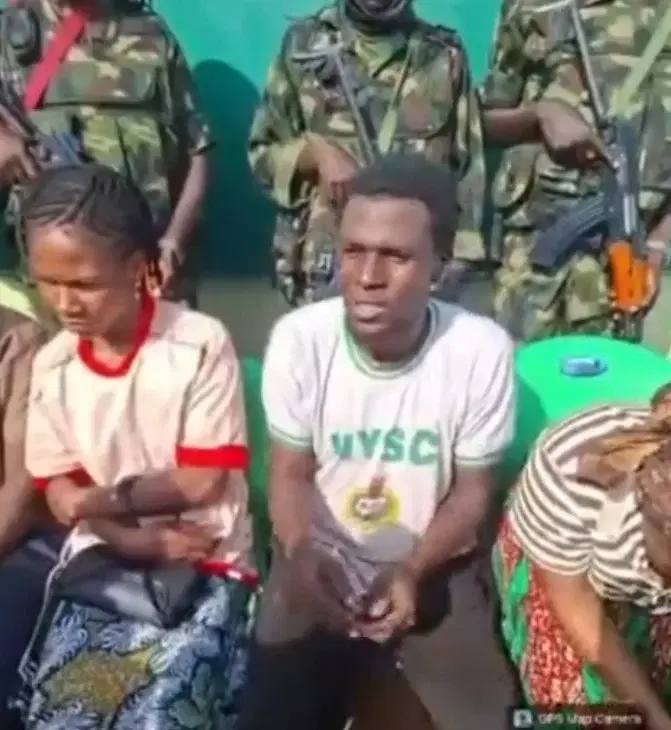
The early morning light filtered through the dense canopy of the Ofu forest, casting a trembling green glow over the narrow footpaths where twenty‑one young Nigerians had been forced to march under the watchful eyes of armed captors. Just days before, they had boarded organized vehicles in Bayelsa, hopeful faces turned toward Abuja after completing the mandatory National Youth Service Corps orientation, unaware that the road would become a corridor of terror. According to Vanguard News, the abductees recalled how the driver’s desperate attempt to flee was met with gunfire, the doors flung open, and the group ushered into the bush while rounds of bullets cracked overhead, a symphony of fear that left them breathless and compliant. As they trekked deeper, the kidnappers’ voices grew louder, promising a month of captivity before execution, and warning that any movement without permission would invite a bullet—a threat that turned each step into a silent prayer. The victims endured flogging, kicking, and relentless verbal abuse, their bodies bruised and spirits frayed, yet they clung to the slender hope that rescue might come from the very forces sworn to protect the nation. When the distant rumble of engines finally reached their ears, it was not the growl of pursuers but the disciplined advance of troops from the 12 Brigade, Nigerian Army, working in concert with the Nigeria Police Force, the Department of State Service, local hunters, and vigilantes, a coalition that turned the forest’s darkness into a stage for deliverance.
In that moment, the captives’ whispered thanks rose above the rustle of leaves, a testament to the fragile thread that binds courage, community, and the relentless pursuit of safety in a nation still learning to guard its youth.
The Tapestry of Fear: Voices from the Bush
The personal testimony of David Ayodele, one of the rescued NYSC members, painted a harrowing portrait of life in captivity that resonated far beyond the immediate horror of the abduction. He recounted how, after being forced from the vehicle, the group was made to sit in a clearing where the kidnappers calmly announced that they would be held for one month before being killed, a declaration that froze the blood of every young man and woman present. According to Punch Nigeria, Ayodele described the relentless trek through thick undergrowth, the constant barrage of verbal taunts, and the physical punishment meted out for the slightest misstep, details that underscored the brutality of the captors’ regime. The victims, comprising eight males and thirteen females as reported by the Daily Trust, were denied basic sustenance, forced to drink from stagnant pools, and deprived of any sense of temporal orientation, their days marked only by the shifting light that filtered through the leaves. The psychological toll was palpable; Ayodele admitted that the threat of being shot for moving without permission rendered the group virtually immobile, each individual a statue of fear waiting for an uncertain fate. Yet amid the despair, a thread of solidarity emerged as the youths shared water, whispered encouragement, and clung to the belief that their families and the nation would not abandon them.
The eventual encounter with the joint security team, which Ayodele praised effusively, transformed terror into relief, and his gratitude toward the army, police, DSS, hunters, and vigilantes became a rallying cry for renewed trust in Nigeria’s security apparatus. This narrative, woven from personal anguish and collective resilience, offers a window into the human cost of kidnapping and the profound impact of swift, coordinated intervention.
The Machinery of Mercy: How Security Forces Converged
The rescue operation that freed the twenty‑one abductees was not a spontaneous act of heroism but the culmination of meticulous intelligence gathering, inter‑agency coordination, and grassroots participation that exemplifies a evolving security doctrine in Nigeria. Acting on credible reports of a mass abduction along the Alloma–Ejule–Itobe road axis, the Headquarters 21 Battalion mobilized troops from the 12 Brigade, who then linked up with the Nigeria Police Force, the Department of State Service, and a network of local hunters and vigilantes familiar with the forest’s hidden trails. Lieutenant Hassan Abdullahi, the Acting Assistant Director of Army Public Relations, emphasized that the joint team conducted a coordinated search of the Egume and Ochaja forest areas, ultimately locating the hostages and effecting their release on the afternoon of August 31, 2026. The Daily Trust noted that one male victim sustained a gunshot wound during the ordeal and was promptly evacuated for medical treatment, underscoring the operation’s immediacy and the risks faced by the rescuers. President Bola Tinubu, in a statement on X, hailed the mission as a testament to the effectiveness of a unified security approach, expressing relief that the 15 NYSC members and six other Nigerians had been restored to safety. The operation’s success rested on the seamless sharing of real‑time intelligence, the deployment of ground troops adept at bush navigation, and the invaluable local knowledge of hunters who could read the forest’s signs like a map.
This synergy between formal security institutions and community‑based actors illustrates a shift toward a more holistic response to kidnapping, one that leverages both state capacity and societal vigilance to confront criminal enterprises that thrive in remote terrains.
The Ripple Effect: Economic and Social Tremors
Beyond the immediate relief of the rescued youths, the Kogi abduction sent ripples through Nigeria’s socio‑economic fabric, highlighting the pervasive cost of insecurity on a nation striving for development. Analysts point out that each kidnapping incident imposes a financial burden that stretches beyond ransom payments to include lost productivity, increased security expenditures, and diminished investor confidence; the World Bank estimates that violence and crime can shave as much as two percentage points off Nigeria’s annual GDP growth. In the aftermath of the Kogi rescue, local traders in Lokoja reported a temporary dip in market activity as fear kept consumers indoors, while transporters along the Alloma–Ejule–Itobe corridor faced delays as security checkpoints multiplied. The NYSC program itself, designed to foster national unity and skill deployment, suffers when its members become targets, potentially discouraging prospective corps members from participating and weakening the scheme’s objective of integrating youth across ethnic lines. Socially, the incident intensified anxiety among families with children serving in the service corps, prompting calls for enhanced protection measures and greater transparency regarding deployment routes. Community leaders in Ofu and Dekina LGAs urged the government to invest in rural road lighting, mobile patrol units, and rapid response teams to deter future attacks.
Simultaneously, the rescue sparked a wave of solidarity, with citizens across the country taking to social media to celebrate the joint operation, a display of national pride that could translate into sustained public support for security reforms. Thus, the episode serves as a stark reminder that safety is not merely a humanitarian concern but an economic imperative, and that investments in protective infrastructure yield dividends in stability, trust, and growth.
The Political Stage: Leadership, Policy, and Public Trust
President Bola Tinubu’s swift acknowledgment of the rescue underscored the growing expectation that the highest office must not only condole but also actively champion effective security interventions, a dynamic that shapes public perception of governance. His statement on X, issued on the Monday following the operation, praised the coordinated Search and Rescue effort and signaled a commitment to deepening inter‑agency collaboration, a move that political analysts interpret as an attempt to bolster his administration’s credibility amid rising concerns over banditry and kidnapping. Historically, Nigerian presidents have faced criticism for delayed or tepid responses to security crises, a pattern that can erode confidence and fuel perceptions of incompetence. By contrast, Tinubu’s immediate commendation of the troops, police, DSS, hunters, and vigilantes served to reinforce a narrative of decisive leadership, potentially mitigating political fallout and fostering a sense of national unity. Moreover, the operation’s success provides a concrete case study for policymakers advocating for the institutionalization of joint task forces that combine regular forces with local intelligence networks, a model that has shown promise in other conflict‑prone regions. Legislative bodies may now feel increased pressure to allocate additional funding for training, equipment, and community‑engagement programs, while oversight committees could scrutinize the effectiveness of existing anti‑kidnapping statutes.
The political capital gained from such a high‑profile rescue could therefore be leveraged to push through reforms that address root causes—poverty, unemployment, and weak governance—thereby transforming a moment of crisis into an opportunity for systemic change.
The Cultural Mosaic: Hunters, Vigilantes, and Community Resolve
The involvement of local hunters and vigilantes in the Kogi rescue highlights a cultural dimension often overlooked in national security discourse, wherein indigenous knowledge and communal solidarity become force multipliers against criminal elements. In many rural Nigerian communities, hunters possess an intimate understanding of forest topography, animal trails, and hidden clearings that can elude conventional military units, making their expertise invaluable during search and rescue operations. Vigilante groups, though sometimes viewed with suspicion due to concerns over extrajudicial actions, frequently act as the first line of defense, providing early warnings, monitoring suspicious movements, and offering logistical support to formal security agencies. In this instance, their collaboration with the 12 Brigade and the Nigeria Police Force exemplified a partnership that blurred the lines between state and society, creating a hybrid security apparatus attuned to the nuances of the local environment. Cultural analysts note that such cooperation fosters a sense of ownership among residents, encouraging them to report anomalous activities and to participate in peace‑building initiatives. Furthermore, the visible affirmation of these community actors by national leadership—through President Tinubu’s praise and the Army Public Relations’ commendation—helps to legitimize their role and may reduce the stigma that often surrounds vigilante groups. Technologically, while the operation relied heavily on human ingenuity, there is growing interest in augmenting these efforts with low‑cost drones, satellite imagery, and mobile communication platforms that can extend the reach of hunters and vigilantes alike.
By marrying traditional wisdom with modern tools, Nigeria can craft a security strategy that is both culturally resonant and technologically adept, ensuring that the forests that once concealed danger become spaces of collective vigilance and protection.
Future Implications: A Blueprint for Safer Horizons
The rescue of the twenty‑one abductees in Kogi offers a template for confronting the multifaceted challenge of kidnapping that Nigeria can adapt and scale across its volatile zones. First, the episode reinforces the necessity of actionable intelligence; investing in sophisticated surveillance, informant networks, and data‑fusion centers can shorten the lag between abduction and response. Second, the triumph of joint operations underscores the value of institutionalizing permanent inter‑agency task forces that include representation from the military, police, DSS, and community‑based groups, complete with joint training exercises and shared communication protocols. Third, the economic dimension calls for targeted investments in rural infrastructure—such as improved road networks, reliable electricity for communication towers, and mobile health units—to reduce the isolation that criminals exploit. Fourth, social programs aimed at youth empowerment, vocational training, and livelihood creation can address the socioeconomic drivers that push individuals toward criminality, thereby shrinking the pool of potential recruits for kidnapping gangs. Fifth, fostering a culture of timely reporting and protecting whistleblowers through legal safeguards will enhance the flow of critical information from communities to authorities. Finally, continuous evaluation and after‑action reviews of operations like the one in Kogi will allow the security establishment to refine tactics, incorporate lessons learned, and adapt to evolving criminal methodologies.
If these strands are woven together into a coherent national strategy, the forest that once echoed with threats of death may instead resound with the steady tread of patrols, the hopeful chatter of returning youths, and the quiet confidence of a nation that has learned to protect its most valuable asset—its people.
📰 Sources Cited
- Vanguard News: Video: Kidnappers threatened to kill us after one month — Rescued NYSC member
- Punch Nigeria: VIDEO: They threatened to keep us for one month, kill us, rescued corps member recounts ordeal in Kogi
- Daily Trust: One injured as troops rescue abducted corps members in Kogi
- Punch Nigeria: Tinubu hails rescue of 15 NYSC members, six others abducted in Kogi
0 Comments
Sign in to commentNo comments yet. Be the first to share your thoughts!