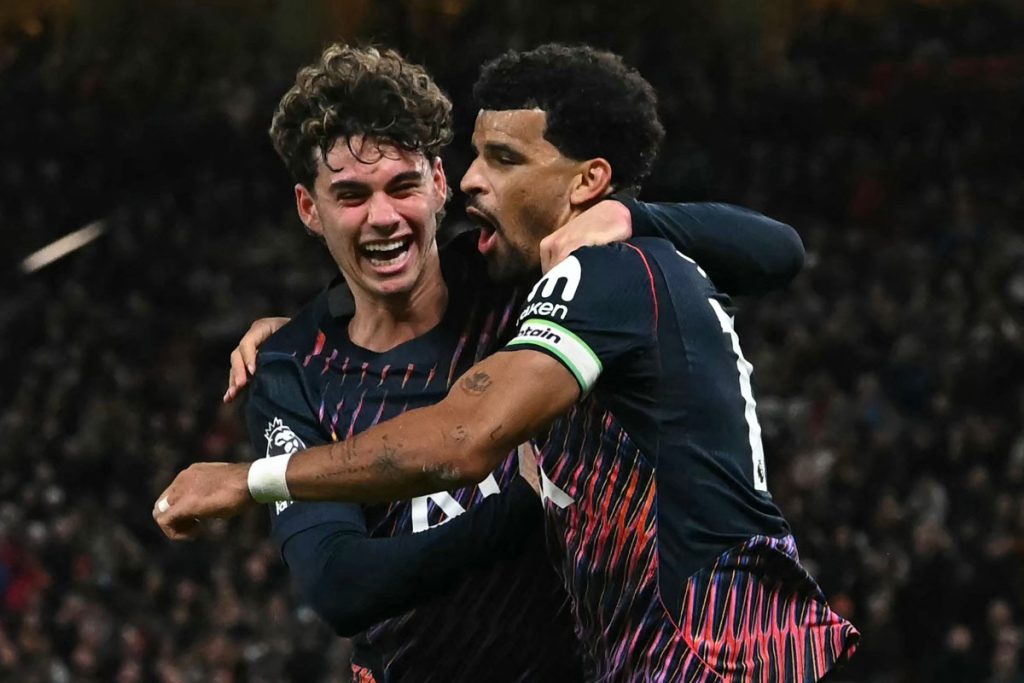
The floodlights of Old Trafford flickered like a restless heartbeat on a crisp Saturday afternoon, casting long shadows over a pitch that had witnessed triumphs and tribulations for more than a century. Manchester United, a club steeped in legend, found themselves tethered to a familiar frustration as they faced a Tottenham Hotspur side reduced to ten men after a fiery headbutt that saw Rodrigo Bentancur marching off in the 78th minute. The atmosphere was thick with anticipation, yet also laced with a palpable sense of dread among the home faithful, who had watched their team sputter to a mere six points from the opening six Premier League fixtures—a tally not seen since the mid‑1980s. As Bryan Mbeumo slipped a cool finish past the Spurs goalkeeper in the 73rd minute, the roar that rose from the Stretford End seemed to herald a long‑awaited breakthrough, only to be answered moments later by a defiant header from Dominic Solanke in stoppage time, salvaging a point for the visitors and leaving the Red Devils to ponder what might have been. The draw, reported extensively across Nigerian outlets such as Vanguard News, Punch Nigeria, and Blueprint Newspapers, became more than a scoreline; it was a mirror reflecting deeper malaise within the squad, a tactical conundrum for manager Michael Carrick, and a rallying cry for a Tottenham side desperate to prove that their £300 million rebuild could yet yield grit and unity.
In the ensuing minutes, the game unfolded as a chess match of nerves, where each pass, each tackle, and each whispered instruction from the touchline carried weight far beyond the immediate contest, hinting at broader economic strains, cultural expectations, and the ever‑looming pressure of modern football’s technological gaze.
The Theatre of Dreams Under Siege
The narrative of the match began not with a whistle but with a simmering tension that had been building since the summer transfer window, when Tottenham’s ambitious overhaul—funded by a reported £300 million ($397 million) investment—failed to yield immediate dividends, leaving them rooted at the bottom of the table as the international break approached. According to Vanguard News, the Spurs supporters had three weeks to fester on their predicament, a period during which doubts about the club’s direction grew louder, yet the break also offered a chance for introspection and recalibration. When the teams finally emerged onto the hallowed turf, the contrast was stark: United, despite their own struggles, entered the game with a sense of entitlement born of history, while Spurs arrived with a chip on their shoulder, eager to prove that their recent lack of cutting edge could be overridden by sheer will. The opening exchanges saw Tottenham dominate large spells, pinning United inside their own half and creating a series of chances that, as the Sun Nigeria report noted, were squandered with frustrating regularity—Solanke’s close‑range effort, Kudus’ wild blast, and Udogie’s curled effort all whispering of what might have been. Yet it was United who struck first, when Bryan Mbeumo latched onto a pass from Matheus Cunha and fired into the far corner, a moment that, according to Complete Sports, gave the hosts a fleeting illusion of control.
The subsequent dismissal of Bentancur for a headbutt on Luke Shaw transformed the contest into a test of nerve: could United, now with a man advantage, impose their will, or would the reduced Spurs side find a way to claw back? The answer arrived in the dying seconds, when Solanke, having been handed the captain’s armband by Roberto De Zerbi in a surprise move that underscored the coach’s faith in his talisman, outmuscled Lisandro Martinez to glance in Sandro Tonali’s cross, securing a point that, as Vanguard News highlighted, edged Spurs up to 18th place, kept them above the relegation zone by virtue of goals scored, and left United languishing in 12th with just three points to spare. The draw thus became a microcosm of the season’s broader themes: missed opportunities, defensive frailties, and the relentless pressure to convert advantage into victory.
The Financial Strain and Worst Start in Four Decades
Beneath the surface of individual brilliance and tactical maneuvering lay a stark economic reality that had been simmering for months, one that the Blueprint Newspapers article laid bare with unflinching clarity: Manchester United had recorded their worst start to a league season in forty years, amassing a mere six points from their first six Premier League outings—a figure that placed them alongside the dismal campaigns of the mid‑1980s, when the club was still navigating the aftermath of managerial transitions and financial constraints. This statistic was not merely a number; it represented a cascade of repercussions that rippled through the club’s commercial ecosystem, affecting sponsorship deals, match‑day revenue, and the broader perception of the brand in global markets. Analysts quoted in the same piece warned that the prolonged dip in performance could trigger renegotiations of broadcasting rights and deter potential investors who view on‑field success as a proxy for off‑field stability. The financial strain was further compounded by the club’s ongoing efforts to modernize its infrastructure, a costly endeavor that demands consistent cash flow to service debt and fund youth development initiatives. In parallel, Tottenham’s own fiscal narrative was equally compelling; their £300 million rebuild, while ambitious, had yet to translate into league victories, leaving them to grapple with the pressure of justifying such outlay to stakeholders who expect a return on investment not only in silverware but also in commercial growth and fan engagement.
The juxtaposition of these two narratives—United’s historic slump versus Tottenham’s costly yet fruitless overhaul—painted a picture of modern football where financial muscle does not automatically guarantee competitive success, and where the economic dimensions of the sport are inseparable from its sporting outcomes. As the match progressed, the weight of these fiscal realities seemed to press upon the players, manifesting in hesitant passes, a lack of cutting edge in the final third, and a palpable anxiety whenever the opposition threatened to break through.
The Human Drama: De Zerbi’s Kiss and Carrick’s Plea
Amid the tactical chessboard and the ledger‑book anxieties, human emotions flared with unexpected intensity, providing moments that transcended the ordinary match report and entered the realm of storytelling worthy of a long‑form feature. The most talked‑about incident arrived shortly after Bentancur’s dismissal: Tottenham coach Roberto De Zerbi, overcome by a mixture of relief, frustration, and perhaps a paternal instinct, bent down and planted a kiss on the forehead of his dismissed midfielder, a gesture that was captured by cameras and subsequently dissected in the Punch Nigeria article where De Zerbi explained his actions as an expression of solidarity and a reminder that the team must play for one another, especially when reduced to ten men. The kiss, while seemingly a small act, resonated deeply with supporters and pundits alike, symbolizing a coach’s willingness to embrace vulnerability and to reinforce a collective identity that could withstand adversity. On the opposite touchline, Michael Carrick, serving as interim head coach, delivered a candid post‑match assessment that laid bare the frustrations of a side that repeatedly failed to see out games despite holding numerical advantages. In the Vanguard News coverage of his remarks, Carrick urged his players to become more “streetwise” and “stubborn,” insisting that the team needed to control the game better in the opposition’s half, look after the ball more effectively, and develop a ruthless edge when protecting a lead.
His words echoed a broader sentiment within the dressing room—a yearning for mental fortitude that could translate tactical discipline into tangible results. The interplay between De Zerbi’s affectionate gesture and Carrick’s demanding plea highlighted a duality in football leadership: the need for empathy and unity on one hand, and the insistence on rigor and accountability on the other. Together, they painted a portrait of two managers navigating the same turbulent waters, each seeking to instill a different but complementary set of values in their squads as they strove to turn perilous draws into hard‑earned victories.
The Tactical Battlefield: Numbers, Streetwise Play, and Technology
Beyond the emotions and economics, the match unfolded as a tactical laboratory where numbers, spatial awareness, and the ever‑present influence of technology converged to shape outcomes. The initial phases saw Tottenham enjoying a territorial advantage, completing a higher percentage of passes in United’s half and creating chances that, according to the Sun Nigeria report, were repeatedly wasted due to a lack of composure in the final third. This inefficiency was starkly contrasted by United’s opportunistic strike, a moment that underscored the effectiveness of a direct, vertical approach when space is afforded—a tactic that had been honed through extensive video analysis and data‑driven scouting, tools that modern clubs rely upon to dissect opponent tendencies. The introduction of advanced tracking systems, wearable GPS units, and real‑time analytics has allowed coaching staff to monitor player workload, sprint distances, and positional heat maps with unprecedented precision, enabling in‑game adjustments that were once the preserve of halftime chalk talks. In this encounter, Carrick’s triple substitution on the hour mark—bringing on Carlos Baleba, Joshua Zirkzee, and another fresh leg—was informed by such data, aiming to inject dynamism into midfield and provide a new outlet for Matheus Cunha to drop deeper, a maneuver that, as Vanguard News noted, briefly shifted the equilibrium.
Yet the failure to capitalize on the numerical advantage after Bentancur’s red card revealed a gap between data‑informed preparation and on‑field execution; the team appeared to lack the “streetwise” instinct Carrick called for, failing to pinch the opposition, control the tempo, and see the game out despite having superior numbers for twelve minutes. Meanwhile, Tottenham’s resilience, despite being down to ten men, was aided by their own technological edge: the club’s use of video opposition analysis to identify set‑piece patterns allowed Sandro Tonali’s precise cross to find Solanke’s head at the far post, a moment that epitomized how modern football blends raw athleticism with meticulous preparation. The match thus served as a vivid illustration that while technology can illuminate patterns and optimize performance, the ultimate arbiter remains the human capacity to adapt, to exhibit composure under pressure, and to translate insight into action—a lesson that both managers would carry forward into the fixtures ahead.
Future Implications: A Blueprint or a Band‑Aid?
As the echo of the final whistle faded into the night, the implications of this draw stretched far beyond the immediate standings, prompting a reckoning that could shape the trajectories of both clubs for the remainder of the season and beyond. For Manchester United, the persistent inability to convert leads into wins, coupled with their worst start in four decades, signals a need for more than superficial tweaks; it suggests a structural reassessment of recruitment philosophy, coaching continuity, and the cultivation of a winning mentality that can withstand adversity. Experts cited in various Nigerian outlets warned that without a decisive shift—investing in players who possess both technical prowess and mental resilience, and perhaps embracing a more holistic approach to player development that integrates psychological conditioning with tactical training—the club risks sliding further down the table, jeopardizing its Champions League aspirations and diminishing its commercial allure. Conversely, Tottenham’s hard‑earned point, secured through a stoppage‑time equalizer that showcased both individual brilliance and collective resolve, offers a glimmer of hope that their £300 million investment may yet yield dividends if the club can harness the unity demonstrated by De Zerbi’s side and translate it into consistent performances. The gesture of handing the captain’s armband to Solanke, coupled with the coach’s public affirmation of faith, could serve as a catalyst for fostering a leadership culture that empowers players to take ownership of outcomes, a factor often cited as critical in turning potential into performance.
Looking ahead, the integration of advanced analytics, wearable tech, and AI‑driven scouting will continue to evolve, but the match at Old Trafford reminded all stakeholders that technology is merely an enabler; the decisive factor remains the human element—character, cohesion, and the willingness to fight for each other when the odds are stacked. Whether the lessons drawn from this encounter forge a genuine blueprint for renewal or merely serve as a temporary band‑aid masking deeper fissures will depend on the willingness of both clubs to confront uncomfortable truths, to invest in long‑term cultural change, and to marry the precision of modern football science with the timeless virtues of grit and unity. As the season unfolds, the eyes of fans, analysts, and owners alike will remain fixed on the touchlines, waiting to see if the echoes of this draw will reverberate into a chorus of triumph or fade into a lament of missed opportunity.
📰 Sources Cited
- Punch Nigeria: EPL: Why I kissed Bentancur after red card against Man United — Tottenham coach
- Blueprint Newspapers: EPL: Manchester United record worst league start in 40 years after Tottenham draw
- Complete Sports: Man United Equal Unwanted 40-Year Record In 1-1 Draw With 10-Man Spurs
- Vanguard News: 10-man Tottenham ramp up pressure on Man Utd boss Carrick
- Vanguard News: Carrick demands more ‘streetwise’ Man Utd after Spurs setback
- Sun News Online: EPL: Man United held by 10-man Tottenham
- Google News Nigeria: 10-Man Tottenham Hold Man United To Draw, Ramp Up Pressure On Carrick - Channels Television
0 Comments
Sign in to commentNo comments yet. Be the first to share your thoughts!