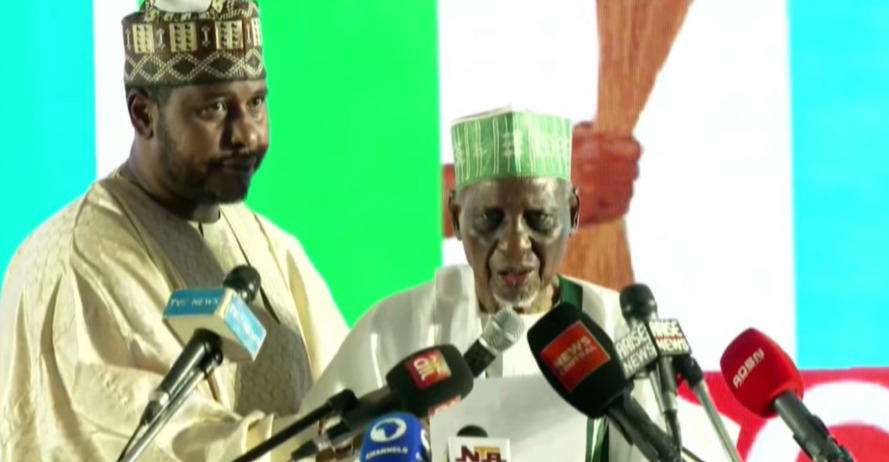
The air over Abuja hummed with a restless energy as the sun climbed over the Niger River, casting long shadows across the freshly inaugurated APC Presidential Campaign Council, where a centenarian statesman, Alhaji Tanko Yakasai, born in 1925, rose to offer his blessing to President Bola Tinubu’s bid for a second term, his voice trembling yet firm as he wished the incumbent success in the coming election, a moment captured by Vanguard News that highlighted not only his age but the symbolic bridge he represented between Nigeria’s turbulent past and its uncertain future. Simultaneously, in the bustling streets of Edo State, the former governor and now ADC Vice Presidential Candidate Rotimi Amaechi stood before a town hall crowd, his words sharp as a machete, declaring that only mad people would cast their ballot for Tinubu in 2027, a provocative claim reported by Daily Trust that ignited both applause and outrage, framing the upcoming contest as a referendum on sanity itself. Meanwhile, the APC’s National Publicity Secretary Felix Morka appeared on Arise News to dismiss rumors of a rift between party governors and the Minister of the Federal Capital Territory, Nyesom Wike, over Wike’s inclusion in the campaign council, labeling the disagreement a “false battle” and insisting that all factions remained united behind Tinubu’s re‑election agenda, a narrative echoed by Sun News Online that sought to calm internal party anxieties.
Across the nation, the wife of the Minister of State for Petroleum Resources, Dr Ogechi Lokpobiri, took to the podium in Abuja to rally Nigerian women and health professionals behind the Tinubu Health Sector Practitioners Alliance, urging them to see the administration’s reforms as painful but necessary steps toward sustainable development, a call amplified by both Sun News Online and Blueprint Newspapers that highlighted her role as National Coordinator of TIHSEPA and her praise for the First Lady’s Renewed Hope Initiative. In the classrooms and dormitories of universities nationwide, the National Association of Nigerian Students announced an ambitious plan to mobilise ten million votes across the six geopolitical zones for Tinubu, a declaration made during a visit to Vice President Kashim Shettima at the Presidential Villa and reported by Leadership Newspaper, underscoring the youth’s potential to become a decisive bloc in the electoral calculus. As these disparate voices converged, the economic undercurrents of hunger, inflation, and subsidy debates swirled beneath the surface, setting the stage for a contest that would test not only political loyalties but the very fabric of Nigerian society.
The Economic Backdrop: Hunger, Subsidy Debates, and the Promise of Renewed Hope
Nigeria’s economy in the lead‑up to 2027 presented a paradox of hardship and hope, with inflation gnawing at household budgets while the government touted ambitious reform programmes designed to lift the nation out of stagflation. Phrank Shaibu, a communication aide to former Vice‑President Atiku Abubakar, told the Mic On Podcast that the 2027 election would be the easiest for his principal, arguing that hungry and impoverished Nigerians, disillusioned by the current administration’s performance, would flock to Atiku in search of affordable living, a claim reported by Vanguard News that cited Atiku’s 29 percent vote share in 2023 as a baseline from which he hoped to surge. Shaibu further contended that the Tinubu cabinet, including the Minister of Works David Umahi, was aware of its shortcomings, pointing to Umahi’s plan to engage four thousand social media influencers to showcase government projects as a sign that the administration felt compelled to manufacture popularity rather than rely on tangible impact, a critique that resonated with many citizens feeling the bite of removed fuel subsidies and rising transport costs. In contrast, Dr Ogechi Lokpobiri defended the reform agenda, insisting that the short‑term pain of subsidy removal and tax adjustments was being offset by long‑term gains in infrastructure, healthcare, and education, and she urged women to view the administration’s policies as laying the foundation for a stronger, more sustainable Nigeria, a perspective echoed by the Sun News Online piece that highlighted her call for peaceful mobilisation and her admiration for the First Lady’s Renewed Hope Initiative, which she said had already complemented federal efforts in social welfare and economic empowerment.
The economic discourse was further enriched by the centenarian Yakasai’s benediction, whose own lifetime of witnessing Nigeria’s booms and busts lent gravitas to his wish for Tinubu’s success, suggesting that even the oldest observers saw merit in the current trajectory despite the palpable discomfort on the ground. As the nation grappled with these competing narratives, the question of whether economic distress would drive voters toward opposition promises or reward incumbent perseverance became a central theme that would shape campaign messaging, policy pledges, and ultimately the ballot boxes in early 2027.
The Political Theater: Party Unity, Opposition Fervor, and the Mobilisation of Youth
Behind the scenes, the political machinations surrounding Tinubu’s re‑election bid revealed a tapestry of alliance‑building, dissent management, and grassroots mobilisation that sought to turn abstract policy into concrete votes. The APC’s inauguration of its Presidential Campaign Council on a Wednesday, as detailed by Premium Times, signaled a formalised structure tasked with overseeing campaign messaging, media engagement, and collaboration among party leaders, elected officials, and state campaign structures, a move designed to streamline the party’s effort and present a united front despite undercurrents of tension. Felix Morka’s dismissal of any rift between APC governors and Nyesom Wike, framed as a “false battle,” aimed to quell speculation that the minister’s inclusion in the council might fracture the party, a narrative reinforced by Sun News Online which quoted Morka emphasizing a shared interest in securing Tinubu’s return to office. In stark contrast, Rotimi Amaechi’s incendiary rhetoric at the Edo town hall — where he likened Tinubu supporters to thieves and warned that only mad people would vote for the incumbent — served as a rallying cry for the opposition, particularly the African Democratic Congress, and was reported by Daily Trust as a direct challenge to the APC’s unity claims, suggesting that dissent remained vibrant and vocal. Meanwhile, the National Association of Nigerian Students, under the leadership of Comrade Akinteye Afeez, announced a plan to mobilise ten million votes across the six geopolitical zones, a declaration made during a visit to Vice President Kashim Shettima at the State House and reported by Leadership Newspaper, highlighting the student body’s self‑identification as the country’s largest constituency and its alignment with the Renewed Hope Administration.
This youth mobilisation was complemented by Osun State Governor Ademola Adeleke’s public endorsement of Tinubu, reported by Blueprint Newspapers, in which he argued that four years were insufficient for the administration’s reforms to bear fruit and pledged to lead the campaign movement with action rather than mere talk. The interplay of these forces — party council structuring, opposition firebranding, youth organising, and gubernatorial backing — created a dynamic political arena where narratives of legitimacy, competence, and vision were constantly contested, reframed, and re‑issued in the lead‑up to the election.
The Cultural and Social Dimension: Women, Health Professionals, and the Quest for Inclusive Leadership
Cultural currents and social movements played an equally pivotal role in shaping the electoral landscape, particularly through the mobilisation of women and health professionals who sought to influence policy from the grassroots upward. Dr Ogechi Lokpobiri, wife of the Minister of State for Petroleum Resources and National Coordinator of the Tinubu Health Sector Practitioners Alliance (TIHSEPA), addressed a gathering in Abuja where she called on Nigerian women and health professionals to support Tinubu’s re‑election bid, arguing that the administration’s reforms, despite creating short‑term challenges, were aimed at addressing deep‑rooted structural problems and laying the groundwork for sustainable economic development, a stance reported by both Sun News Online and Blueprint Newspapers. She emphasized that women could not afford to remain on the sidelines, urging them to actively participate in national affairs and support programmes that would improve healthcare delivery, strengthen social welfare, empower families, and create economic opportunities, a call that resonated with the broader push for gender inclusion in governance. Lokpobiri further praised the First Lady, Senator Oluremi Tinubu, describing her as an “Icon of Impact” for her interventions targeting women, children, and other vulnerable groups, and highlighted the Renewed Hope Initiative as a complementary force to federal efforts in social welfare, healthcare, education, and economic empowerment, a narrative that sought to link the president’s agenda with tangible benefits for the nation’s most marginalized.
In parallel, the centenarian Yakasai’s benediction, rooted in a lifetime of observing Nigeria’s cultural shifts, served as a reminder that traditional respect for elders could still be harnessed to lend legitimacy to political endeavours, even as younger generations pushed for change. The convergence of these cultural threads — women’s advocacy, health professional engagement, elder statesmanship, and youthful enthusiasm — created a multifaceted social tableau in which the election was not merely a contest of parties but a reflection of Nigeria’s evolving identity, its aspirations for inclusive leadership, and its struggle to balance tradition with modernity.
The Technological and Informational Battlefield: AI, Fake News, and the Struggle for Truth
As the campaign intensified, the technological dimension emerged as a critical arena where the spread of information — and misinformation — could sway perceptions and potentially incite violence. Senate President Godswill Akpabio urged the implementation of guardrails against AI‑generated falsehoods, warning that the threat of electoral violence fueled by fake news had become a pressing concern as Nigerians prepared for the 2027 general elections, a position articulated by Blueprint Newspapers in its piece on safeguarding the polls from artificial intelligence‑driven deception. This warning came amid reports that the Tinubu administration planned to engage thousands of social media influencers to showcase its achievements, a strategy critiqued by Phrank Shaibu who argued that a government truly impacting citizens’ lives should not need to rely on such manufactured publicity, a point he made during his Mic On Podcast interview and later echoed by Vanguard News in its coverage of Atiku’s prospects. The influencer tactic, exemplified by Minister of Works David Umahi’s televised announcement of hiring four thousand influencers, underscored a growing reliance on digital outreach to counteract negative narratives about economic hardship, subsidy removal, and perceived governance failures. Simultaneously, the APC’s campaign council, as outlined by Premium Times, was tasked with overseeing media engagement, suggesting an institutional effort to manage the flow of information, counter false narratives, and amplify positive messaging through coordinated channels.
The interplay of these forces — state‑sponsored influencer campaigns, opposition critiques of propaganda, institutional media management, and calls for AI safeguards — highlighted a battleground where truth was contested, perceptions were molded, and the electorate’s ability to discern fact from fiction would be tested. In this environment, the role of traditional media, fact‑checking initiatives, and digital literacy initiatives became increasingly vital, as stakeholders sought to ensure that the electoral process remained informed rather than manipulated.
Future Implications: A Nation at the Crossroads of Reform and Resistance
Looking ahead, the convergence of economic pressures, political maneuvering, social mobilisation, and technological challenges paints a picture of a Nigeria standing at a crossroads, where the outcome of the 2027 election could either cement a trajectory of bold reform or usher in a period of heightened polarization and unrest. If President Tinubu secures a second term, the administration’s pledge to continue subsidy reforms, infrastructure investment, and social welfare initiatives — bolstered by the backing of figures like Alhaji Tanko Yakasai, Governor Ademola Adeleke, and the National Association of Nigerian Students — may translate into sustained macro‑economic stabilization, though critics such as Phrank Shaibu and Rotimi Amaechi warn that unresolved hunger and perceived elitism could fuel further dissent. Conversely, a victory for the opposition, particularly a resurgence of Atiku Abubakar buoyed by the promise of affordable living and the mobilization of disaffected voters, could signal a retreat from the current reform agenda and a return to populist policies aimed at immediate relief, potentially jeopardizing long‑term structural adjustments. The youth’s pledge to deliver ten million votes, the women’s health‑sector alliance’s call for inclusive governance, and the elders’ benedictions collectively suggest that any victorious coalition will need to bridge generational, gender, and regional divides to govern effectively.
Moreover, the ongoing struggle against AI‑driven misinformation and the push for guardrails highlighted by Senate President Akpabio indicate that the integrity of the information ecosystem will be a decisive factor in shaping voter perceptions and preventing electoral violence. Ultimately, the 2027 election will not merely decide who occupies Aso Rock; it will reflect Nigeria’s capacity to reconcile reform with resistance, tradition with transformation, and hope with hardship, setting the tone for the nation’s democratic trajectory in the decade to come.
📰 Sources Cited
- Vanguard News: 100-year-old Yakasai wishes Tinubu success in 2027 election
- Sun News Online: 2027: Morka dismisses APC governors’ rift with Wike over Tinubu’s re-election
- Premium Times: 2027: APC to inaugurate presidential campaign council for Tinubu’s re-election Wednesday
- Vanguard News: 2027 will be Atiku’s easiest election; hungry Nigerians will vote for him — Shaibu
- Sun News Online: 2027: Lokpobiri rallies women for Tinubu’s re-election
- Blueprint Newspapers: 2027 polls: Guardrails against AI-falsehoods
- Blueprint Newspapers: 2027: Tinubu ’s re-election bid gets boost as Grace Lokpobiri mobilises women
- Daily Trust: 2027: Only mad people will vote for Tinubu – Amaechi
- Blueprint Newspapers: Adeleke backs Tinubu’s re-election, says four years insufficient for reforms
- Leadership Newspaper: 2027: NANS Targets 10m Votes For Tinubu’s Re-election
0 Comments
Sign in to commentNo comments yet. Be the first to share your thoughts!