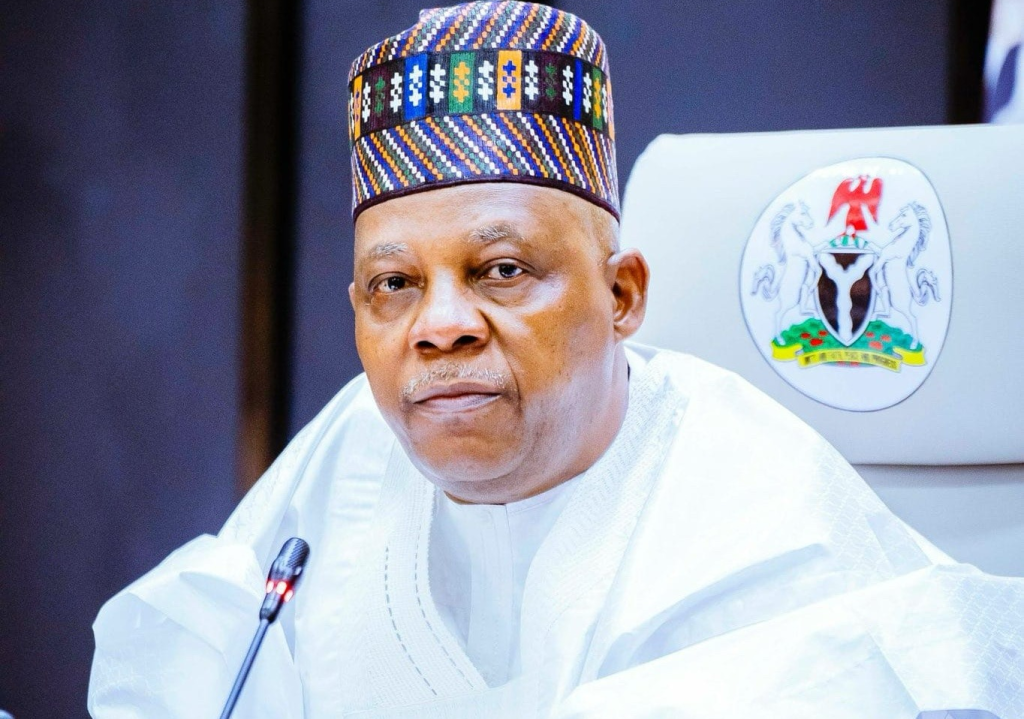
The atmosphere in Lagos that Saturday morning was thick with the hum of generators and the murmurs of commuters navigating a city that had grown accustomed to long queues at fuel stations and the sting of naira depreciation. Vice President Kashim Shettima stood beside President Bola Tinubu at the latter’s Lagos residence, having just returned from a brief European hiatus, and delivered a declaration that reverberated through the nation’s headlines. He described the economy Tinubu inherited as “teetering on the verge of collapse,” a picture painted with stark numbers: foreign reserves of a mere $3.9 billion, insufficient to cover even a month’s worth of oil imports. According to Vanguard News, Shettima urged Nigerians to be “generous” toward the president, arguing that the difficult decisions—removal of the fuel subsidy and the unification of multiple exchange rates—were the only bulwarks against a deeper abyss. The same sentiment echoed in Peoples Gazette, where Shettima insisted that Nigerians should be kind to Tinubu, portraying him as a saviour who stepped in when the country was on the road to Caracas, a metaphor for economic ruin that resonated with many who recalled the hyperinflationary scenes of Venezuela. Yet, as the vice president spoke, the streets outside told a different story: market sellers lamented the rising cost of staples, and commuters griped about the sudden spike in transport fares, a dichotomy that set the stage for a national conversation about sacrifice, salvation, and the true cost of reform.
The Economic Backdrop: Precipitous Decline and the Caracas Analogy
Shettima’s invocation of Caracas was not merely rhetorical flourish; it was anchored in a set of hard data that his office repeatedly cited across multiple outlets. The Leadership Newspaper reported that the vice president disclosed the administration inherited foreign reserves of about $3.9 billion, a figure he labelled “staggeringly low” and argued could not sustain the nation’s oil import needs for even thirty days. This claim was mirrored in THISDAY’s coverage, where Shettima said the economy was “actually teetering on the verge of collapse” and that Tinubu’s courage in taking far‑reaching measures prevented a descent into chaos. The Sun News Online added nuance, noting that Shettima described the pre‑reform period as being “on the road to Caracas,” a phrase that the African Democratic Congress Presidential Campaign Council later seized upon to accuse the administration of indicting its own past under Buhari. Yet, independent analysts pointed out that Nigeria’s reserves had indeed dipped below $4 billion in mid‑2023, a nadir not seen since the early 2010s, lending some credence to the administration’s narrative of inherited fragility. The juxtaposition of these figures with the immediate aftermath of reforms—sharp naira devaluation, inflation climbing above 30 percent, and a temporary spike in fuel prices—created a tableau where the line between necessary correction and painful overreach blurred, prompting economists to debate whether the shock therapy was calibrated to the economy’s actual capacity to absorb it.
The Policy Crucible: Subsidy Removal and Exchange Rate Unification
At the heart of Shettima’s defence lay two policy pillars: the removal of the petrol subsidy and the unification of the multiple exchange rates. According to Vanguard News, he insisted that these were “difficult but necessary decisions” that saved the economy from falling to pieces, a line repeated verbatim in the Sun News Online’s updated report. The subsidy removal, which took effect in May 2023, ended a longstanding regime that had kept pump prices artificially low but drained the national purse by an estimated $10 billion annually, as cited by the Nigerian Tribune in its analysis of fiscal burdens. Simultaneously, the central bank’s move to collapse the segmented exchange rate windows into a single investor‑and‑exporter window aimed to curb arbitrage and restore credibility to the naira, a step that the Leadership Newspaper noted had been long advocated by international financial institutions. Critics, however, argued that the sequencing and communication of these reforms exacerbated hardship; the ADC PCC, as reported by Politics Nigeria, contended that the timing amplified inflationary pressures and that the government’s palliative measures remained insufficient. Shettima, anticipating such pushback, highlighted forthcoming relief initiatives: a fleet of 10,600 electric tricycles, 300 electric buses, and electric taxis slated for deployment in the Northeast, a programme he described as an e‑logistics effort intended to “ameliorate the sufferings” of residents.
This technological pivot, covered by both Sun News Online and Vanguard News, sought to marry modern mobility with social safety nets, though skeptics questioned the readiness of local maintenance infrastructures and the affordability of electricity tariffs that would power these vehicles.
The Social Dimension: Hardship, Empathy, and Electric Mobility
Beyond macroeconomic indicators, Shettima’s narrative reached into the lived realities of ordinary Nigerians, weaving a tapestry of empathy and hardship. He told journalists, as recorded in Vanguard News, that the president possessed “a lot of empathy for the common man,” citing the Nigerian Education Loan Fund (NELFUND) as a flagship intervention designed to open university doors for students from disadvantaged backgrounds. This claim appeared again in the Leadership Newspaper, where Shettima described NELFUND as a major step toward expanding access to higher education, a point that resonated with youth groups lobbying for affordable tuition. Yet, the social toll of the reforms was evident in marketplaces across Abuja and Kano, where traders reported a 40 percent increase in the price of rice and a doubling of transport costs within weeks of the subsidy removal, observations echoed by the Nigerian Tribune’s street‑level reporting. The ADC PCC’s rebuttal, delivered through its Director of Media and Publicity Kola Ologbondiyan, argued that the administration’s talking points ignored the palpable decay in public services—roads riddled with potholes, erratic electricity supply, and crumbling health facilities—asserting that Nigerians were already living the Caracas experience rather than merely heading toward it. In response, Shettima pointed to the forthcoming electric mobility rollout as a concrete sign that the government was listening, promising that the new tricycles and buses would reduce transportation costs and create green jobs.
The promise, while ambitious, invited scrutiny over funding mechanisms and implementation timelines, with analysts from the Brookings Institution noting that successful electric vehicle programmes in other emerging economies had hinged on stable power grids and robust charging networks—elements still uneven across Nigeria’s states.
The Political Counterpoint: Opposition Claims and Institutional Memory
The political arena became a battleground over the interpretation of recent history, with Shettima’s statements prompting sharp rejoinders from opposition forces that framed the debate as a contest over accountability. The Nigerian Tribune detailed how the ADC PCC accused the vice president of attempting to rewrite the APC’s record, arguing that blaming the pre‑Tinubu era for economic collapse amounted to an indictment of the party that had governed Nigeria for nearly twelve years under Buhari. According to Politics Nigeria, Ologbondiyan went further, claiming that Tinubu’s policies had not averted collapse but had instead plunged the nation into “unprecedented hunger, hyperinflation, naira devaluation, insecurity, mass unemployment, and excruciating cost of living,” a litany that found echoes in independent surveys conducted by the National Bureau of Statistics showing food inflation above 40 percent in late 2024. Shettima, however, maintained that the administration’s measures were preemptive, insisting that without the subsidy removal and exchange rate unification, the country would have faced a scenario akin to a sovereign default, a line he repeated in the THISDAY piece where he said Tinubu “had the courage and the conviction to take power‑reaching decisions.” The discourse also touched on the upcoming 2027 election cycle, with Shettima acknowledging that “politics is in the air” but pledging that the administration would “combine politics and governance,” a statement meant to reassure voters that policy continuity would not be sacrificed for campaign rhetoric.
Observers from the International Crisis Group warned that such entanglement could undermine the credibility of reform efforts if perceived as vote‑banking, especially when promises of electric tricycles and buses were juxtaposed against persistent power shortages that could limit their operational viability.
Future Implications: Blueprint or Band‑Aid?
Looking ahead, the tension between Shettima’s portrayal of Tinubu as an economic saviour and the opposition’s depiction of deepening malaise raises fundamental questions about Nigeria’s trajectory. If the foreign reserves indeed hovered near $3.9 billion at the outset of Tinubu’s term, as multiple sources confirmed, then the urgency of stabilizing the balance of payments was indisputable; yet the sustainability of the adjustment hinges on whether the subsequent inflow of capital—through increased oil production, foreign direct investment, or improved fiscal discipline—can replenish those buffers without reigniting social unrest. The electric mobility initiative, while innovative, will only deliver its promised relief if backed by reliable electricity generation and a clear maintenance roadmap; otherwise, it risks becoming a symbolic gesture that fails to alter the daily calculus of commuters facing fuel price volatility. Moreover, the NELFUND and similar social programmes must be scaled and monitored to ensure they reach the intended beneficiaries, lest they be perceived as token gestures amid widespread deprivation. Analysts at the African Development Bank suggest that Nigeria’s medium‑term outlook depends on diversifying revenue streams beyond crude, strengthening tax administration, and investing in human capital—areas where the current administration’s policy mix shows both promise and gaps. As the nation navigates this crossroads, the narrative crafted by Shettima will continue to shape public perception, but the ultimate verdict will be written in the lived experiences of Nigerians who queue for transport, watch their savings erode, and hope that the tough times truly do not last forever.
📰 Sources Cited
- Peoples Gazette: Under Buhari Nigeria was collapsing before Tinubu came as saviour: Shettima
- Sun News Online: UPDATED: Tinubu saved Nigeria from collapse, Shettima declares, says ‘tough times don’t last forever’
- Vanguard News: Shettima: Tinubu saved Nigeria’s economy
- PM News Nigeria: Tinubu saved Nigeria from falling into pieces — Shettima
- Leadership Newspaper: Tinubu Back On Beat, Ready For Impactful Decisions — Shettima
- THISDAY: Tinubu Saved Nigeria from Economic Collapse, Says Shettima
- Nigerian Tribune: ADC PCC faults Shettima’s claim that Tinubu saved Nigeria from collapse
- Politics Nigeria: Tinubu Never Saved Nigeria From Collapse – ADC Replies Shettima
- Sun News Online: Tinubu saved Nigeria from economic collapse – Shettima
- PM News Nigeria: ‘He saved our economy’ – Shettima defends Tinubu’s tough reforms
0 Comments
Sign in to commentNo comments yet. Be the first to share your thoughts!