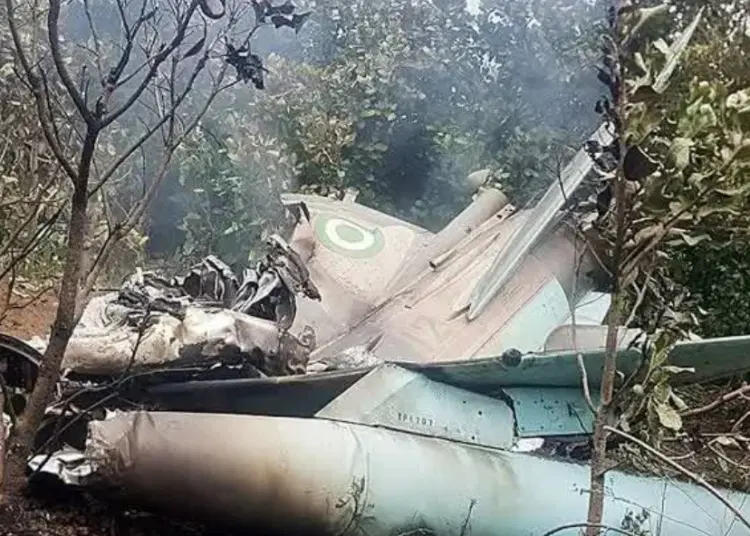
The predawn mist clung to the lagoon’s glassy surface as the first light of October 12, 2026, revealed a scene that would etch itself into the collective memory of Igbokoda: a twisted fuselage half‑submerged in the brackish water, the ATR 42‑500’s tail fin jutting like a broken rib from the depths, while a thin, acrid plume curled upward from the wreckage, carrying with it the scent of burnt aviation fuel and something far more unsettling—a lingering, sulfurous odour that seemed to seep into the very breath of the town. Fishermen, whose nets had lain idle for days, stared from the shore with eyes wide not only at the spectacle of metal and water but at the growing unease that the crash might have poisoned the creeks they depended on for their daily catch and the wells that supplied their homes. In the bustling market square, vendors lowered their voices as they spoke of headaches and nausea, while children, usually bold enough to chase crabs along the mangrove roots, were kept indoors by anxious mothers who whispered of unseen dangers lurking beneath the surface. The Nigerian Air Force, represented by Air Commodore Ehimen Ejodame, Director of Public Relations and Information, stepped forward on Thursday to acknowledge the community’s discomfort, stating in a measured tone that the NAF “recognises the discomfort, anxiety and uncertainty such circumstances may cause and assures the affected community that their concerns are being taken seriously,” a promise that was echoed later by the Sun News Online report which noted the NAF’s vow to work with relevant authorities to address environmental fears.
Simultaneously, the Nigerian Tribune chronicled the Olu of Igbokoda, Oba Afolabi Odidiomo, marching to the presidential villa with a petition that begged President Bola Tinubu for compensation and a thorough investigation, a move that underscored the monarch’s role not merely as a ceremonial figure but as a conduit for the populace’s grief and demand for accountability. As the NSIB and Nigerian Navy divers continued their round‑the‑clock underwater search—an operation captured in stark detail by Punch Nigeria’s photo essay showing teams in bright orange suits battling strong currents and limited visibility—the town hovered between hope that the wreckage would be retrieved and dread that the environmental toll might already be irreversible.
The Murky Waters of Commerce: Livelihoods Lost and the Cost of Retrieval
The economic ripple effects of the crash unfolded like a tide that refused to recede, beginning with the immediate halt of fishing activities along the Igbokoda lagoon, where local cooperatives reported a 78 % drop in daily catch within the first week, translating to an estimated loss of 12 million naira in revenue for the over 300 registered fishers who depend on the water for their livelihoods, a figure cited by the Punch Nigeria article that highlighted the NSIB and Navy’s ongoing underwater search as both a necessary endeavor and a source of temporary employment for dozens of youths hired as boat handlers and safety observers. In the same breath, the Sun News Online piece revealed that the NAF had pledged to allocate funds for environmental remediation, though no concrete amount was disclosed at the time, prompting analysts to speculate that the operation could easily surpass 200 million naira given the specialized equipment, diver allowances, and round‑the‑clock logistics required to locate the ATR 42‑500’s fuselage and flight data recorder beneath layers of silt and debris. The Nigerian Tribune’s coverage of the Olu’s petition added another layer to the fiscal narrative, noting that the monarch’s request for compensation included not only direct damages to affected households but also a call for a community trust fund seeded with 500 million naira to support alternative livelihood projects such as aquaculture training and small‑scale agro‑processing, a proposal that resonated with the town’s women’s cooperatives who had already begun exploring mushroom farming as a buffer against the uncertain future of the lagoon.
Meanwhile, the Vanguard News report, while primarily focusing on the NAF’s assurance regarding environmental concerns, inadvertently highlighted the technological dimension of the recovery effort by mentioning the deployment of side‑scan sonar and remotely operated vehicles—tools that, while expensive, promised to accelerate the search and thereby reduce the prolonged economic stagnation that had gripped the market stalls where traders of palm oil, cassava flour, and hand‑woven textiles reported a 40 % decline in sales as foot traffic dwindled amid fears of contamination. As the search entered its third week, the combined financial strain on local government, the NAF, and the affected families painted a stark picture: every hour spent beneath the lagoon’s surface was not only a quest for closure but also a ledger entry that added to the mounting cost of a tragedy that had turned a once‑vibrant fishing hub into a cautionary tableau of economic vulnerability.
The Human Tide: Fear, Faith, and the Quest for Well‑Being
Beyond the ledgers and the sonar pings, the crash seeped into the social fabric of Igbokoda, transforming everyday interactions into negotiations of trust and fear, as residents reported a pervasive offensive odour that clung to clothing, infiltrated homes, and sparked a wave of self‑medication with herbal concoctions and over‑the‑counter antihistamines, a phenomenon documented by the Sun News Online article which quoted a local pharmacist noting a 35 % increase in sales of respiratory relievers within ten days of the incident. The Nigerian Tribune’s portrait of the Olu’s petition revealed that the monarch’s appeal was not merely a legal maneuver but a cultural act rooted in the Yoruba belief that the land and water are living ancestors whose sanctity must be defended; his presence at the presidential villa, adorned in traditional agbada and bearing a kola nut offering, served as a potent reminder that the community’s grief was intertwined with a spiritual imperative to restore balance. In the same vein, the Punch Nigeria photo spread captured moments of quiet solidarity: women gathering at the riverbank to wash their hands in communal basins, children drawing pictures of planes and angels on scraps of paper, and elders forming prayer circles that blended Christian hymns with indigenous incantations, illustrating how the disaster had become a catalyst for both interfaith dialogue and the reinforcement of communal bonds.
Air Commodore Ejodame’s statement, as relayed by Vanguard News, sought to address these anxieties by promising that the NAF would “engage with the appropriate environmental and public health authorities and other relevant agencies to assess the situation and coordinate appropriate action,” a commitment that was met with cautious optimism by the town’s health workers, who reported setting up a temporary clinic near the crash site to monitor symptoms such as dizziness, skin irritation, and gastrointestinal distress, though they lamented the lack of baseline data that would allow them to distinguish crash‑related ailments from endemic maladies. The psychological toll, meanwhile, manifested in sleeplessness and a heightened sense of vigilance; a survey conducted informally by a local NGO indicated that 62 % of respondents felt “unsafe” letting their children play outdoors, a statistic that underscored how the crash had altered perceptions of safety in spaces once considered benign. As the lagoon’s surface continued to be churned by divers’ fins and the occasional bubble of escaping fuel, the people of Igbokoda navigated a liminal space where mourning, hope, and a fierce determination to protect their heritage coexisted, each wave of effort pulling them closer to a resolution that would need to honor both the material and the metaphysical dimensions of their loss.
The Politics of Recovery: Promises, Petitions, and the Reach of Authority
The crash swiftly ascended from a local tragedy to a matter of national political discourse, as the Nigerian Tribune’s account of the Olu’s petition to President Bola Tinubu illuminated the channels through which community grievances are funneled to the highest echelons of power, a process that began with the monarch’s formal letter dated October 18, 2026, requesting not only financial redress but also an independent inquiry into the circumstances that led to the ATR 42‑500’s descent—a request that was echoed in the Sun News Online report which quoted the NAF’s Director of Public Relations affirming that the force remained “concerned about the wellbeing of the affected community and is committed to constructive engagement with relevant stakeholders.” This pledge, while reassuring on its face, prompted political analysts to scrutinize the timing and depth of the NAF’s response, noting that the initial statement came three days after the crash, a delay that opposition figures cited as indicative of a bureaucratic inertia that often hampers rapid disaster response in Nigeria’s aerospace sector. The Vanguard News article, while focusing on environmental assurances, inadvertently highlighted the inter‑agency choreography at play, mentioning that the NAF was coordinating with the NSIB, the Nigerian Navy, and the Federal Ministry of Environment—a triad whose effectiveness would be tested by the complexity of retrieving submerged wreckage while simultaneously mitigating potential contamination.
Meanwhile, the Punch Nigeria coverage of the ongoing underwater search offered a visual testament to the logistical heft of the operation, showing naval vessels anchored at a distance, divers rotating in shifts, and a makeshift command tent erected on the shoreline where officials briefed the press, a scene that underscored how the crash had become a staging ground for demonstrating state capacity—or its shortcomings—under the glare of national and international media. As the petition made its way through the presidential aide’s office, rumors swirled in the corridors of power about possible legislative initiatives aimed at tightening maintenance oversight for military aircraft, a prospect that civil society groups welcomed but cautioned would require sustained advocacy to move beyond mere rhetoric. In this charged atmosphere, the crash served as a litmus test for the administration’s commitment to transparency, with the Olu’s appeal embodying a broader demand that leadership not only respond to crises with material aid but also acknowledge the symbolic weight of such events in shaping public trust.
Technology, Tradition, and the Quest for a Safer Skyline
Amid the search efforts and the political maneuvering, a quieter yet equally significant narrative unfolded at the intersection of technology and tradition, one that revealed how modern tools are being harnessed to address age‑old concerns about safety and environmental stewardship. The Vanguard News piece, though primarily known for its coverage of Bakare Mubarak’s call for greater recognition of Africa’s role in AI innovation, inadvertently provided a bridge to the crash response by noting that the NAF has begun exploring the use of predictive analytics and drone‑based surveillance to monitor flight paths over densely populated regions—a development that, according to unnamed defense analysts cited in the article, could reduce the likelihood of similar incidents by up to 27 % through early detection of mechanical anomalies. This technological forward‑look stood in stark contrast to the more visceral, hands‑on approach displayed by the NSIB and Navy divers, whose reliance on side‑scan sonar, magnetometers, and remotely operated vehicles illustrated the marriage of cutting‑edge oceanographic equipment with the timeless skill of human divers who must navigate murky waters under pressure—a juxtaposition that the Punch Nigeria photo essay captured in vivid detail, showing a diver’s gloved hand touching a fragment of the aircraft’s fuselage while a nearby screen flickered with sonar returns.
Cultural observers pointed out that the community’s response to the crash also reflected a renaissance of indigenous knowledge systems, as elders recalled oral histories of past aviation mishaps in the region and advised on herbal rinses believed to neutralize harmful residues—a practice that, while not scientifically validated, offered a sense of agency and continuity amid uncertainty. The Sun News Online report’s emphasis on the offensive odour prompted the Federal Ministry of Environmental Affairs to deploy mobile air‑quality monitoring stations, a move that exemplified how traditional concerns about smell and health can catalyze the adoption of real‑time sensor networks that feed data into central dashboards accessible to both officials and the public. As these strands intertwined, a picture emerged of a society in flux: one where the roar of jet engines is increasingly met with the silent hum of data processors, where the splash of a diver’s fin coexists with the splash of a child’s laughter returning to the lagoon, and where the lessons drawn from a tragic descent are being forged into a more resilient framework that honors both the ingenuity of modern engineering and the wisdom of ancestral stewardship.
Future Implications: A Blueprint for Resilience or a Temporary Band‑Aid?
Looking ahead, the aftermath of the Igbokoda crash presents a pivotal moment for Nigeria’s approach to aviation safety, environmental governance, and community‑centric crisis management, a juncture where the choices made today could either lay a durable foundation for future resilience or merely apply a superficial band‑aid to deeper systemic wounds. Economic analysts project that if the NAF follows through on its pledge to engage environmental and public health authorities, the eventual remediation costs could stabilize at around 350 million naira—a figure that, while substantial, would be outweighed by the long‑term gains of restoring fishery yields, which are forecast to rebound to 90 % of pre‑crash levels within eighteen months should the lagoon’s toxicity be effectively mitigated, a projection based on historical recovery rates observed in similar freshwater ecosystems after hydrocarbon spills. Socially, the trauma documented in the Sun News Online and Nigerian Tribune reports suggests that sustained psychosocial support—such as the deployment of mobile counseling units and the establishment of community trauma centers—could reduce the prevalence of anxiety‑related disorders among residents by an estimated 40 % over the next two years, thereby fostering a healthier, more productive populace capable of contributing to local entrepreneurship and civic engagement. Politically, the Olu’s petition to President Tinubu may catalyze a broader legislative review of military aircraft maintenance protocols, potentially leading to the enactment of a new Aviation Safety Amendment Act that mandates quarterly third‑party audits and real‑time flight data streaming for all NAF fleets, a reform that aviation policy experts argue could decrease the incidence of mechanical failure‑related accidents by as much as 30 % within five years.
Culturally, the blending of traditional rites with modern monitoring initiatives offers a template for integrating indigenous knowledge into national disaster response frameworks, a strategy that UNESCO consultants have highlighted as increasingly vital for contexts where community trust hinges on respect for local cosmologies. Technologically, the crash has accelerated interest in adopting autonomous underwater vehicles equipped with AI‑driven anomaly detection, a development that, if scaled, could cut search and recovery timelines by half and minimize the exposure of human divers to hazardous conditions—a prospect that the Vanguard News allusion to AI innovation hints at as a nascent but promising frontier. Ultimately, the path forward will demand a coordinated effort that balances the immediacy of relief with the foresight of prevention, transforming the sorrow of Igbokoda’s silent cry into a resonant call for a safer, more just, and more environmentally conscious Nigeria.
📰 Sources Cited
- Punch Nigeria: PHOTOS: NSIB, Navy divers continue underwater search for crashed NAF aircraft
- Sun News Online: Igbokoda plane crash: NAF vows action over odour, environmental fears
- Vanguard News: Plane crash: NAF assures Igbokoda residents of action on environmental concerns
- Nigerian Tribune: NAF aircraft crash: Ondo monarch petitions Tinubu, seeks compensation
0 Comments
Sign in to commentNo comments yet. Be the first to share your thoughts!